
Home service marketing
Home Service Marketing: What to Answer Before Customers Call
More leads are not always the first problem. For plumbers, electricians, HVAC companies, cleaners, landscapers, and repair businesses, better-fit calls often start with clearer answers.
The most expensive mistake in home service marketing is assuming every slow week needs more advertising.
Sometimes it does. If no one can find your plumbing company, cleaning service, HVAC repair business, landscaping crew, electrical contractor, moving company, or appliance repair shop, you need visibility. But many home service businesses already have people finding them through Google, referrals, reviews, trucks, yard signs, flyers, local directories, or social pages.
The leak happens after attention, but before the first real conversation.
A potential customer sees your business, checks your profile, scans your reviews, compares a few options, and starts wondering:
- Do they serve my area?
- Is this job too small?
- Will they charge just to come out?
- Can they help today?
- Are they licensed and insured?
- Do I need photos before calling?
- Will I get stuck in a vague arrival window?
- What happens if the repair does not hold?
If those questions are hard to answer, some customers call anyway. Others hesitate, keep comparing, send a vague message, or move to the next business.
That is why the most practical home service marketing question is not only "How do we get more leads?" It is: what does a good customer need to understand before they are ready to call?
More Leads Can Make the Wrong Problem Worse
"More leads" sounds like the obvious answer because it is measurable. More form fills, more calls, more messages, more clicks. But a home service business can be busy and still be wasting time.
More leads can create more wrong-area calls, low-fit jobs, price-only shoppers, duplicate questions, emergency requests you do not handle, and vague inquiries that require three messages before you know whether the job is real.
This does not mean lead generation is bad. It means lead generation without pre-call clarity can turn marketing into sorting work.
For small teams, that matters. A solo cleaner, two-person HVAC shop, family plumbing company, or local repair business does not have a sales department to filter every inquiry. The owner, dispatcher, technician, or office manager often handles the call while also running the business.
So the goal is not just more calls. The goal is better-fit calls: customers who understand the basics, know whether they are in your service area, have realistic expectations, and know what information to prepare.
How Home Service Customers Decide Before Contacting You
The U.S. Small Business Administration describes market research as a way to understand customers, reduce risk, and make better decisions about demand, pricing, location, and competition. For a home service business, the everyday version is simple: understand the questions customers ask before they trust someone with their home.
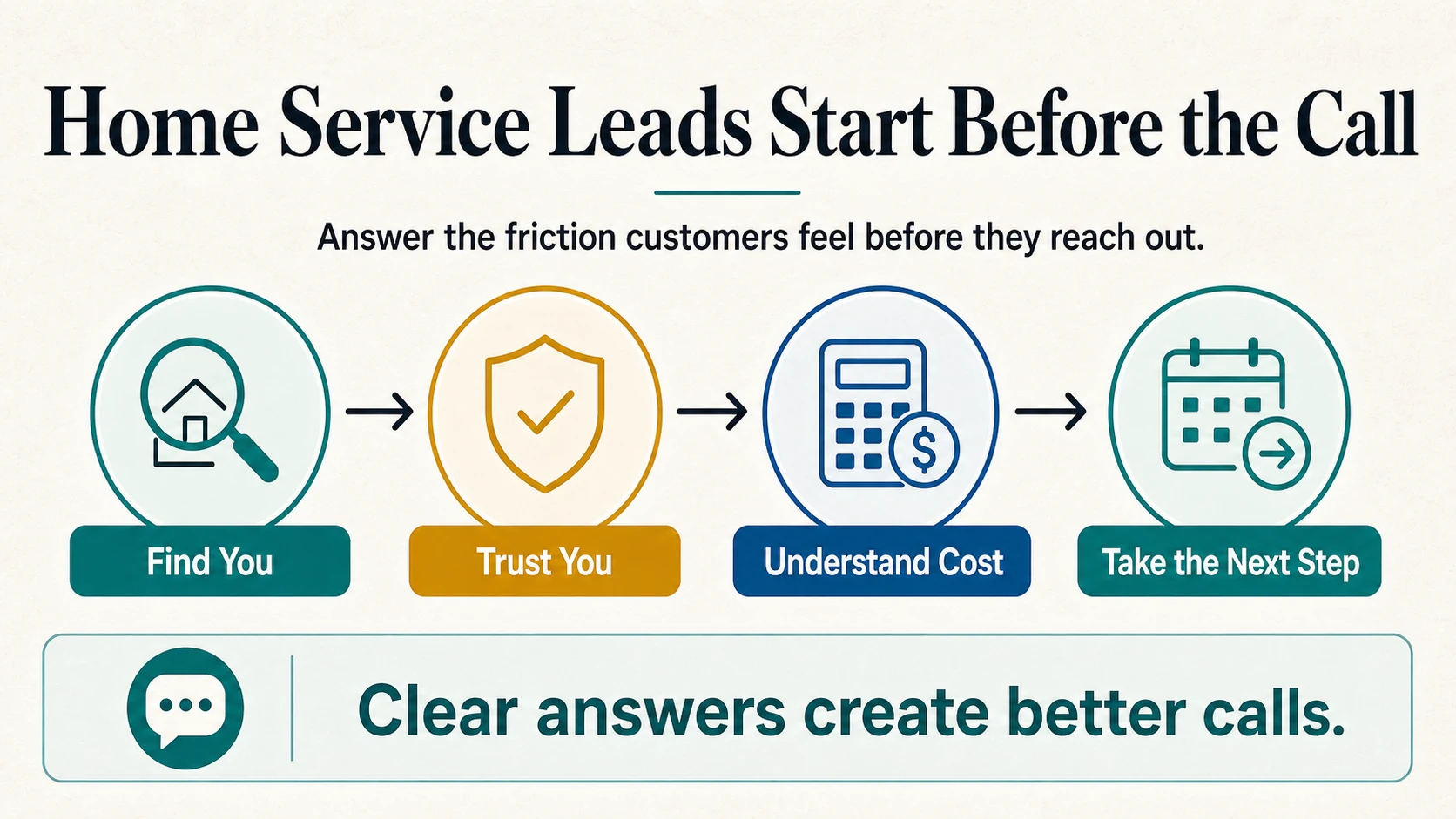
Those questions usually fall into four stages.
1. Can I Find You?
This is the visibility stage. The customer searches, sees your Google Business Profile, finds your website, checks a referral, sees a truck, or follows a link from a neighborhood group.
Google Business Profile support pages emphasize practical local information such as business details, service areas, calls, website actions, messages, and directions. For home service businesses, this is not just administrative data. It is marketing infrastructure.
If your profile, website, and local listings do not clearly show what you do and where you work, customers may never reach the trust stage.
2. Can I Trust You?
Home service trust is unusually personal. The customer may be letting a stranger into their house, paying for work they cannot fully evaluate, or making a decision under stress because something is broken.
Reviews help here. BrightLocal's Local Consumer Review Survey tracks how consumers use reviews to evaluate local businesses, and the broader pattern is clear: reviews are part of the trust decision, not a decorative badge.
But reviews cannot carry the whole job. A five-star profile does not answer whether you handle older homes, whether you charge a diagnostic fee, whether you serve a specific ZIP code, or whether the customer needs to be home during the visit.
3. Can I Understand the Cost Risk?
Home service customers know final pricing can depend on inspection, parts, access, urgency, and scope. Most do not expect a perfect quote from a web page.
What they do want is a sense of the pricing logic.
Do you charge for estimates? Is there a service call fee? Are emergency visits priced differently? What affects the final quote? Can they send photos first? Is the minimum job size clear?
If the answer is only "Call for pricing," you may still get calls. But you may also get more calls from people who are not a fit, or fewer calls from people who would have been a fit if the process felt less risky.
4. Do I Know the Next Step?
This is where many home service websites lose momentum.
A customer is interested, but the page does not say whether they should call, text, send photos, fill out a form, book online, choose emergency service, or wait for business hours. The result is friction.
Customer-effort research published in Harvard Business Review is useful here: reducing the work customers must do to solve a problem can matter more than trying to delight them with extra touches. For home services, "easy" often means the customer knows exactly what to do next.
The Questions Every Home Service Business Should Answer Before the First Call
You do not need to answer every possible question on your website. You need to answer the questions that qualify the customer and reduce avoidable back-and-forth.
Service Area
Be clear about cities, neighborhoods, ZIP codes, counties, or travel limits. If you charge extra outside a certain area, say so. If you do not publish a full list, give customers a way to check quickly.
This is especially important for service-area businesses that do not operate from a storefront. Google's guidance for service-area businesses exists because location and coverage affect how customers find and evaluate you.
Problem Fit
Customers need to know whether you handle their type of job.
Do you repair the brand they own? Do you handle small jobs? Do you do commercial work, residential work, or both? Do you clean apartments, offices, move-outs, or post-construction spaces? Do you install, repair, inspect, or maintain?
A vague service list creates vague calls. A specific "we help with..." list creates better-fit inquiries.
Pricing Logic
You do not have to publish final prices for every job. But you should explain how pricing works.
- Is there a diagnostic fee?
- Is there a minimum visit charge?
- Do you give free estimates?
- Does emergency service cost more?
- What factors change the price?
- When can you give a final quote?
The point is not to make a promise you cannot keep. The point is to remove unnecessary mystery.
Urgency and Availability
If you handle emergency calls, define what counts as an emergency. If you do not, explain the fastest normal response path. If same-day appointments are sometimes available, say how customers should ask.
This reduces calls from customers you cannot help and helps urgent customers choose the right route.
Proof and Risk Reduction
Home service customers often look for license, insurance, warranty, guarantee, background-check, safety, and satisfaction details. Do not bury these only in a footer or long policy page.
Put reassurance near quote forms, service pages, and booking steps, especially when the customer is deciding whether to invite your team into their home.
Photos or Details to Prepare
Many businesses can qualify a job faster if the customer sends photos, model numbers, measurements, symptoms, access notes, or a short description.
Tell customers what to send before the first call. This can turn a vague inquiry into a useful one.
Arrival Window and Visit Expectations
Customers care about logistics. Do they need to be home? How long does a visit usually take? Will they receive a call before arrival? What if they live in an apartment building or gated community?
These details are not small. For busy customers, logistics are part of the buying decision.
Best Next Step
End every major page with a clear next step. Not just "Contact us." Tell them what kind of contact fits the situation.
- "Call for urgent same-day repair."
- "Send photos for a first review."
- "Book online for standard maintenance."
- "Text your ZIP code to confirm service area."
- "Use the quote form for non-urgent projects."
The customer should not have to guess which door to use.
Where These Answers Should Live
A common mistake is putting all answers on one FAQ page and calling it done. A good FAQ page can help, but high-impact answers should also appear near the moment of decision.
Use this placement map:
- Google Business Profile: service categories, business hours, service area, phone number, website link, photos, and key updates.
- Homepage: what you do, who you serve, where you work, and the fastest next step.
- Service pages: problem fit, pricing logic, preparation, warranty, and what happens during the visit.
- Quote form: what details or photos to send, what response time to expect, and what cannot be quoted without inspection.
- Voicemail: business hours, emergency route, and where to get answers after hours.
- Flyers, door hangers, mailers, trucks, and yard signs: a short promise plus a QR code or link to common answers.
- Review responses: gentle reinforcement of services, service area, reliability, and next-step clarity without sounding scripted.
If phone calls are a major bottleneck, connect this with a missed-call reduction workflow. If questions arrive after business hours, review your after-hours customer service setup. If physical materials create interest but cannot answer follow-up questions, a QR code customer service path can help.
Practical Example: An HVAC Company
Imagine a small HVAC company that wants more leads before summer. The owner is thinking about buying more ads.
Before spending more, the team reviews recent calls and notices a pattern:
- Many callers are outside the service area.
- Customers ask whether there is a diagnostic fee.
- People do not know whether older systems are supported.
- Some customers want emergency help the business does not offer after 8 p.m.
- Technicians often need photos of the outdoor unit, thermostat, and error code before the visit.
The problem is not only lead volume. It is pre-call clarity.
The business can make five changes in a week:
- Add ZIP-code service-area language to the homepage and Google Business Profile.
- Add a short "diagnostic fee and pricing" explanation to the repair page.
- Create a "before you call" checklist for photos and model numbers.
- Clarify emergency availability and after-hours boundaries.
- Update the voicemail message to route urgent and non-urgent requests differently.
Those changes do not replace advertising. They make every existing marketing channel work harder because customers can qualify themselves before calling.
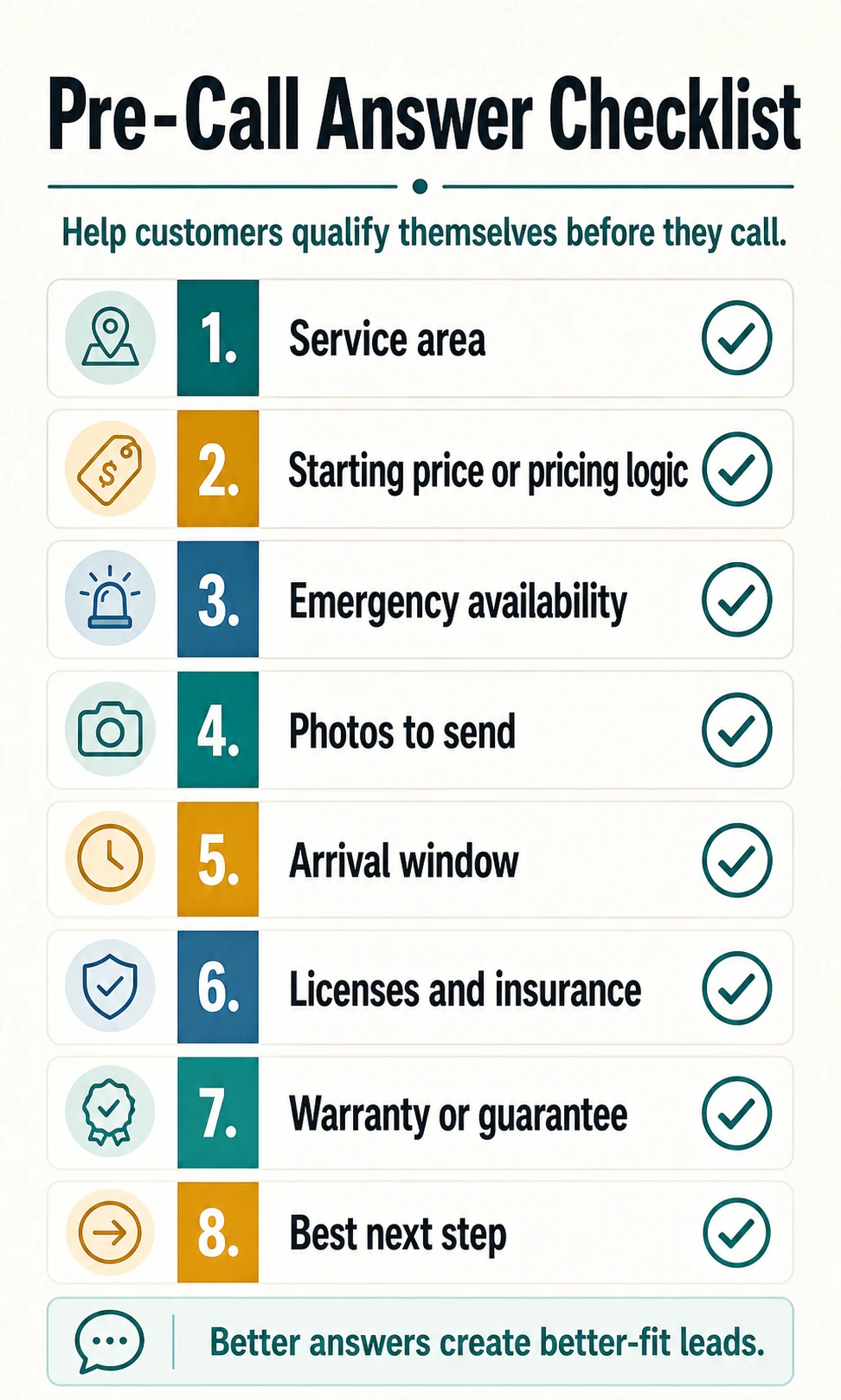
Pre-Call Answer Checklist
Use this checklist to review your website, Google profile, quote form, voicemail, and printed materials.
- State your service area clearly, including cities, ZIP codes, or travel limits.
- List the job types you handle and the job types you do not handle.
- Explain pricing logic: diagnostic fee, minimum charge, estimates, emergency pricing, and quote limits.
- Define emergency availability and normal response expectations.
- Tell customers what photos, model numbers, measurements, or details to prepare.
- Show trust signals near the decision point: license, insurance, warranty, guarantee, review links, or safety notes.
- Explain visit logistics: arrival window, whether the customer must be home, access needs, and appointment length.
- Give the best next step for urgent, standard, and quote-request situations.
Use Reviews, But Do Not Make Reviews Do All the Work
Reviews are powerful because they reduce trust risk. A customer can see whether other people had a good experience, whether the business showed up, and whether the work felt professional.
But reviews are not a substitute for clarity.
A review can say "great service," but it usually does not answer whether you charge a travel fee, whether you handle condos, whether you work on a specific brand, whether customers need to send photos, or how fast emergency help works.
Think of reviews as proof. Think of pre-call answers as orientation. You need both.
How to Measure Whether Your Answers Are Improving Lead Quality
Do not measure this only by traffic. A better home service marketing system should change the quality of conversations.
Track these signals for a month:
- Fewer calls from outside your service area
- More customers mentioning the correct service
- More inquiries that include photos or useful details
- Fewer repeated pricing-process questions
- Fewer emergency requests you do not handle
- Shorter first calls because basics are already clear
- More customers choosing the right route: call, quote form, text, booking link, or after-hours request
This is where customer feedback analysis becomes useful. The questions customers ask before calling are not just support topics. They show which parts of your marketing are unclear.
Where AI and QR Codes Can Help Without Becoming a Gimmick
For home service businesses, AI and QR codes are useful only when they answer real customer questions. They are not valuable because they look modern. They are valuable when they reduce avoidable back-and-forth.
A QR code on a truck, flyer, door hanger, estimate sheet, business card, or yard sign can send customers to answers about service area, pricing logic, photos to send, emergency availability, and next steps. An AI answer layer can be helpful when it is trained on approved business information and knows when to route customers to a person.
Tools like RealLink AI can support that kind of workflow by putting approved answers behind a QR code or link, but the strategy still starts with your real customer questions. If you have not identified the questions that shape lead quality, no tool can magically know what matters.
Start with the questions. Then choose the channel.
What to Do This Week
You do not need a full marketing rebuild. Run a simple pre-call clarity audit.
- Write down the last 20 customer questions from calls, texts, forms, DMs, and staff conversations.
- Group them by service area, problem fit, cost, urgency, proof, logistics, and next step.
- Choose the top five questions that affect whether the customer is a good fit.
- Add those answers to the places customers already check: Google profile, homepage, service page, quote form, voicemail, flyer, or QR destination.
- Review call quality for the next 30 days.
Home service marketing is not only about being found. It is about helping the right customer feel ready to reach out.
When the customer can find you, trust you, understand the cost risk, and know the next step, your calls get better before the phone rings.
Sources and Further Reading
- U.S. Small Business Administration: Market research and competitive analysis
- Google Business Profile Help: Service-area businesses
- Google Business Profile Help: Performance reporting
- BrightLocal: Local Consumer Review Survey
- Harvard Business Review: Stop Trying to Delight Your Customers
FAQ
What is home service marketing?
Home service marketing is the process of helping local customers find, trust, and contact businesses such as plumbers, electricians, HVAC companies, cleaners, roofers, landscapers, repair shops, and contractors. It includes local search, reviews, websites, referrals, ads, printed materials, and customer response workflows.
What should a home service business answer before customers call?
Start with service area, job types, pricing logic, emergency availability, photos or details to prepare, license and insurance information, warranty or guarantee basics, arrival expectations, and the best next step for urgent and non-urgent requests.
Should home service businesses publish prices?
Not always exact final prices. Many home service jobs require inspection. But businesses should explain pricing logic, such as diagnostic fees, minimum charges, estimate policies, emergency pricing, and the factors that change the final quote.
How can I get better home service leads without buying more ads?
Improve pre-call clarity. Update your Google Business Profile, service pages, quote forms, voicemail, and printed materials so customers can quickly understand service area, fit, pricing process, trust signals, and next steps before calling.
Are QR codes useful for home service marketing?
Yes, when they lead to useful answers instead of a generic homepage. QR codes on trucks, flyers, business cards, door hangers, estimates, and yard signs can help customers ask common questions, check service area, understand next steps, or prepare details before contacting the business.