
Organic social media strategy
Organic Social Media Strategy for Small Businesses
The goal is not to post more. The goal is to build an account system that turns attention into trust, useful questions, and clear next steps.
Most small businesses do not have a content problem. They have an account architecture problem.
That sounds strange if you have been told that organic social media growth is mostly about posting more often, using better hooks, chasing trends, or picking the right hashtags. Those things can help. But they are not the foundation.
The deeper problem is that many social media accounts are asked to do every job at once. One account has to introduce the business, entertain strangers, educate buyers, prove credibility, answer repeated questions, announce promotions, build trust, handle comments, and push people toward booking or buying.
That is a lot to ask from a single feed.
When the account has no clear structure, the owner feels busy but the audience feels confused. New visitors do not immediately understand who the account is for. Existing customers see too much promotion. Potential buyers cannot find the answers they need before taking the next step.
A better organic social media strategy starts with a different question:
What role should this account play in the customer's decision journey?
This article explains a practical "layered tunnel" approach that small businesses, local operators, B2B teams, and growing brands can use without pretending to be full-time media companies.
Why Posting More Does Not Fix a Confusing Account
Posting more can amplify a clear strategy. It cannot rescue a confusing one.
A restaurant can post daily Reels and still lose guests if the profile does not make reservations, hours, parking, menu questions, and private-event details easy to find. A salon can get views and still lose bookings if new visitors cannot understand services, price range, location, and how to choose a stylist. A B2B consultant can publish smart posts and still create weak leads if the account never explains who the service is for, what problems it solves, and what a first conversation looks like.
This is why "post more" is often the wrong first prescription. Before increasing volume, fix the system people enter after they notice you.
The public research points in the same direction. Pew Research Center's social media fact sheet shows that Americans use different platforms in different ways. A customer may discover you on TikTok, check your Instagram, search your business name, read reviews, visit your website, and then ask a question.
McKinsey's work on the consumer decision journey also explains why the old straight-line funnel is too simple. People loop through discovery, evaluation, comparison, trust signals, and post-purchase experience.
Social platforms themselves are built around relevance and interaction. LinkedIn explains that its feed ranks content partly by what members are likely to find relevant and valuable. Meta's public Instagram Feed Ranking System Card describes a personalized ranking system. TikTok Business emphasizes fast, clear creative and audience fit. YouTube's Shorts guidance frames short-form video as a discovery path that can introduce people to a channel.
The takeaway is not "hack the algorithm." The takeaway is simpler: build a social presence that is easy for the right person to understand.
The Layered Tunnel: A Better Mental Model Than the Funnel
Traditional funnels are useful, but they can make social media look too linear. In real life, people do not always move from awareness to consideration to purchase in a clean sequence. They bounce around.
They see a post. They tap your profile. They read three comments. They look at your pinned posts. They check whether you are local. They come back a week later. They ask a friend. They compare you with two alternatives. They send a DM. Then they decide.
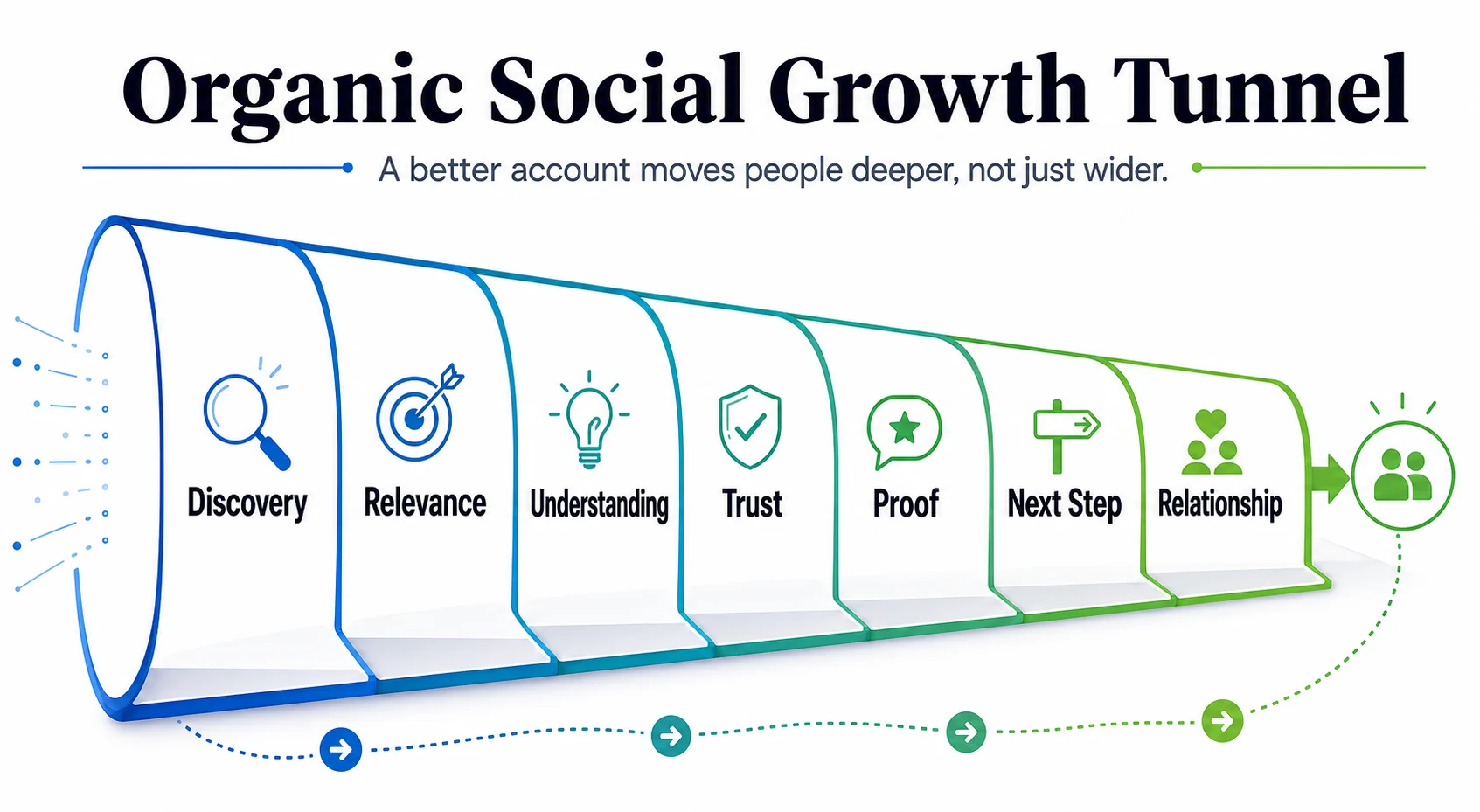
A layered tunnel is a better working model for organic social media because it focuses on depth of understanding rather than raw audience size.
The layers are:
- Discovery: why a stranger stops scrolling.
- Relevance: why the right person thinks, "This is for me."
- Understanding: how the account helps the customer make sense of their problem.
- Trust: how the account shows judgment, values, process, and consistency.
- Proof: how the account reduces doubt with examples, reviews, process, and outcomes.
- Next step: how the account makes it easy to ask, book, buy, visit, or compare.
- Relationship: how customers stay connected after the first action.
The mistake is expecting every post to do all seven jobs. A stronger strategy assigns each post, account, highlight, pinned item, and link a clear role.
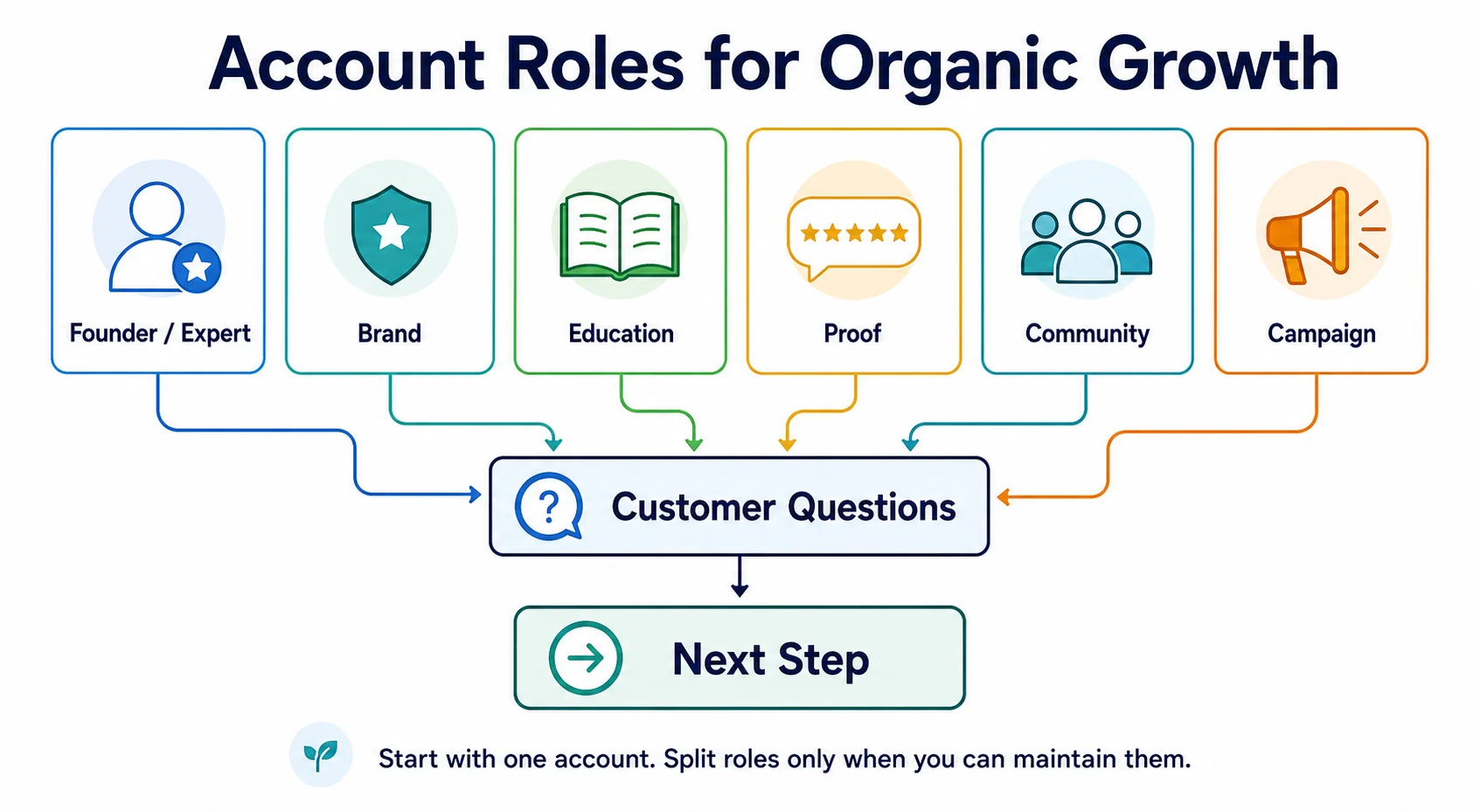
The Six Account Roles Organic Growth Needs
You do not need six accounts. Most small businesses should start with one account and clear content roles. Splitting into multiple accounts only makes sense when you have the time, audience, and operational discipline to maintain them.
But every business should understand the six roles.
1. Founder or Expert
This role builds human trust. It works especially well for B2B services, consultants, agencies, coaches, medical-adjacent practices, legal-adjacent services, home services, and local operators where the buyer wants to trust a person before trusting a brand.
Good content includes opinions, field lessons, common mistakes, customer misunderstandings, decision rules, and behind-the-scenes judgment.
2. Brand
The brand role provides official clarity. It explains what the business does, who it serves, what is available, what changed, and where to go next.
This is where offers, services, menus, product updates, policies, events, announcements, and official proof belong. A brand account does not need to sound like a person. It needs to be clear, useful, and consistent.
3. Education
Education is the engine of organic growth because useful explanations are easier to save, share, and trust than advertisements.
For a small business, education can mean checklists, how-to posts, buyer guides, mistake lists, short explainers, comparison posts, and "what to know before you..." content.
4. Proof
Proof reduces hesitation. This includes customer reviews, before-and-after examples, process photos, case studies, product demonstrations, common questions, and real-world use cases.
Proof works best when it teaches. "Look at this result" is weaker than "Here was the problem, here is what we changed, and here is what a similar customer should understand."
5. Community
Community content helps customers feel connected to each other and to the business. It can include customer spotlights, user-generated content, local events, customer questions, and discussion prompts.
Mark Granovetter's classic work on the strength of weak ties is useful here. Information often spreads through loose connections between groups, not only through close friends. On social media, customers, neighbors, peers, and adjacent audiences can carry your message farther than your own account can.
6. Campaign
Campaign content supports launches, seasonal pushes, events, limited offers, challenges, and announcements. It is useful, but it should not become the whole account.
If every post is a campaign post, the account starts to feel like a flyer rack. Campaigns work better after discovery, education, trust, and proof have already done their job.
How Different Businesses Should Structure Their Accounts
Solopreneurs and Experts
Start with one personal expert account. Use it to show your point of view, explain customer problems, and make the next step clear. A lightweight brand page can act as a portfolio or official landing place, but the person usually creates trust faster.
Your pinned posts should answer: who you help, what problem you solve, and what someone should do next.
Local Businesses
Restaurants, salons, hotels, repair shops, retailers, and service businesses should usually start with one primary business account. Make the profile practical before making it fancy.
New visitors should quickly find hours, location, booking path, service area, menu or service list, price expectations, parking, policies, and common questions. Social content should connect to the real decisions customers make before visiting, booking, or calling.
B2B and Professional Services
B2B teams often need both a company account and at least one strong human account. The company account provides official resources and proof. The founder, executive, consultant, or practitioner account provides judgment and perspective.
For B2B, comments and conversations matter. A small number of relevant prospects can be more valuable than a large number of casual views.
Consumer Brands and Retail
Consumer brands need a stronger mix of discovery, proof, and community. Show real usage, comparisons, customer questions, product selection help, and reasons to choose one product over another.
Do not turn every post into a product pitch. Use content to reduce shopping friction.
Multi-Location Businesses
Do not create a separate account for every location unless each location can actually post, respond, and keep details current. A weak local account can hurt trust more than no local account.
If resources are limited, keep one main account and organize local content through highlights, location-specific posts, landing pages, or Google Business Profiles.
How to Set Up Each Account
Account setup is not decoration. It is information architecture for a distracted visitor.
Name and Handle
Use words people understand. If possible, include the category, location, or specialty in the display name.
"Mina Studio" is less clear than "Mina Studio | Austin Hair Color." "Growth Lab" is less clear than "Growth Lab | B2B Sales Content."
Bio
A strong bio answers four questions:
- Who do you help?
- What problem do you help them solve?
- What makes your approach credible or different?
- What should they do next?
Example for a local service business:
Helping busy homeowners in Phoenix understand repair options before they book. Clear service areas, pricing logic, and photo-based estimates. Start with the repair checklist.
Pinned Posts
Treat pinned posts like the first three sections of a landing page.
- Start here: who the account is for and what problem you solve.
- How we think: your process, philosophy, or decision framework.
- Proof or next step: reviews, examples, pricing guidance, booking path, or a helpful checklist.
Highlights, Playlists, and Featured Sections
Instagram Highlights, TikTok Playlists, YouTube playlists, and LinkedIn Featured sections all do the same job: they turn scattered posts into organized paths.
Useful labels include Start Here, FAQ, Pricing, Reviews, Process, Before/After, For Beginners, Book, Menu, Services, Locations, and Support.
Profile Link
Do not send every visitor to a generic homepage. Social visitors usually have a question. Your link should help them answer it.
Good destinations include a booking page, FAQ, price guide, service-area checker, product quiz, customer support page, free checklist, quote form, or a page built around repeated social questions.
Soft next step: turn social questions into an answer path
If your social posts are starting to create repeated questions, RealLink AI can help you give customers a simple place to ask before they call, book, or visit. You can link it from your bio, put it behind a QR code, and review the questions people ask most often.
A Practical Example: Local Salon Account System
Imagine a small salon in Denver. The owner posts haircut photos, color transformations, appointment openings, and occasional promotions. Some posts get likes, but bookings are inconsistent.
The problem may not be content quality. It may be missing account structure.
A better setup could look like this:
- Discovery: short Reels about common hair color mistakes, seasonal hair care, and what to know before a big change.
- Relevance: posts for specific customers, such as "first-time color clients," "busy professionals," or "curly hair clients in Denver."
- Understanding: carousels explaining consultation, pricing range, maintenance, and what photos to bring.
- Trust: stylist point-of-view posts about how they decide whether a service is a good fit.
- Proof: before-and-after posts that explain starting condition, process, time, and maintenance.
- Next step: pinned post and bio link for booking, consultation requirements, price range, location, parking, and cancellation policy.
This account does not need to go viral. It needs to make the right local customer more confident before booking.
The 30-Day Organic Social Media Reset
Use this as a practical reset if your account feels busy but not strategic.
Days 1-3: Define the Account Role
- Write one sentence describing who the account is for.
- Choose the main job: discovery, education, trust, proof, conversion, or community.
- List the top 20 questions customers ask before buying, booking, visiting, or calling.
- Identify whether a founder or expert voice is needed.
Days 4-7: Rebuild the Profile
- Make the display name searchable and clear.
- Rewrite the bio around customer problem and next step.
- Create or update three pinned posts.
- Organize highlights, playlists, or featured links.
- Replace the generic homepage link with a more useful next step.
Week 2: Build Content Pillars
Create four content pillars:
- Customer questions
- Practical education
- Proof and examples
- Point of view and process
Pull five post ideas from each pillar. That gives you 20 ideas without staring at a blank calendar.
Week 3: Build Relationships
Organic growth is not only publishing. It is also participation.
- List 20 accounts your customers already follow.
- Leave five useful comments per day.
- Answer every meaningful comment on your own posts.
- Turn repeated comments and DMs into new posts.
- Share one outside post per week with your own useful take.
Week 4: Review the Right Metrics
Do not measure organic social only by views. Views tell you whether people saw something. They do not tell you whether the account is becoming a business asset.
Track profile visits, follows per profile visit, saves, shares, comments, DMs, link clicks, bookings, quote requests, customer questions, and the quality of inquiries.
Common Mistakes to Avoid
Making Every Post Promotional
Promotional posts are necessary, but they should not carry the whole account. People save, share, and trust content that helps them make better decisions.
Creating Too Many Accounts Too Early
More accounts create more maintenance. A focused single account is usually better than six abandoned ones.
Chasing Viral Reach Without Buyer Relevance
Viral posts can create attention, but attention that does not connect to your buyer's problem often disappears fast.
Sending Social Traffic to a Weak Next Step
If the profile link does not answer the visitor's next question, the social strategy leaks. Make the next step obvious and useful.
Ignoring Repeated Questions
Repeated questions are not a nuisance. They are your audience telling you what is unclear. They can become posts, FAQ sections, booking-page improvements, sales scripts, support answers, and product insights.
Sources and Further Reading
- Pew Research Center: Social Media Fact Sheet
- McKinsey: The Consumer Decision Journey
- McKinsey: The New Consumer Decision Journey
- Stanford Sociology: Mark Granovetter, The Strength of Weak Ties
- LinkedIn Help: How the Feed ranks content
- Meta AI: Instagram Feed Ranking System Card
- YouTube Creators: YouTube Shorts
- TikTok Business Help Center: Creative best practices
FAQ
What is an organic social media strategy?
An organic social media strategy is a plan for growing attention, trust, engagement, and business outcomes without relying primarily on paid ads. For small businesses, it should define the account's audience, role, content pillars, profile structure, engagement routine, and next step.
How often should a small business post on social media?
Consistency matters, but clarity matters first. Many small businesses can start with three to five useful posts per week, plus daily comment and message management. Posting more often helps only when the account already has a clear audience and content structure.
Should a small business have separate accounts for the owner and the brand?
Sometimes. B2B, consulting, expert services, and high-trust local businesses often benefit from a founder or expert account. Restaurants, salons, retailers, and local shops may be fine with one strong business account. Separate accounts only make sense when each can be maintained.
Do small businesses need to go viral to grow on social media?
No. Viral reach can help discovery, but most small businesses need relevant reach, trust, and clear next steps more than a huge audience. A small number of local or high-intent prospects can be more valuable than thousands of casual viewers.
What should be in the bio link?
The bio link should answer the visitor's next question. Good destinations include a booking page, FAQ, service guide, pricing explanation, customer support page, product selector, checklist, or a question-answer page built around common customer concerns.
Turn social attention into answered customer questions
If your posts, profile, signs, menus, or QR codes are creating repeated customer questions, RealLink AI helps you give people a simple 24/7 place to ask and helps you see what they ask most often.