
Customer insights
Customer Feedback Analysis for Small Businesses
Use questions, complaints, reviews, and support notes to find the exact page, policy, script, or process that needs improvement.
Summary
Customer feedback analysis is the practice of collecting real customer language, grouping it by the decision or friction it reveals, and assigning one visible business change. Reviews and surveys matter, but pre-purchase questions, support requests, call notes, returns, and staff observations can reveal uncertainty earlier.
Start with a defined sample and one counting rule. Keep the exact wording, channel, journey stage, intended outcome, current answer, and next action. Prioritize a theme by frequency, decision impact, confidence, reach, and effort. Then compare the same measures before and after the change. The goal is not a sentiment dashboard; it is a better customer path.
The most useful feedback often arrives before a sale or task is complete, disguised as an ordinary question.
- "Do you take walk-ins?"
- "How much does this usually cost?"
- "Is parking available?"
- "Do you serve this area?"
- "Will this part fit the older model?"
- "Which service includes site cleanup?"
- "How long does installation usually take?"
- "Can someone explain the difference between these two options?"
At first glance, these are just customer questions. Operationally, they are small demands on your time. Strategically, they are something better: a map of uncertainty.
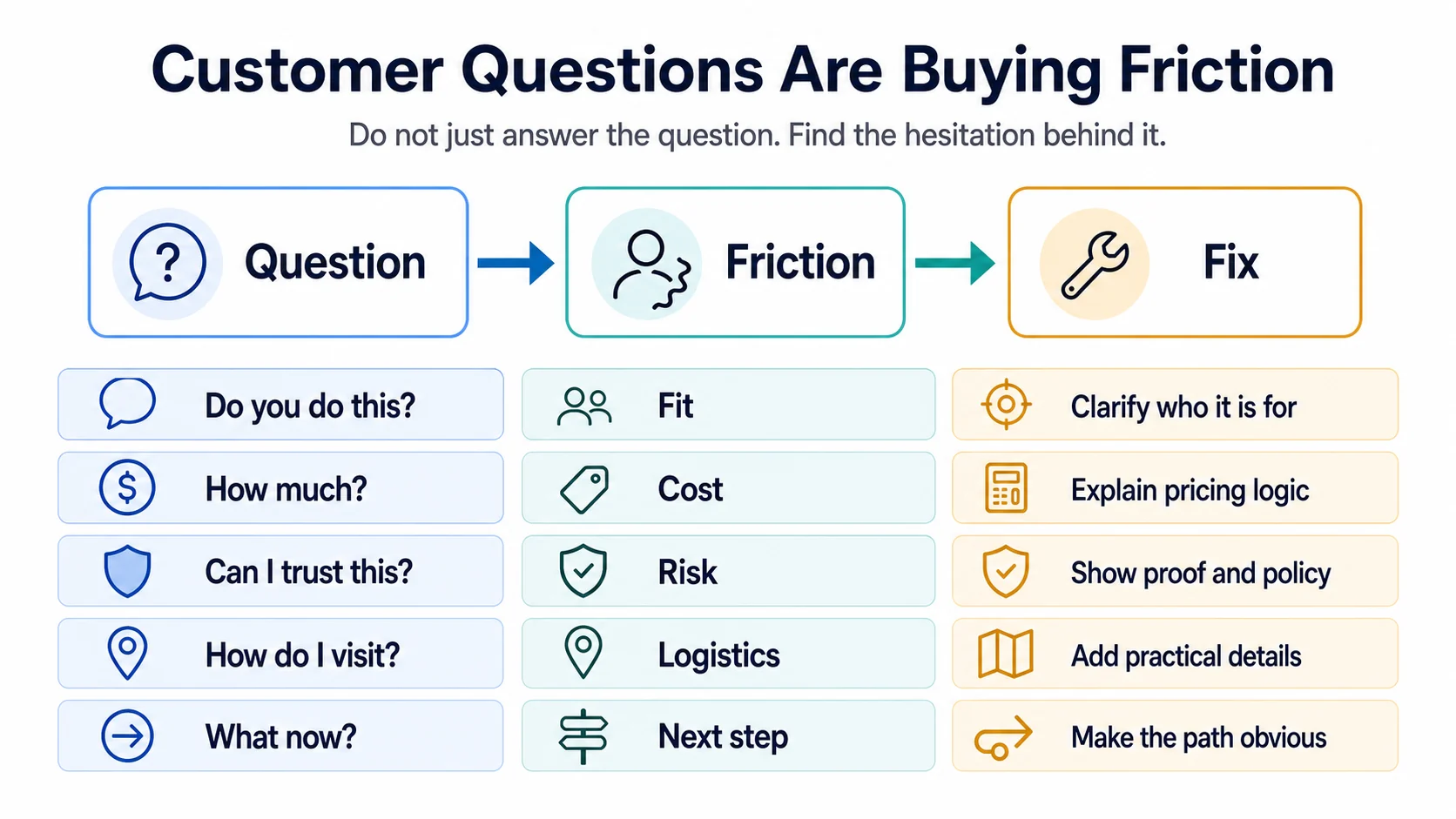
Here is the point of view that should change how a small business reads feedback: customer questions are not just support work. They are buying friction made visible.
If the same question keeps appearing, an important answer may be too hard to find, too vague to trust, or too disconnected from the next action. Analysis becomes practical when the business records the pattern, identifies the missing decision support, and changes the place where customers actually need the answer.
Why Questions Are More Useful Than They Look
The U.S. Small Business Administration describes market research as a way to understand customers and reduce risk. A small business can apply that idea to information it already receives: calls, emails, reviews, return reasons, walk-in questions, website searches, support notes, and conversations with people who did not complete the next step.
A question is useful because it includes a moment and an intended decision. "Where do I park?" may mean a customer is deciding whether a visit is practical. "Does this part fit the older model?" may mean the customer cannot finish setup. "What changes the quote?" may mean the customer is not ready to share the information needed for an estimate.
Keep those three layers separate: the exact wording, the decision behind it, and the business change that could help. A pile of comments is storage. A consistent link from evidence to action is analysis.
The Five Types of Customer Questions Worth Tracking
You do not need a complicated taxonomy. For many retailers, trades, manufacturers, event suppliers, and non-regulated service businesses, five groups are enough to begin.
1. Fit Questions
Fit questions ask, "Is this for me?"
- "Do you work with small homes?"
- "Does this part fit the 2022 model?"
- "Can your team work outside the city?"
- "Do you repair this brand?"
- "Is this package suitable for a two-day event?"
These questions show that your offer may be too broad, too vague, or too hard to match to the customer's situation. If the same fit question appears often, add clearer examples to the product page, service page, quote guide, sign, or printed material nearest the decision.
The fix is not always a longer FAQ. Sometimes the fix is a better headline, better service labels, better photos, or a simple "Best for..." note.
2. Risk Questions
Risk questions ask, "Can I trust this?"
- "Are you licensed and insured?"
- "What happens if I am not satisfied?"
- "What happens if the delivery is damaged?"
- "Is the deposit refundable?"
- "Will this damage my product?"
These questions are often more important than they sound. Customers may not be asking for information only. They are asking for reassurance.
If risk questions repeat, do not hide the answer in an unrelated policy page. Put the approved explanation near the decision point: the quote form, package description, product page, counter sign, service agreement, or confirmation message.
3. Cost Questions
Cost questions ask, "What will I be committing to?"
- "How much does it cost?"
- "Is there a minimum?"
- "Do you charge for estimates?"
- "What affects the final price?"
- "Are there extra fees?"
Many small businesses avoid pricing details because every job is different. That is understandable. But saying nothing forces customers to call, hesitate, or compare you against a competitor who explains pricing more clearly.
You do not always need exact prices. You can explain pricing logic: starting prices, ranges, minimums, what changes the quote, what is included, and when a final estimate requires inspection.
A useful rule: if customers cannot know the final price yet, at least help them understand the pricing process.
4. Logistics Questions
Logistics questions ask, "Can I make this work?"
- "Where do I park?"
- "How long does it take?"
- "Do I need an appointment?"
- "What should I bring?"
- "Do you deliver to my ZIP code?"
- "Can I pick up after work?"
These questions often create avoidable calls because the answer is practical. They are candidates for better signage, confirmation messages, location details, QR answer paths, delivery-area pages, and clearer pre-visit instructions.
Do not dismiss logistics as boring. For busy customers, logistics are part of the product.
5. Next-Step Questions
Next-step questions ask, "What do I do now?"
- "Should I call or book online?"
- "Do I send photos first?"
- "Which service should I choose?"
- "Who do I contact for a large order?"
- "Can I ask a question before booking?"
These are the questions that reveal a broken handoff. The customer may be interested, but the path is unclear.
If a next-step question repeats, fix the path, not just the answer.
Use a Feedback Log With One Counting Rule
Define the unit before counting. A practical starting rule is one distinct customer need per conversation. Repeating the same need in one exchange counts once; uncovering a separate decision counts as another event. Document the rule so phone, email, counter, and web notes are comparable.
| Field | What to record | Example |
|---|---|---|
| Date and period | Event date plus reporting week or month. | 2026-08-05 / Week 32 |
| Source | Phone, email, website, review, QR, counter, event, return, or other real origin. | Product insert QR |
| Exact wording | The customer's words after removing unnecessary personal information. | "Which adapter works with the older unit?" |
| Journey stage | Compare, buy, prepare, use, renew, return, or get help. | Use |
| Friction type | Fit, risk, cost, logistics, next step, complaint, or idea. | Fit |
| Current answer | Where the answer currently lives and whether staff agree. | Two conflicting PDF manuals |
| Customer outcome | Continued, delayed, contacted staff, abandoned, or unresolved. | Installation delayed |
| Proposed action | The smallest visible improvement and its owner. | Publish model compatibility table |
Do not paste full messages into a shared analysis sheet by default. Keep the minimum wording needed to understand the issue and store identifiable follow-up records in the system designed for them.
Do Not Count Questions Blindly
One trap in customer feedback analysis is treating frequency as importance.
If 40 people ask about parking and four business buyers ask whether a component meets their compatibility requirement, which question matters more? The answer depends on the business consequence, confidence in the evidence, and who will see the fix. A rare question can still matter when it blocks a valuable or risky decision.
| Priority factor | Question to ask | Warning |
|---|---|---|
| Frequency | How often did the distinct need appear under the documented rule? | High volume can reflect one unusually busy channel. |
| Decision impact | Does the answer affect buying, setup, trust, return, or successful use? | Do not infer revenue from interest alone. |
| Confidence | Do exact examples from more than one person or channel support the theme? | A generated summary is not source evidence. |
| Reach | How many relevant customers will see the proposed fix? | A good answer in the wrong place has little effect. |
| Effort and risk | Can the change be made accurately, reviewed, and kept current? | Consequential answers may require an authorized owner. |
Write the chosen action in one sentence: “We will publish a model compatibility table because the question appeared in three channels, existing documents conflict, and customers cannot complete setup without the answer.” That is clearer than “Improve product information.”
That is the difference between reporting and analysis.
A Simple Weekly Customer Feedback Analysis Workflow
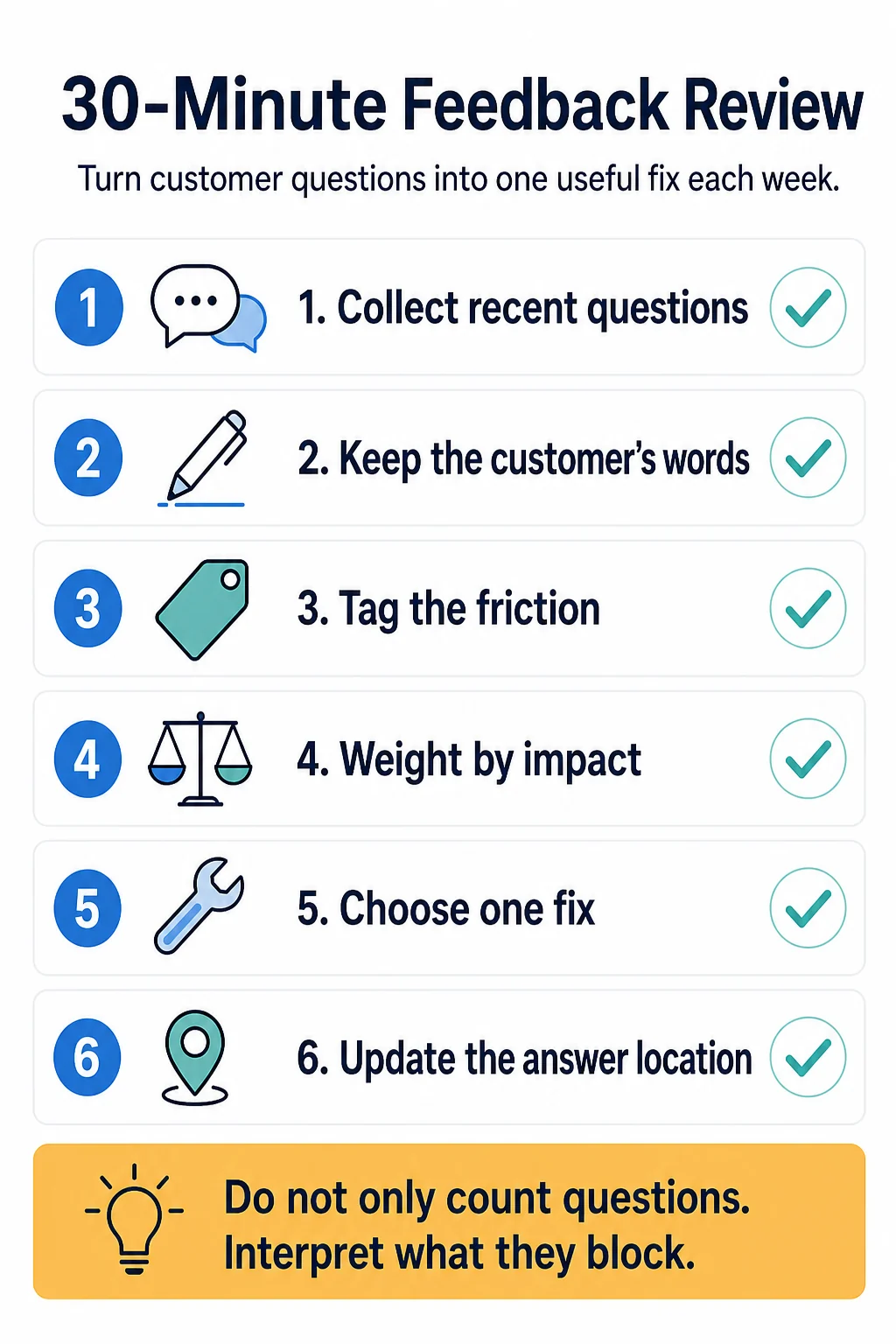
Choose a review cadence that matches your volume. A busy team may sample weekly; a lower-volume business may need a month before a pattern is meaningful. Keep the source coverage and counting rule consistent enough to compare periods.
Step 1: Collect Questions From Real Touchpoints
Use the places where questions already happen: missed-call notes, voicemail topics, email inquiries, website forms, social messages, counter questions, staff notes, reviews, returns, QR or public-link questions, and quote-form comments.
Do not collect personal details unless you need them. For analysis, the question itself is usually enough.
Step 2: Copy the Exact Customer Language
Do not immediately translate customer wording into business wording.
If customers say "Does the standard bracket fit the older unit?" do not rewrite it as "compatibility inquiry." The customer's phrase tells you what they are trying to verify and which words should appear in the answer.
Customer language is useful for website copy, staff scripts, FAQs, product pages, signs, service descriptions, and search terms.
Step 3: Tag the Question by Friction Type
Use simple tags: fit, risk, cost, logistics, next step, complaint, product or service idea, and language or accessibility need.
One question can have more than one tag. "What changes the installation quote, and should I send site photos first?" is both cost and next step.
Step 4: Decide Where the Answer Should Live
This is the part most businesses skip.
Do not ask, "How should we answer this question?" Ask, "Where should this answer have been visible before the customer had to ask?"
Possible places include your homepage, service page, product page, pricing explanation, quote form, confirmation message, voicemail greeting, storefront sign, counter sign, product packaging, receipt, business card, social profile link, or staff script.
The best answer in the wrong place still creates friction.
Step 5: Assign One Visible Improvement
Do not try to overhaul everything at once. Pick the question pattern with the strongest combination of frequency, impact, confidence, reach, and responsible effort.
Then make one change: add a pricing explanation, rewrite a service description, publish a compatibility table, improve delivery-area details, add a contextual QR answer, revise the voicemail message, create a preparation note, or train staff on one approved answer.
Name the owner, publication point, approval source, and review date. An insight without an assigned change is still unfinished analysis.
Worked Example: An Equipment Supplier With Compatibility Questions
An equipment supplier receives these questions by email, phone, and a QR code inside the package:
- "Does this adapter fit the older unit?"
- "Which cable is included?"
- "Is the firmware version important?"
- "Where is the model number?"
- "Can I order the bracket separately?"
The first label might be “product questions.” That is too broad to guide a change. The exact language shows a compatibility and identification problem. Two manuals use different model names, the product page does not show where to find the serial label, and staff give different answers about the included cable.
The supplier chooses one improvement package:
- A model compatibility table owned by the product team.
- A photo showing where to find the model and firmware version.
- A package-contents list that separates included and optional items.
- One approved staff answer for uncertain or custom configurations.
- A model-specific QR destination on the installation card.
The team records the two-week baseline, publishes the changes, and then reviews the next two weeks under the same channel coverage and counting rule. Fewer compatibility questions plus fewer unresolved installations is stronger evidence than a drop in question volume alone.
Measure Whether the Fix Worked
Record the baseline, the exact change, the observation period, and the decision you will make. A falling question count can mean the information is clearer, but it can also mean the answer is hidden or customers moved to another channel.
| Measure | Before | After | Interpret with |
|---|---|---|---|
| Distinct question events | Count under the documented rule | Count under the same rule | Comparable channel coverage |
| Unresolved follow-ups | Questions without a usable next step | Same definition | Staff availability and demand changes |
| Answer confidence | Conflicting, missing, approved, or current | Same categories | Source ownership and review date |
| Customer outcome | Continued, delayed, abandoned, or escalated | Same categories | Seasonality and campaign changes |
| New questions | Unexpected issues at baseline | Questions created by the change | Whether the answer introduced confusion |
Do not claim causality from a short comparison. Use the evidence to decide whether to keep, revise, move, expand, or reverse the change.
What This Changes in Your Business
When you analyze customer questions well, you stop treating support as cleanup and start treating it as research.
A repeated question can tell you:
- Your website is missing a decision-making detail.
- Your pricing explanation is too vague.
- Your menu, catalog, or service list uses business language instead of customer language.
- Your physical signs do not answer what walk-up customers need.
- Your booking process assumes too much.
- Customers are worried about risk, not just cost.
- A new audience is showing up with language or accessibility needs.
- Staff are answering the same thing in different ways.
- A profitable service is hard to understand.
- A policy is technically available but practically invisible.
The point is not to eliminate every question. Some questions are good. A thoughtful question can mean the customer is engaged.
The goal is to eliminate avoidable uncertainty.
Where AI Tools Can Help, Without Replacing Judgment
AI can suggest groups, summarize a defined sample, and help a reviewer compare customer wording. It should not silently decide what matters or convert an incomplete sample into an exact account of customer demand.
- Minimize the input. Remove names, phone numbers, addresses, payment details, account information, and private context that the analysis does not need.
- Keep the sample definition. Record the period, channels, exclusions, and counting rule before generating a summary.
- Compare output with source examples. Check whether different intents were merged or one unusual comment became an overconfident theme.
- Tag by business decision. “Positive” and “negative” are weaker than “pricing uncertainty,” “compatibility gap,” “delivery-area confusion,” or “missing next step.”
- Keep a human owner. A responsible person approves the label, priority, customer-facing change, and review date.
The FTC's small-business data guidance recommends knowing what personal information the business holds, keeping only what it needs, protecting it, and disposing of it securely. The NIST Generative AI Profile provides a framework for testing, monitoring, and governing risks such as confident but false output. Apply those principles before uploading customer text to any supplier.
For a small business, useful AI output is a review aid linked back to exact examples. It is not a replacement for the feedback log, privacy controls, source material, or business judgment.
Close the Loop With One Owned Change
Finish every review with an owner, action, location, approval source, and check date. Update the page, sign, policy, product information, staff script, or handoff that created the uncertainty. Tell the staff who receive the question what changed so they do not continue using an old answer.
- Preserve the exact examples that justified the change.
- Update every channel that relies on the same approved answer.
- Record the version and review date for changing information.
- Test the revised path as a customer would encounter it.
- Compare the same measures after a reasonable observation period.
- Record new uncertainty created by the change.
The goal is not to eliminate every question. Good questions can indicate interest or a genuinely individual situation. Remove avoidable uncertainty and make the valuable conversations easier to recognize.
Sources and Further Reading
- U.S. Small Business Administration: Market research and competitive analysis
- Google Analytics Help: Collect website and app search terms
- Federal Trade Commission: Protecting Personal Information, A Guide for Business
- NIST: Artificial Intelligence Risk Management Framework, Generative Artificial Intelligence Profile
FAQ
What is customer feedback analysis for a small business?
Customer feedback analysis is the process of collecting customer comments, questions, complaints, reviews, calls, DMs, and support requests, then grouping them into patterns that help the business improve decisions, communication, products, services, and customer experience.
What customer feedback should a small business track first?
Start with repeated questions that affect buying decisions: pricing, availability, service fit, trust, policies, location, booking steps, wait time, parking, delivery area, and what happens next.
Are customer questions really feedback?
Yes. Customer questions reveal what people do not understand, trust, or know how to do yet. They are especially useful because they often appear before the purchase, when the business still has a chance to reduce friction.
How often should a small business review customer feedback?
Choose a cadence that matches the volume. A busy team may sample weekly, while a lower-volume business may need a month of feedback. Keep the source coverage and counting rule consistent enough to compare periods.
What is the biggest mistake in analyzing customer feedback?
The biggest mistake is counting comments without interpreting what they mean. A question is not just a topic. It may reveal risk, price anxiety, unclear next steps, missing information, or a trust gap.
Last updated
Last updated: 2026-08-12. Added a feedback-log schema, counting rules, a five-factor prioritization method, an equipment-supplier example, before-and-after measurement, and current official privacy and AI-risk references.