
Trade show lead follow-up
Trade Show Lead Follow-Up: How to Turn Booth Scans Into Sales Conversations
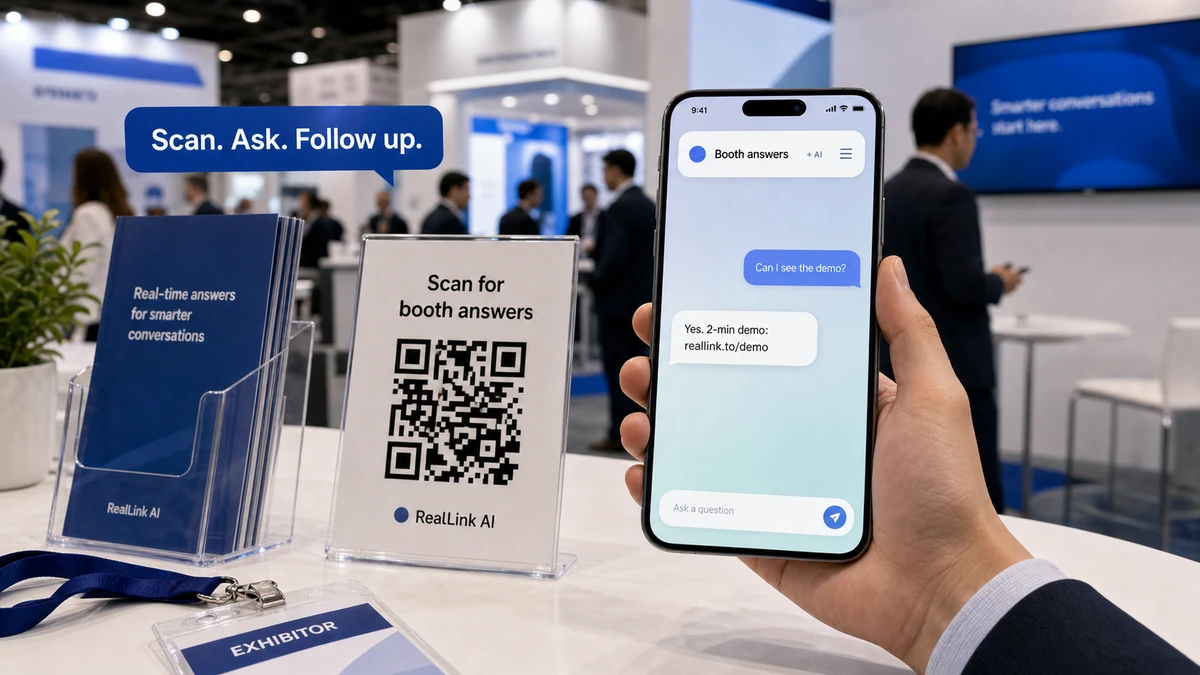
A scan is not a lead by itself. The question a visitor asks after the scan is the real follow-up context.
TL;DR
Most exhibitors do not lose trade show leads because they forget to follow up. They lose them because the follow-up has no context. A badge scan, QR scan, or business card tells you who visited, but not what they cared about. A better system connects every scan to the visitor’s question, product interest, timeline, buying concern, and next step.
Key takeaways
| Topic | Meaning |
|---|---|
| A scan is not the same as intent | Badge scans and QR scans need question context to become useful sales follow-up. |
| Fast follow-up is not enough | A quick generic email still feels irrelevant if it ignores what the visitor asked. |
| The QR destination matters | The page after the scan should answer demos, pricing context, specs, samples, and next steps. |
| Sales teams need context | “Asked about dealer pricing” is more useful than “visited booth at 2:14 PM.” |
| Question patterns improve the next show | Repeated questions reveal what your booth copy, brochure, and sales script should clarify. |
Table of contents
What is trade show lead follow-up?Why do booth scans fail to become sales conversations?What do most trade show follow-up guides miss?What questions do booth visitors ask before they buy?Bad vs betterDecision tableChecklistExamplesHow to do trade show lead follow-up without RealLink AIRealLink AIFAQWhat is trade show lead follow-up?
Trade show lead follow-up is the process of turning booth interactions into useful sales conversations after the event. It includes collecting contact information, preserving visitor intent, sending relevant next steps, and helping sales continue the conversation with context instead of starting from zero.
A good follow-up system answers four questions: who visited, what they cared about, what question they asked, and what should happen next.
At a trade show, the visitor’s attention is fragmented. The follow-up has to feel like a continuation of the booth moment, not a cold restart.
Why do booth scans fail to become sales conversations?
Booth scans fail because they often capture identity without intent. A scanner can record a name, company, job title, and email, but it rarely records the visitor’s concern, buying stage, use case, budget question, or internal approval process.
A visitor who asks about distributor pricing is different from someone who asks about ERP integration. If both are stored as “booth scan,” your sales team loses the most valuable part of the interaction.
What do most trade show follow-up guides miss?
Most trade show follow-up advice focuses on timing, email templates, CRM hygiene, and lead scoring. Those things matter, but they miss the source of relevance: the visitor’s actual question after the scan.
A badge scan can tell you a person was physically present. A QR scan can tell you a person was curious enough to open something. A question tells you what they were trying to solve.
A QR code is not the strategy. The answer after the scan is.

What questions do booth visitors ask before they buy?
Booth visitors ask questions about fit, proof, price, timing, implementation, risk, and internal justification. Many are too specific for a brochure but too common to leave unanswered until a sales call.
- What does this product or service actually do?
- Who is it best for, and who is not a fit?
- What affects pricing or project scope?
- Can I see a demo video after I leave the booth?
- What information is needed before a quote?
- Does this work for my industry, location, language, or channel?
- Can I share this with my boss, buyer, or technical team?
- What happens after I request more information?
Bad vs better
A better follow-up is more specific, not necessarily longer.
| Situation | Weak follow-up | Better follow-up |
|---|---|---|
| Visitor scans a QR code | Send everyone to the homepage | Send visitors to a booth-specific answer page |
| Visitor asks about pricing | “We will follow up soon” | Capture the pricing question and send the relevant pricing path |
| Visitor wants a demo | Give a generic brochure | Let them ask for the demo topic and send the matching video or URL |
| Visitor is a distributor | Add them to the same prospect list | Tag the question as partner or distributor interest |
| Sales follows up | “Great meeting you at the show” | “You asked about dealer pricing and west coast shipping.” |
Decision table
Choose the QR destination by visitor intent and booth type.
| Booth type | Best follow-up method | What to capture |
|---|---|---|
| Small business booth | QR answer page plus simple contact path | Top questions, product interest, best next step |
| B2B SaaS exhibitor | Demo-specific follow-up | Use case, team size, integration concern |
| Manufacturer | Product/spec follow-up | Model interest, volume, region, distributor question |
| Exporter | Multilingual answer path | Country, language, shipping/import question |
| Franchise or dealer program | Qualification follow-up | Location, capital range, experience, timeline |
Checklist
Prepare the answer plan before printing booth materials.
- Choose the main goal of the booth.
- Write the top 20 questions visitors are likely to ask.
- Create a booth-specific QR destination, not just a homepage link.
- Prepare follow-up categories by intent.
- Write short follow-up templates for each category.
- Train booth staff to ask one context question.
- Make follow-up expectations clear when collecting contact details.
- Review question patterns after each show day.
Examples
Strong examples connect the physical booth moment to a specific follow-up answer.
B2B software demo booth
A visitor scans after watching a demo and asks about integration. The follow-up can send the integration overview first instead of a generic pitch.
Manufacturing booth
A buyer asks about minimum order quantity. That question should trigger MOQ, lead time, and packaging follow-up.
Export booth
An international visitor asks whether the company ships to their country. A multilingual answer path gives the export team better context.
Dealer or franchise booth
A visitor asks about territories. That should route to dealer development, not the general newsletter.
Conference sponsor booth
A visitor asks for the slide deck and checklist. This is a content-driven lead that deserves useful resources before a hard sales push.

How to do trade show lead follow-up without RealLink AI
You can improve trade show follow-up without RealLink AI by using a clear event landing page, QR tracking, segmented forms, staff notes, CRM tags, and follow-up templates by interest. The key is to capture visitor intent, not just contact information.
A manual system can work: create separate QR codes by booth zone, ask one interest question, train staff to add short notes, and segment follow-up by pricing, demo, dealer, technical, or partnership interest.
The weakness is friction. Visitors may not fill out a form on the show floor, and staff may forget notes when the booth is busy.
How RealLink AI makes trade show follow-up easier
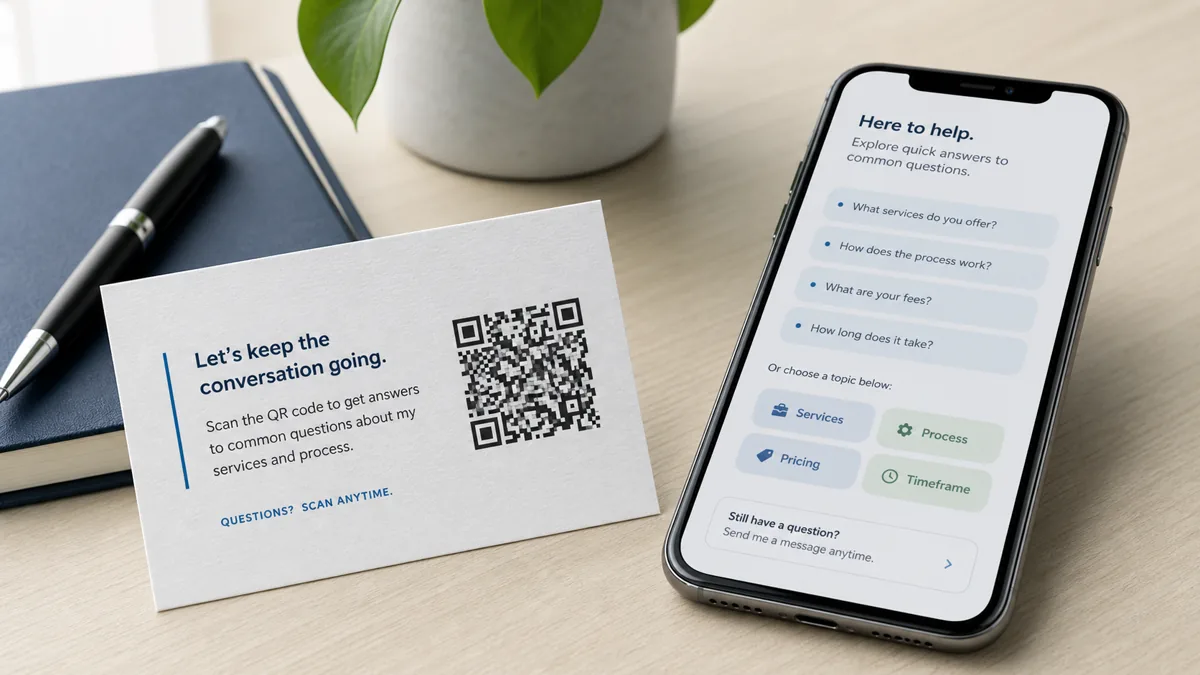
RealLink AI makes trade show follow-up easier by turning a booth QR code into an AI answer page where visitors can ask questions after they scan. The answer page can respond with trained business information, plain URLs, or embedded media while preserving question patterns for follow-up.
RealLink AI is not a generic chatbot widget. It is a public answer page for physical touchpoints: booth signs, flyers, brochures, product tags, business cards, catalogs, and post-show links.
The customer-facing page stays simple: speech bubbles, plain answers, plain URL links, optional YouTube or TikTok embeds, a hamburger menu, and a bottom input.

What claims and consent issues should exhibitors watch?
For U.S. exhibitors, follow-up claims and contact practices should be clear and supportable. When collecting information for sales or marketing follow-up, explain what visitors should expect and avoid fake urgency, fake results, or claims your team cannot substantiate.
Google’s people-first content guidance is useful here: answer the task the visitor came to solve. The FTC advertising FAQ for small business is also a practical reminder to keep claims truthful and clear.
What should you read next?
Plan the QR destination, answer flow, and follow-up system around your booth materials.
Related guide
Messe Frankfurt Exhibitor Guide
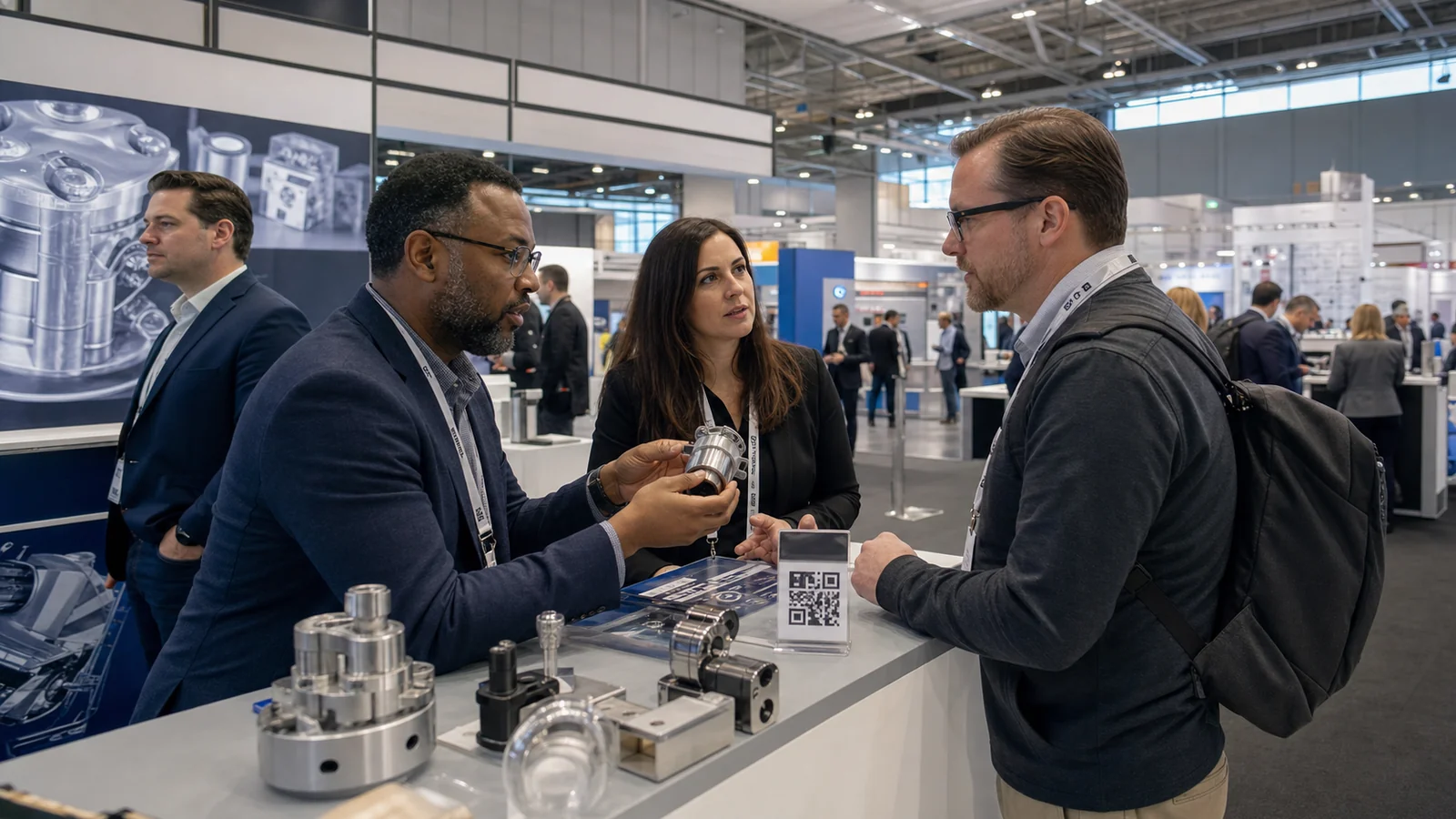
A Messe Frankfurt exhibitor guide for capturing certification, distributor, quality proof, product documentation, quote, and follow-up questions with booth and catalog QR flows.
RealLink AI
Related guides
RealLink AI
QR Code Generator vs AI Answer Page
RealLink AI
QR Code Ideas for Business Cards
FAQ
What is the best way to follow up with trade show leads?
Follow up with context. Mention what the visitor asked, send the most relevant next step, and keep the message short.
How fast should I follow up after a trade show?
Many teams aim for 24 to 48 hours, but speed alone is not enough. Relevance matters more than a fast generic email.
What should a trade show QR code link to?
A booth QR code should link to a booth-specific destination that answers pricing context, demos, specs, availability, contact paths, or proof.
Is a badge scan enough for lead follow-up?
A badge scan is useful but incomplete. It usually identifies the visitor without capturing their question, urgency, role, or buying stage.
How can I make trade show follow-up less generic?
Segment leads by what they asked, what they scanned, and what next step they requested.
Can QR codes help with trade show lead capture?
Yes, if the destination is useful. A QR code that opens an answer point can create stronger follow-up context than a generic page.
How does RealLink AI help with booth scans?
RealLink AI turns a booth QR scan into an AI answer page where visitors ask questions and receive trained answers.
What should I avoid in trade show follow-up?
Avoid fake urgency, inflated claims, irrelevant bulk emails, unclear consent, and follow-up that ignores the visitor’s question.
Last updated and author/founder note
Last updated: 2026.
Founder note: Trade shows create attention, but attention expires quickly. Do not let your booth materials go silent after the scan.
Turn booth scans into answer points
A trade show scan should not become a cold row in a spreadsheet. Create a RealLink AI answer page for your booth sign, brochure, product display, business card, or post-show follow-up link.