
How to Reduce Repetitive Customer Questions
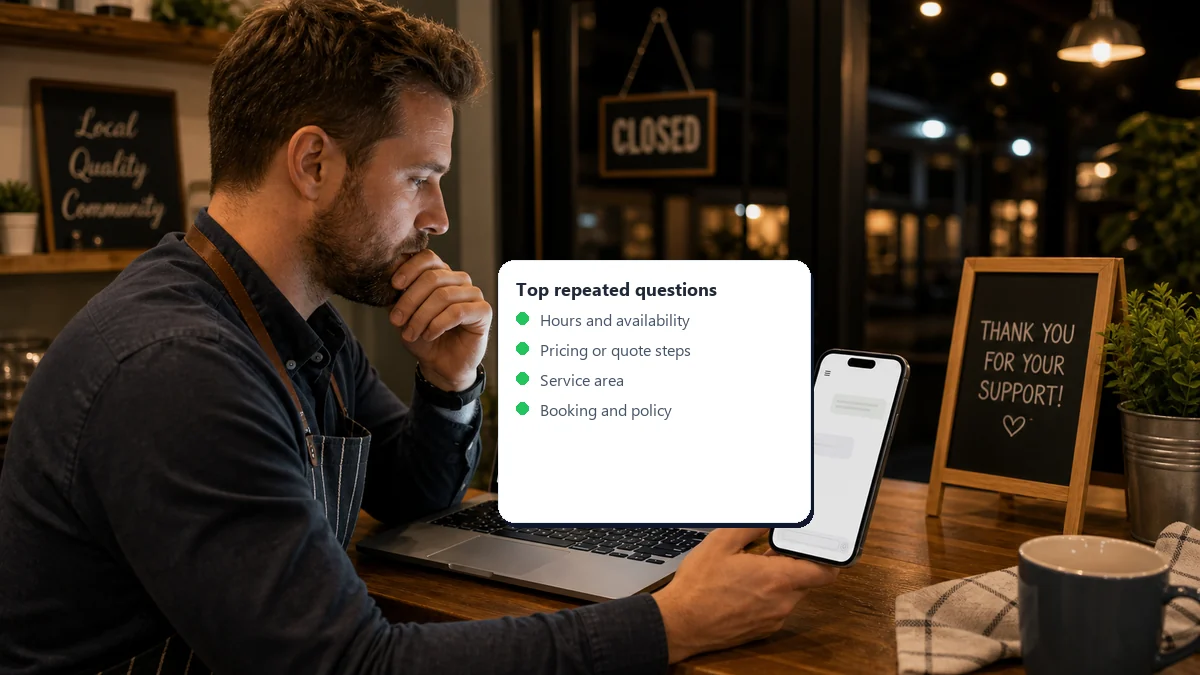
To reduce repetitive customer questions, stop treating them as interruptions and start treating them as missing answers. Customers ask the same questions when the right answer is not easy to find at the moment they need it.
TL;DR
To reduce repetitive customer questions, identify the top questions customers ask before buying, visiting, booking, ordering, or requesting a quote. Group them by intent, write short approved answers, and place those answers where the questions happen: your website, signs, menus, flyers, packaging, emails, staff scripts, and QR destinations. The goal is not to stop every conversation. The goal is to remove low-value repetition so customers get clarity faster and staff can focus on higher-value conversations.
What are the key takeaways?
Repetitive questions usually mean the answer exists in the wrong place, is too vague, or is not trusted. A better system collects questions, turns them into approved answers, places those answers near the decision, and reviews patterns monthly.
What is the fastest way to reduce repetitive customer questions?
The fastest way is to list the top 10 questions customers ask before they act, write direct approved answers, and place those answers in the exact channel where the question happens. Do not hide a critical answer in a long FAQ if the customer needs it on a sign, flyer, menu, product page, or QR destination.
A customer asks "What time do you close?" because the hours are unclear. A lead asks "How much does it cost?" because the pricing logic is vague. A visitor asks "Do I need an appointment?" because the next step is not obvious.
Repetitive questions are usually not a customer problem. They are an answer placement problem.
Why do customers keep asking the same questions?
Customers repeat questions when the answer is missing, buried, outdated, vague, or placed in the wrong channel. A business may technically have the answer somewhere, but if the customer cannot find it quickly during the decision moment, they will call, message, ask staff, or leave.
- The website has general information but few direct answers.
- The FAQ exists, but it is not linked from flyers, menus, signs, packaging, or booking pages.
- Staff answer questions differently, which creates confusion.
- Prices, hours, service areas, and policies are described too vaguely.
- The business updates social media but forgets printed materials.
- QR codes open homepages instead of question-specific pages.
- Customers ask in different languages, but answers exist only in one language.
A QR code is not the strategy. The answer after the scan is.
What do most guides miss about repetitive questions?
Most guides tell businesses to create an FAQ page. That helps, but it is incomplete. Customers do not always ask questions while browsing your FAQ. They ask while standing outside, reading a flyer, scanning a menu, holding a product, comparing prices, or trying to book.
The answer needs to match the touchpoint. A storefront sign needs hours and appointment rules. A restaurant menu needs allergen and specials answers. A service flyer needs price, scope, and quote steps. A product package needs setup, warranty, and support answers.
What questions do customers actually ask?
Customers ask practical questions that reduce risk before they act. They want to know cost, fit, availability, timing, rules, location, proof, safety, and next steps. The exact wording changes by industry, but the intent is usually predictable.
- How much does it cost?
- Is this the final price?
- What is included and what is not included?
- Are you open today?
- Do I need an appointment?
- Do you serve my area?
- How long does it take?
- Can I book online?
- What should I prepare?
- What happens after I submit the form?
- Do you offer refunds, exchanges, or guarantees?
- Can I see examples?
These are not random support tickets. They are buying signals.
What is a bad solution versus a better solution?
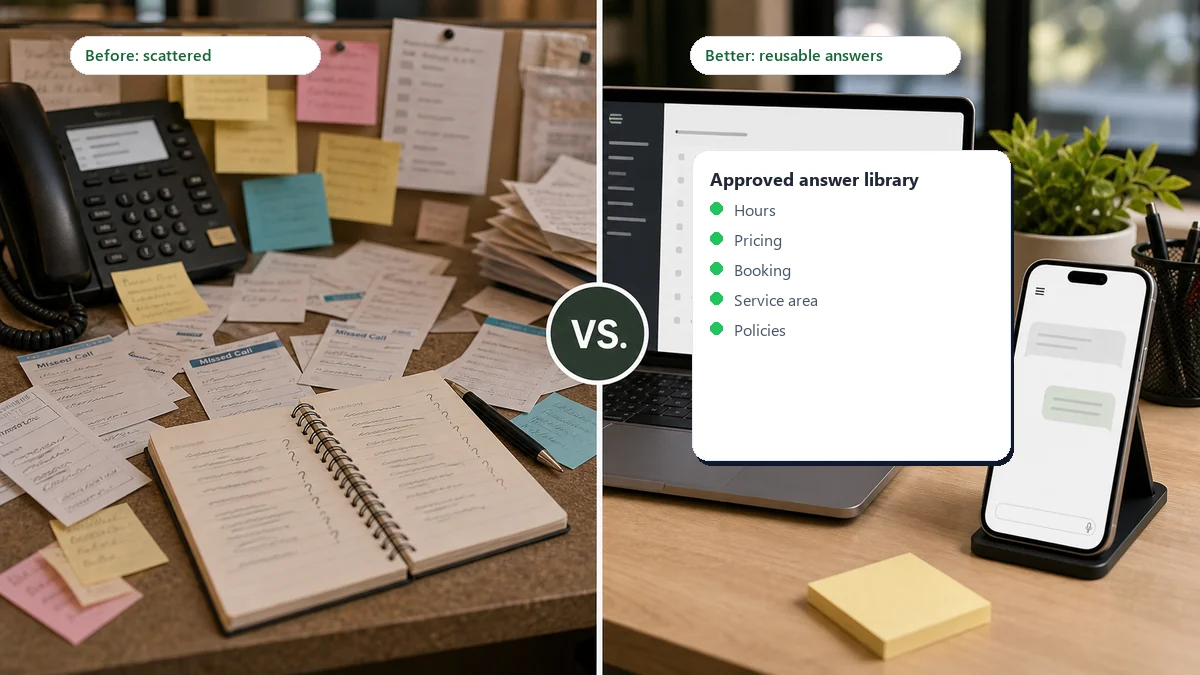
A weak solution adds another place for customers to ask the same thing. A better solution answers the common question before it becomes a call, message, or staff interruption. The difference is not automation alone; it is answer placement and clarity.
| Repeated question problem | Bad solution | Better solution |
|---|---|---|
| Customers ask about hours | "Hours are on the website." | Put today's hours on Google, website, signs, QR pages, voicemail, and answer pages. |
| Customers ask about price | "Call for pricing." | Explain starting price, quote factors, what changes price, and what to send. |
| Customers ask what is included | Long service page. | Short answer blocks: included, not included, add-ons, and custom quote triggers. |
| Customers ask from flyers | QR code to homepage. | QR code to the exact flyer offer, FAQ, quote steps, or AI answer point. |
| Staff answer differently | Verbal memory. | Approved answer library and staff script. |
Which approach fits your business type?
The right answer system depends on where your customers ask questions. Restaurants need menu and hours answers. Home services need quote-readiness answers. Retailers need policy and product answers. Packaging, signs, and cards need QR destinations that match the customer's moment.
| Business type | Repeated questions | Best answer system |
|---|---|---|
| Restaurant | Hours, menu, allergens, reservations, specials. | Menu QR answer page, table tent FAQ, and after-hours page. |
| Home services | Price, service area, scope, photos, schedule. | Quote-readiness page and flyer QR code. |
| Retail store | Returns, size, stock, hours, parking. | Product FAQ, sign QR code, and staff script. |
| Real estate | Price, open house time, property details, tour next step. | Yard sign QR answer page. |
| Product seller | Setup, warranty, usage, troubleshooting. | Packaging QR answer page. |
| Tourism or hospitality | Language, location, hours, tickets, rules. | Multilingual AI answer page. |
What checklist should you follow?
Use a simple answer workflow before buying new customer service software. First gather the questions, then group them, approve answers, place them near the decision, and review whether customers still repeat the same questions.
- Collect the questions. Ask staff, check messages, review emails, read call notes, scan social comments, and list the top repeated questions.
- Group by intent. Do not group only by exact wording. "How much is it?" and "Is there a fee?" may belong together.
- Write approved answers. Keep answers short, specific, and operationally true. Mention limits when needed.
- Place answers near the decision. Put the answer on the page, sign, QR destination, menu, flyer, product insert, voicemail, or booking step where the question appears.
- Add a clear next step. Tell the customer what to do next: call, text, book, order, scan, send photos, fill out a form, or visit.
- Train staff on the same wording. Use approved answers so customers do not hear five versions of the same policy.
- Review question patterns monthly. If a question keeps repeating, the answer is still missing, unclear, or too hard to find.
- Update printed touchpoints. If you use QR codes, connect them to answer pages that can be updated after printing.
What are practical examples?
The best examples start with a specific repeated question and put the answer closer to the customer's moment. A restaurant, cleaning company, real estate agent, product seller, salon, and home service business all need different answer placement.
Restaurant
A restaurant keeps getting calls about hours, reservations, gluten-free dishes, and today's specials. Instead of sending every QR scan to a PDF menu, the restaurant creates a menu answer page that explains hours, specials, reservation link, and dietary notes.
Cleaning service
A cleaning company keeps answering "What is included in a deep clean?" The better answer explains rooms, add-ons, appliances, windows, baseboards, photos needed, and what requires a custom quote.
Real estate agent
An agent gets repeated questions from yard signs: price, open house time, school district, property taxes, and tour availability. A QR code on the yard sign should open property answers, not only the agent homepage.
Product packaging
A small product brand receives support questions about setup, use, warranty, and returns. A QR code on the package can open an answer page with setup steps, care instructions, warranty policy, and support link.
Salon or spa
A salon receives repetitive questions about pricing, appointment prep, cancellation, service time, and whether walk-ins are accepted. A booking FAQ near the appointment link reduces low-value calls.
Home service flyer
A pressure washing, lawn care, or mobile detailing flyer creates interest but cannot answer follow-up questions. The QR code should answer service area, quote requirements, photos needed, and what happens after contact.
How can you do this without RealLink AI?
You can reduce repetitive customer questions without RealLink AI by building a simple internal answer system: shared approved answers, a public FAQ page, staff scripts, email templates, better signage, and QR codes that point to specific answer pages.
Start with a shared document of approved answers. Add the strongest answers to your website and staff scripts. Update your Google Business Profile, voicemail, booking page, product page, and printed materials. For QR codes, avoid sending every scan to a generic homepage. Match each QR destination to the customer moment.
This works if someone owns the system and keeps it current. The main challenge is that questions happen across many channels: website, phone, signage, flyers, menus, packaging, email, and in-person conversations.
How does RealLink AI make it easier?
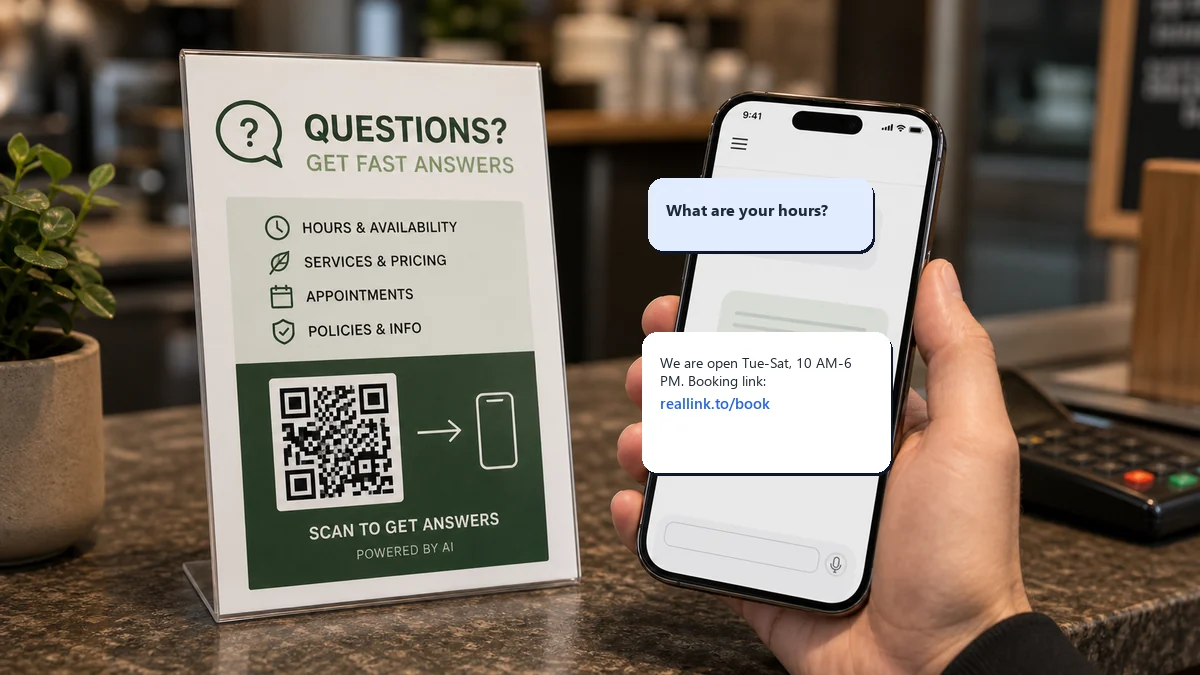
RealLink AI helps small businesses turn repeated questions into public AI answer pages. A customer scans a QR code or opens a public link, asks a question, and receives an approved answer based on the business information you provide.
RealLink AI is best described as an AI answer page or AI answer point, not a generic AI chatbot. The customer-facing experience should stay simple: question bubble, answer bubble, plain text, plain URL links, optional YouTube or TikTok embeds, hamburger menu, and bottom input.
The deeper value is question data. If customers keep asking about hours, pricing, booking, service area, policies, setup, refunds, or preparation, those patterns can guide better website copy, printed materials, staff scripts, offers, and operations.
What should you read next?
- How to Answer Customer Questions After Hours - build an answer workflow when staff are unavailable.
- How Local Businesses Can Reduce Missed Calls - reduce phone friction with better routing.
- QR Code Customer Service for Small Businesses - use signs, cards, menus, and flyers as answer points.
- Customer Service Automation for Small Businesses - automate the right questions without losing trust.
- FAQ Page Best Practices for Small Businesses - write answers customers can actually use.
FAQ about reducing repetitive customer questions
What is the best way to reduce repetitive customer questions?
The best way is to collect repeated questions, group them by intent, write approved answers, and place those answers where customers need them before they call, message, visit, book, or buy.
Why do customers keep asking questions that are already on the website?
Because the answer may be hard to find, too vague, outdated, buried in a long page, or missing from the channel where the customer is making a decision.
Is an FAQ page enough?
An FAQ page helps, but it is rarely enough by itself. Repeated questions should also be answered on signs, menus, product pages, flyers, packaging, QR destinations, booking pages, and staff scripts.
How many questions should a small business answer first?
Start with the top 10 repeated questions. These usually cover price, hours, availability, service area, what is included, next steps, policies, preparation, and contact options.
Should answers be long or short?
Short answers usually work better. Give the direct answer first, then add one or two details, limits, or next steps.
Can QR codes reduce repetitive questions?
Yes, if the QR code opens the right answer. A QR code that opens a generic homepage may not help. A QR code that opens a specific answer page can reduce repeated questions.
Can AI answer customer questions without replacing staff?
Yes. The goal is to answer simple repeated questions and guide customers to the next step, not replace human judgment for complex, sensitive, or high-value conversations.
What should businesses track?
Track what customers ask most often, which questions show confusion, which answers are missing, and which questions appear before purchase, booking, quote requests, or support issues.
Can RealLink AI show question patterns?
Yes. RealLink AI can help business owners see repeated question patterns and use them to improve answer pages, printed materials, staff scripts, and customer service operations.
Last updated and author/founder note
Last updated: 2026. This guide was prepared by RealLink AI for small business owners, operators, and marketers who want fewer repeated customer questions without making customers wait for every basic answer.
Founder note: The point of view is simple: customer questions are buying signals. If the same question repeats, the business is being shown exactly where an answer, sign, page, script, or QR destination needs to improve.
Editorial details: outline, image manifest, schema suggestions, and self-check
| # | Purpose | Filename | Alt text | Caption | Placement | Dimensions |
|---|---|---|---|---|---|---|
| 1 | Hero image | how-to-reduce-repetitive-customer-questions-hero.webp | a small business owner reviewing repeated customer questions and AI answer page insights | Repeated questions are not just support work. They are business data. | Above TL;DR | 1200x675 |
| 2 | Comparison visual | how-to-reduce-repetitive-customer-questions-comparison.webp | a comparison showing scattered repeated questions versus organized customer answers | The better system turns repeated questions into reusable answers. | Near bad vs better table | 1200x675 |
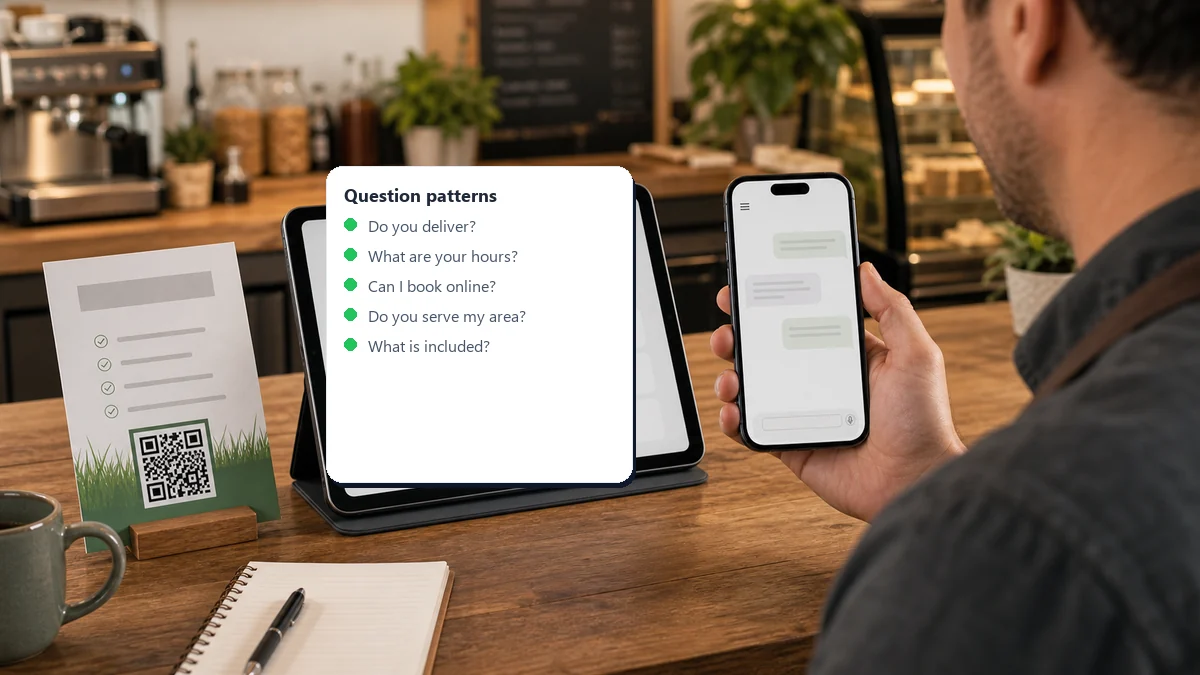
| 3 | Real-world scenario | how-to-reduce-repetitive-customer-questions-example.webp | a small business owner reviewing repeated customer questions and AI answer page insights | Question patterns show what customers need before they act. | Near concrete examples | 1200x675 |
| 4 | Product flow / CTA | how-to-reduce-repetitive-customer-questions-ai-answer-flow.webp | a QR scan opening an AI answer page that answers a repeated customer question with plain text and a URL | A good QR destination answers the question behind the scan. | Near RealLink AI section and CTA | 1200x675 |
Schema suggestions: BlogPosting with image fields, FAQPage for the FAQ, HowTo for the checklist, and BreadcrumbList for Resources > Customer Service > Repeated Questions.
Final self-check: TL;DR included, key takeaways included, comparison table included, decision table included, FAQ includes at least 8 questions, examples include at least 5 scenarios, schema is included, and all 4 raster images are included.