
Multilingual customer service
Multilingual Customer Service for Small Businesses
How to help customers ask questions in their own language, without hiring a full support team.
A customer wants to book, order, visit, or buy from you, but they are not comfortable asking the question in English. They pause. They look for a translated page. They ask a friend. Or they leave and choose a business that feels easier to understand.
That is the everyday language gap many small businesses never see clearly. The customer may be local, visiting from another country, new to the area, or simply more confident in another language. The business may be friendly and capable, but the answer the customer needs is trapped behind one language.
Multilingual customer service does not have to mean building a call center or hiring staff for every language on day one. For many small businesses, the smarter starting point is simpler: identify the questions customers ask most, make those answers easier to access, and create clear handoff rules for anything that needs human judgment.
This guide shows how restaurants, hotels, salons, retail shops, local services, clinics, tourism businesses, and solo operators can support multilingual customers in a practical way.
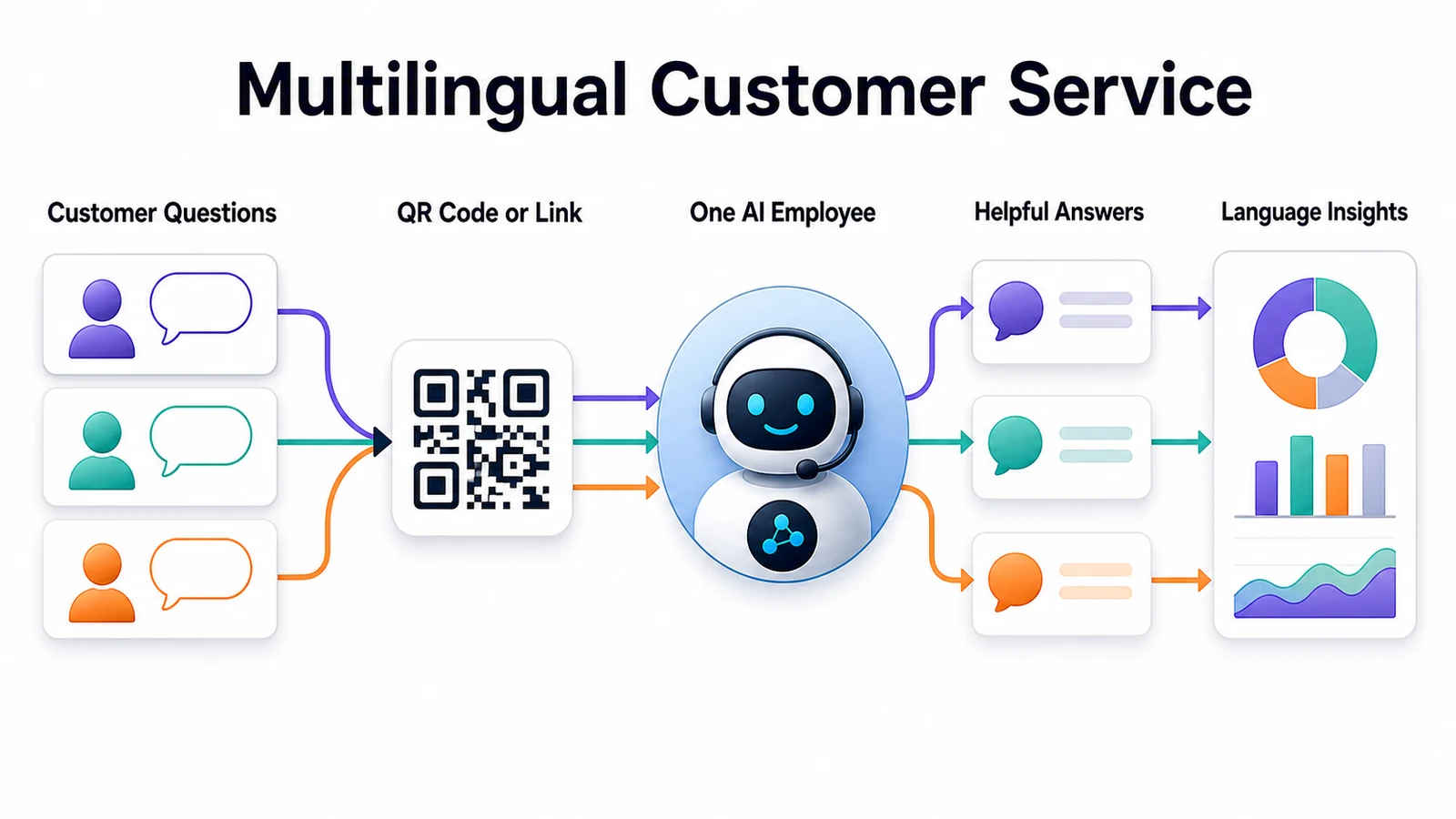
Why Language Gaps Cost Small Businesses
Language gaps are not always dramatic. Most of the time, they show up as small moments of uncertainty.
A guest does not understand check-in instructions. A restaurant customer is unsure about allergens. A salon client wants to know whether a service fits their hair type. A retail shopper wants to ask about sizing or returns. A home service lead wants to know whether the business serves their ZIP code.
If the answer is hard to ask or hard to understand, the customer may not complain. They may simply stop moving forward.
For a small business, that can mean:
- More repeated calls for basic information
- More hesitation before booking or visiting
- More confusion around policies, hours, or pricing
- More staff time spent explaining the same details
- Lost interest from tourists, new residents, and multilingual local customers
- Less visibility into what non-English-speaking customers actually need
The goal is not to pretend every business can instantly serve every language perfectly. The goal is to reduce avoidable friction around common questions.
Start With Questions, Not Translation Projects
A common mistake is treating multilingual support as a giant translation project. The owner imagines translating the whole website, every menu item, every policy, every product description, and every old PDF.
That feels overwhelming, so nothing happens.
A better first step is question-based. Ask: what does the customer need to know before they can take the next step?
Start with the information that comes up again and again:
- Hours and holiday hours
- Location, parking, and directions
- Service area
- Booking, reservation, or appointment steps
- Menu, product, or service basics
- Pricing approach or starting price ranges, when appropriate
- Cancellation, return, deposit, or late-arrival policies
- What to bring before an appointment
- Allergens, ingredients, sizing, setup, or care instructions
- When a customer needs to contact a person
This approach is much more realistic. You do not need to translate everything first. You need to make the highest-friction answers easier to access.
Where Multilingual Support Matters Most
Multilingual support is useful anywhere customers have questions before they buy, book, visit, or use a product. It becomes especially valuable when the customer is standing in front of a physical touchpoint and needs help quickly.
Restaurants and Cafes
Restaurants often get questions about ingredients, allergens, reservations, wait times, takeout, parking, group seating, patio rules, and kitchen hours. A guest who is not confident in English may avoid asking, especially during a rush.
A QR code on a menu, table tent, window sign, or takeout bag can let customers ask practical questions in their own language without interrupting staff every time.
Hotels, Short-Term Rentals, and Tourism Businesses
Travelers often need help with check-in, Wi-Fi, parking, breakfast, checkout, transportation, local recommendations, house rules, accessibility, and emergency contacts. They may arrive tired, late, or unfamiliar with local norms.
Multilingual answers can reduce front-desk pressure while making guests feel less lost.
Salons, Clinics, and Local Services
Service businesses often need customers to understand preparation steps, timing, pricing approach, cancellation rules, and what information to share before the appointment. A language gap can turn a simple booking into a long back-and-forth.
Clear multilingual answers help customers arrive prepared and help staff avoid repeating basic instructions.
Retail Shops and Product Businesses
Retail customers may ask about sizing, returns, warranty, product care, availability, ingredients, compatibility, or how to use a product after purchase. Product-based businesses can put multilingual support behind QR codes on displays, packaging, inserts, receipts, and manuals.
That support can reduce confusion before and after the sale.
Build a Practical Multilingual Customer Service Workflow
The best workflow is simple enough for a small team to maintain. It should help customers without creating risk or making promises the business cannot keep.
1. Collect the Real Questions
Start with what customers already ask. Review calls, texts, DMs, email, Google Business Profile questions, booking notes, staff memory, and questions from your QR code customer service touchpoints.
Do not rewrite everything into internal language. If customers ask, "Can I walk in?" keep that wording. If they ask, "Do you have food without milk?" do not hide it under "dietary accommodation policy." Customer wording tells you what the answer system needs to handle.
2. Create Approved Answers in Plain English First
Before translating anything, make sure the original answer is clear. If your English answer is vague, the multilingual answer will be vague too.
A strong answer usually includes:
- The direct answer
- Any condition or limitation
- The next step
- When staff should be contacted
For example, instead of only saying, "We take reservations," a restaurant could say, "We take reservations for parties of six or more. For smaller groups, walk-ins are welcome. If you have a large group, send your preferred date, time, and party size."
3. Put Access Where Questions Happen
Do not make customers hunt for language help. Place QR codes and links where questions naturally happen:
- Menus and table tents
- Storefront signs
- Hotel room cards
- Business cards
- Flyers and brochures
- Receipts and appointment reminders
- Product packaging and manuals
- Google Business Profile and social bio links
The scan promise should be clear. Good examples include:
- "Have a question? Scan to ask in your language."
- "Need help with hours, parking, or booking? Scan here."
- "Questions about this product? Scan for support."
- "Visiting us after hours? Ask common questions here."
This also connects naturally with after-hours customer service, because language gaps often happen when staff are unavailable.
4. Set Human Handoff Rules
Multilingual support should not answer everything automatically. Some questions need a person, especially if the topic involves judgment, safety, emotion, or money.
Keep human handoff for:
- Complaints
- Refund disputes
- Medical, legal, financial, or safety-sensitive questions
- Emergencies
- Final quotes or custom estimates
- Unusual situations that do not fit your standard policy
A useful answer can still help by setting expectations: "This needs a team member to review. Please leave your name, contact information, and preferred language. We will follow up during business hours."
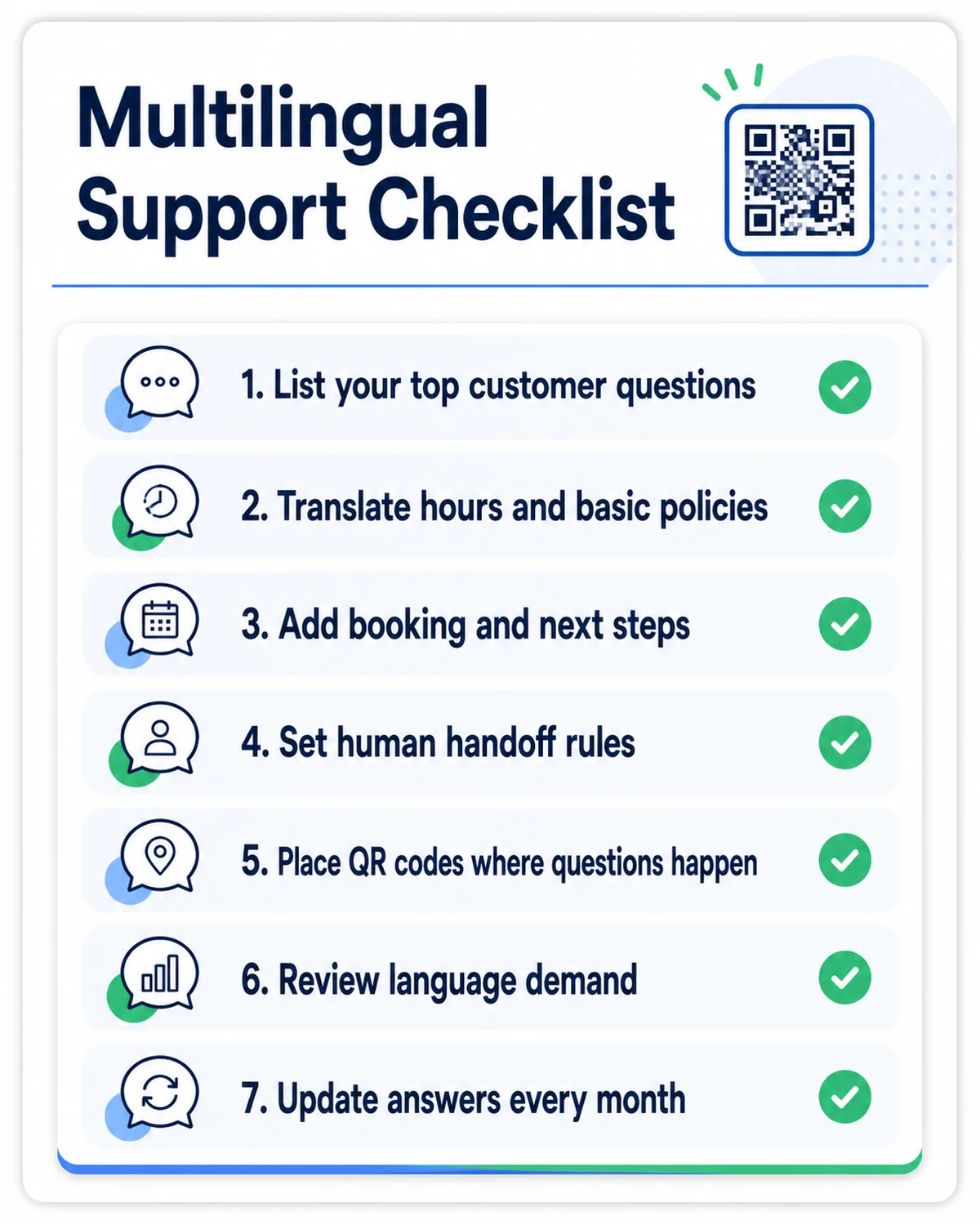
Multilingual Support Checklist
Use this checklist before you launch multilingual customer support.
- List the top customer questions your team answers every week.
- Write approved plain-English answers before translating or automating them.
- Include hours, location, booking steps, policies, and common service details.
- Add clear next steps for booking, calling, visiting, ordering, or sending information.
- Set human handoff rules for sensitive, urgent, emotional, or custom questions.
- Place QR codes or links where customers naturally have questions.
- Test the experience from a phone, not only a desktop computer.
- Ask someone outside the business to try asking a question.
- Review which languages and topics show up over time.
- Update answers whenever hours, prices, services, menus, or policies change.
Practical Example: A Small Hotel
Imagine a small independent hotel near a busy travel area. The front desk team is friendly, but guests arrive speaking different languages. Some guests can read basic English, but they hesitate when asking detailed questions.
The hotel gets repeated questions like:
- What time is check-in?
- Can I check in late?
- What is the Wi-Fi password?
- Is breakfast included?
- Where can I park?
- Can I store luggage after checkout?
- How do I get to the airport?
- Who do I contact after the front desk closes?
The hotel does not need to translate every brochure first. It starts with the questions guests ask most often.
The owner writes clear approved answers in English. Then the hotel puts a QR code on the front desk sign, room card, elevator notice, and post-booking email. The scan promise says, "Questions about your stay? Scan to ask in your language."
Now a guest can ask about parking or late checkout in the language they are most comfortable using. The answer explains the hotel's policy and the next step. If the question involves a refund, emergency, or unusual request, the answer routes the guest to a staff member.
After a few weeks, the owner reviews question patterns. Many guests ask about airport transportation in Spanish. Several ask about luggage storage in Korean. Late-check-in questions come in mostly after 9 p.m. The hotel uses that information to improve its arrival email, room card, and front desk signage.
The result is not only better support. It is better visibility into what multilingual guests need.
What Not to Automate
Multilingual support can make a small business feel more welcoming, but boundaries matter. Translation does not remove responsibility. If a topic is sensitive in English, it is still sensitive in another language.
Be careful with:
- Medical advice
- Legal or financial advice
- Safety instructions
- Emergency response
- Refund disputes
- Final quotes or promises
- Angry or emotional customer situations
For those questions, the best multilingual answer may be a clear handoff, not an instant answer.
That boundary builds trust. Customers would rather know that a real person will review the situation than receive a confident answer that may not fit their case.
How to Measure Language Demand
One of the most useful parts of multilingual customer service is learning which languages and topics matter most to your customers. You may discover demand you did not know existed.
Track simple signals:
- Which languages customers use
- Which questions repeat in each language
- Which QR code placements generate multilingual questions
- Which questions happen after hours
- Which questions lead to booking, ordering, or staff follow-up
- Which answers still confuse customers
This helps you make better decisions. If most multilingual questions are about parking, fix the parking instructions. If tourists ask the same menu questions, improve menu notes. If customers ask in Spanish before booking services, make booking steps clearer.
Multilingual questions are not only support requests. They are customer insight.
A One-Week Plan to Get Started
If this feels like a lot, keep the first version small.
- Day 1: List the top 20 questions customers ask before buying, booking, visiting, or using your product.
- Day 2: Choose the 10 safest questions to answer without human judgment.
- Day 3: Write clear approved answers in plain English.
- Day 4: Add next steps and handoff rules.
- Day 5: Put a QR code or link on one high-value touchpoint.
- Day 6: Test the experience from a phone and ask someone else to try it.
- Day 7: Review the first questions and improve the answers.
Once that works, expand to more touchpoints. Add the link to your Google profile, social bio, printed materials, packaging, or post-booking messages.
Multilingual customer service is not about sounding like a large corporation. It is about making the next step easier for customers who already want to understand, visit, book, or buy.
FAQ
What is multilingual customer service for a small business?
Multilingual customer service helps customers ask questions and understand next steps in a language they are comfortable using. For small businesses, it usually starts with common questions, QR codes or links, clear translated answers, and human handoff rules.
Do small businesses need to hire multilingual staff?
Not always. Some businesses should hire multilingual staff for high-touch or sensitive work, but many can start by making basic information, booking steps, policies, and common answers available in multiple languages.
What information should be available in multiple languages?
Start with hours, location, parking, booking steps, service area, menu or product details, basic policies, preparation instructions, and when to contact a human. Avoid automating sensitive advice or final decisions without review.
Can QR codes help with multilingual support?
Yes. QR codes are useful on menus, signs, cards, flyers, receipts, packaging, hotel room cards, and other places where customers naturally have questions. The scan can lead to answers in the customer's language.
How can RealLink AI help with multilingual customer service?
RealLink AI lets customers ask questions in their own language through a QR code or link. The AI employee answers from the business information you provide, and the owner can review question patterns and language demand over time.