
Flyer marketing strategy
Why Your Business Flyers Are Failing: How to Fix the Doubt Gap
Most flyers do not fail because people hate paper. They fail because the flyer gets a moment of attention, then leaves the reader alone with doubt.
A person sees your offer. They may even want it. Then the quiet questions start: Is this price real? Is this business trustworthy? What happens if I call? Am I going to get pressured? Is this actually for someone like me?
If your flyer does not answer those doubts, the reader does the easiest thing possible: nothing.
That is the hidden wall between a flyer and a sale. It is not a design wall. It is not always a budget wall. It is a trust wall.
The job of a business flyer is not just to share information. The job is to reduce enough doubt that the reader knows the next step is safe, clear, and worth taking.
Flyer conversion is not about printing more facts. It is about printing trust.
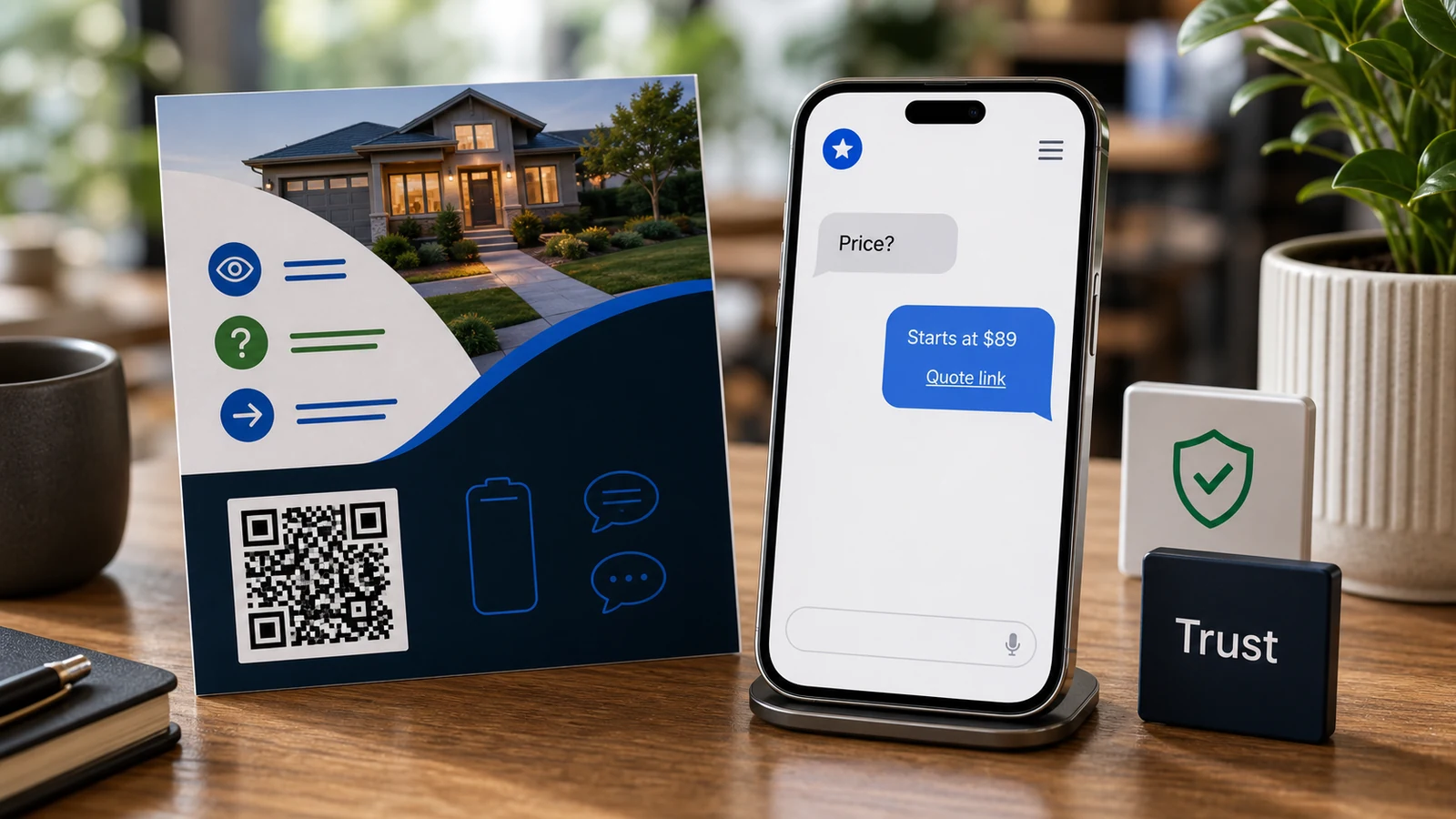
Short version
Watch why flyers get attention but no calls
This short version explains the same core idea: a flyer can get noticed and still fail when the reader's hidden doubts are left unanswered.
- Attention is only the first step.
- Doubt removal is what makes action feel safe.
- The QR destination should answer what the paper cannot.
The Fatal Flaw of Information-Only Flyers
Most small business flyers are built like mini billboards. They try to fit in a logo, headline, discount, service list, phone number, QR code, social handle, photo, address, and maybe a few icons.
That may feel complete to the business owner. To the customer, it often feels incomplete.
The problem is simple: information is not the same as persuasion.
An information-only flyer says:
- Here is our business.
- Here is what we sell.
- Here is our phone number.
- Here is a discount.
A trust-building flyer says:
- Here is the problem we solve.
- Here is why you can believe us.
- Here is what it usually costs or how pricing works.
- Here is what happens next.
- Here is why this step is low-risk.
That difference matters because a flyer is not neutral. When someone receives a flyer, they do not read it like a patient brochure. They read it like an ad from a stranger.
That means the reader is not only asking, "What do they offer?" They are asking, "Can I trust this?"
Google's guidance on helpful, people-first content is written for search, but the same principle applies to print marketing: useful content should help people accomplish a real task. A flyer that only describes the business does less than a flyer that helps the reader decide.
Think of your flyer as a paper salesperson. If a real salesperson walked up and said, "We clean homes. Call us. 20% off," the customer would still have questions. How much? What kind of homes? Who enters my house? Are supplies included? What if I am unhappy? How long does it take? Do I need to be home?
A flyer that cannot answer any of those questions is a silent salesperson. It may announce the offer, but it does not remove the resistance.
The Flyer Conversion Formula
A better flyer starts with a better formula.
Flyer Conversion = Attention x Doubt Removal x Clear Next Step
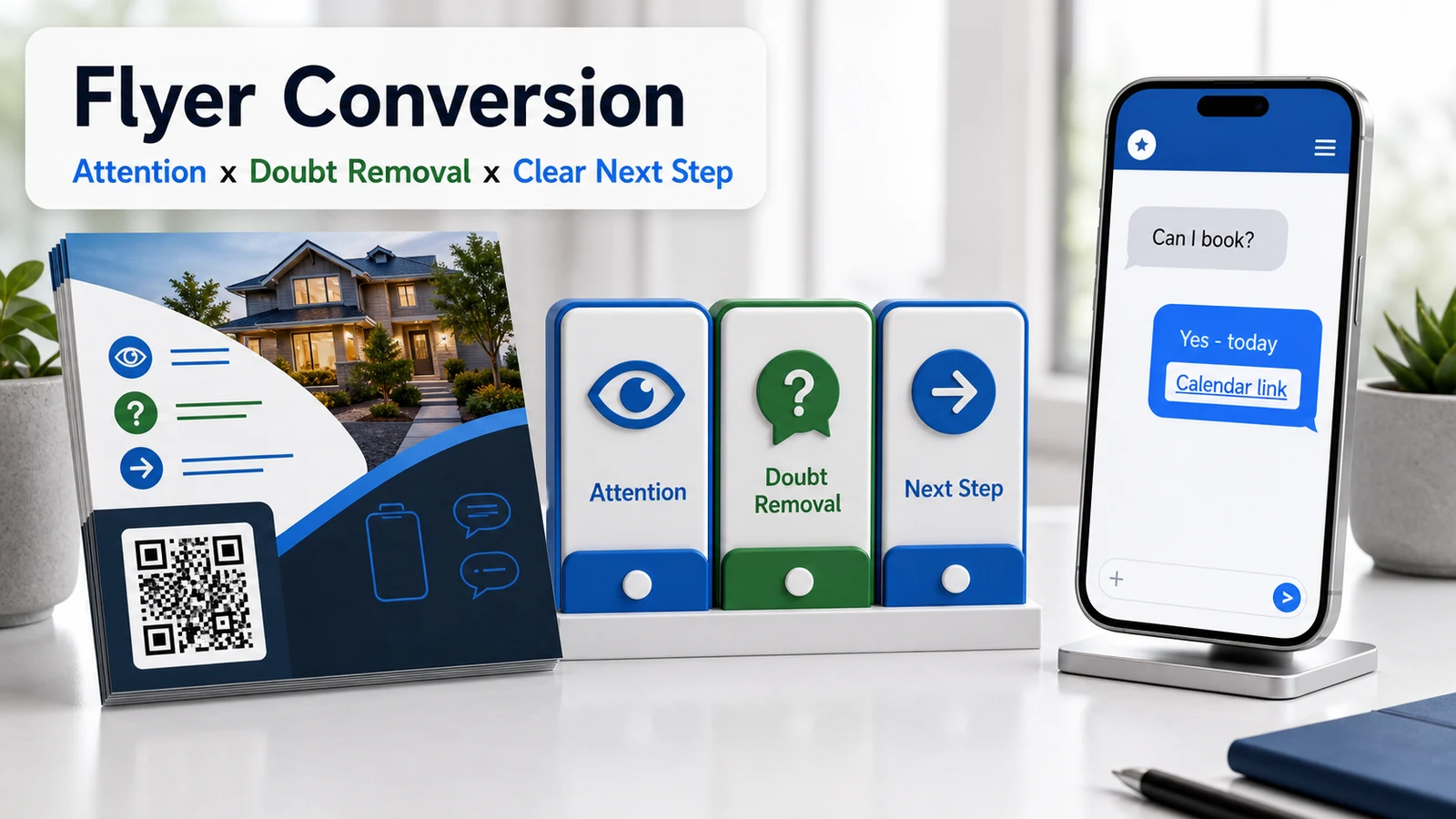
Most flyer design focuses on the first part: attention. Attention is the headline, visual contrast, offer, color, image, size, placement, and first impression. You need it. If nobody notices the flyer, nothing else matters.
But attention alone does not create action.
The reader also needs doubt removal. That is the proof, specificity, pricing clarity, process clarity, reviews, guarantees, business details, and plain-language explanation that makes the offer feel believable.
Then the reader needs a clear next step. Not five possible actions. One obvious move.
- Call for a quote.
- Scan to ask a question.
- Book a consultation.
- Visit this weekend.
- Bring this flyer in.
- Check if we serve your area.
If any part of the formula is weak, flyer conversion drops.
The Friction Factor
There is also a second version of the formula:
Action = Desire / Friction
Desire is the reader's interest. Friction is everything that makes action feel confusing, risky, annoying, or uncertain.
Common flyer friction includes too many offers on one page, unclear price terms, no proof that the business is legitimate, a QR code with no scan promise, no explanation of what happens after a call, cluttered design, no service area, and no reason to trust the business over the next option.
This is why "better design" alone does not always fix a flyer. A prettier flyer can still fail if the reader's doubts remain unanswered.
10 Questions Your Customers Are Secretly Asking
The person holding your flyer may never say these questions out loud. But they are often moving through the reader's mind in seconds.
Use this as your flyer doubt checklist.
1. Is this business real?
A flyer can feel anonymous if it has only a logo, stock image, and phone number. Add trust markers: website, recognizable domain, physical area served, business name, contact method, license or credential when relevant, and a clear way to verify the business.
2. Is this for someone like me?
Vague offers make the reader do the sorting. Say who the service is for: first-time homeowners, busy parents, small offices, local restaurants, new patients, condo owners, event planners, tourists, pet owners, or neighborhood residents.
3. How much will this actually cost?
You may not be able to print a final price for every situation. But you can reduce doubt with a starting price, price range, minimum, estimate process, package example, or "free quote before work begins" language.
4. Are there hidden fees or conditions?
If the offer has limits, say the important ones clearly. The FTC's small business advertising guidance emphasizes that advertising should be truthful, not deceptive, and supported where needed. A flyer should not depend on tiny disclaimers to rescue an exaggerated claim.
5. What happens after I call, scan, or book?
This is one of the most overlooked flyer questions. Tell people what the next step looks like: "Answer 3 questions, get a quote window, choose a time," or "Scan, ask about your project, then book if it fits."
6. Will I be pressured?
Some readers avoid calling because they do not want a sales conversation yet. Reduce that fear with low-pressure next steps: ask a question, check fit, view pricing basics, request an estimate, or see the menu before calling.
7. Has anyone else used this business?
Social proof reduces risk. BrightLocal's 2026 Local Consumer Review Survey reports that reviews remain a major part of how consumers evaluate local businesses, with star ratings, recency, and business responses all shaping trust. If you use reviews on a flyer, keep them accurate and verifiable.
8. Why should I believe the claim?
"Best service in town" is weaker than a specific proof point. Use years in business, certification, local experience, number of completed projects if verified, a review average if current, portfolio examples, before-and-after photos, or a clear process.
9. What if this does not work for me?
Risk reversal can be simple: free estimate, no-obligation consultation, clear cancellation policy, satisfaction policy, transparent scope, or a human handoff for complex questions.
10. Why should I act now instead of later?
Urgency should be real. Seasonal timing, limited appointment windows, event dates, expiring offers, and practical deadlines are valid. Fake scarcity damages trust.
The 5 Pillars of Doubt Removal
A flyer does not need to answer every possible question. It needs to answer the doubts most likely to stop action.
1. Authority
Authority answers: "Who is behind this?" For a small business flyer, authority may come from a license, certification, years of experience, named owner, local specialization, insurance or bonding where relevant, professional association membership, clear contact information, or a recognizable website.
Stanford's web credibility guidelines include similar trust ideas for websites, such as making contact information easy to find and highlighting organizational expertise. A flyer has less space than a website, but the principle is the same: people trust more easily when the source is identifiable and credible.
Weak: Quality work at affordable prices.
Stronger: Licensed local electricians serving North Austin homes since 2014.
2. Social Proof
Social proof answers: "Do other people trust this?" Good flyer social proof can include a current review rating and review count, a short verified review snippet, portfolio image, before-and-after result, or local project examples. Avoid fake reviews, fake ratings, vague "customers love us" claims, or old review numbers that no longer match your public profile.
Weak: Our customers love us.
Stronger: Rated 4.8 stars on Google by local homeowners. Scan to read recent reviews.
Only use a statement like this if it is true and current.
3. Specificity
Specificity answers: "What exactly am I getting?" Generic flyer language creates doubt because the reader has to guess.
Replace "affordable cleaning," "great food," "fast service," "professional team," "new menu," and "best deals" with clearer claims such as "$89 starting price for apartments under 900 sq. ft.," "lunch bowls ready in about 10 minutes," or "scan for today's menu, allergens, and pickup times."
Specificity does not mean overpromising. It means making the offer easier to understand.
4. Risk Reversal
Risk reversal answers: "What happens if I am wrong?" People hesitate when they feel the next step could cost them money, time, privacy, or social discomfort.
Flyers can reduce risk with a free quote, no-obligation estimate, clear consultation length, transparent refund or cancellation terms, "ask before you book," "see pricing basics first," or clear privacy language when collecting information.
Weak: Call now.
Stronger: Scan to ask questions first. Book only if it fits.
5. Process Clarity
Process clarity answers: "What happens next?" This is where many flyers lose interested readers. The business assumes the next step is obvious. The customer does not.
- Scan or call.
- Answer a few fit questions.
- Get pricing basics or an estimate window.
- Choose a time or talk to staff.
Process clarity is especially useful for services that feel intimidating: dental appointments, legal consultations, home repairs, real estate, insurance, financial services, med spas, clinics, and high-ticket local services.
Practical Examples: Bad vs. Better Flyers
These are practical examples, not verified customer case studies. Use them to see how doubt removal changes the message.
| Business type | Weak flyer message | Better flyer message | Doubt removed |
|---|---|---|---|
| Cleaning service | We clean well. Call today. | Apartment cleanings from $89. 1,200+ local homes cleaned. Scan to ask about rooms, supplies, and available days. | Price, proof, process |
| Restaurant | New menu open. | 4.7-star local favorite. Lunch bowls ready in about 10 minutes. Scan for menu, allergens, parking, and pickup. | Trust, speed, logistics |
| Real estate | Open House Sunday. | Tour this Sunday 1-4 PM. Scan for photos, property FAQ, neighborhood notes, and virtual tour. | Details, fit, next step |
| Salon | Book your beauty service. | Not sure what to book? Scan to ask about styles, appointment length, prep, and starting prices. | Service fit, price, pressure |
| HVAC | AC repair discount. | Same-week AC diagnostics in Phoenix. See service area, diagnostic fee, and what happens before a repair quote. | Cost risk, area, process |
| Event | Join us this weekend. | Saturday market, 10 AM-3 PM. Scan for vendor list, parking, dog policy, and weather updates. | Logistics, timing, attendance blockers |
Notice the pattern. The stronger flyer does not simply sound more polished. It answers the reason someone might hesitate.
The Before You Print Checklist
Before you send the flyer to a printer, score it against these questions.
- Does the headline make the reader's problem or desired outcome obvious?
- Does the flyer make one primary offer instead of several competing offers?
- Is the next step clear within three seconds?
- Does the flyer explain what happens after the reader calls, scans, books, or visits?
- Is there at least one real trust signal?
- Is pricing, a starting price, a range, or the pricing process explained?
- Are important offer conditions clear enough to avoid confusion?
- Does the flyer include a low-pressure way to ask a question?
- Is the QR code paired with a specific scan promise?
- Does the QR destination match the flyer message?
- Is the QR code scannable on a printed proof?
- Is the business name, domain, and contact path easy to verify?
- Are claims truthful, specific, and supportable?
- Does the flyer avoid fake urgency, fake testimonials, and exaggerated promises?
- If a customer were skeptical, would this flyer make the next step feel safer?
If you answer "no" to more than three of these, the flyer probably needs more trust before it needs more design.
Audit the doubt before you print
Take one flyer and mark every place where a customer might wonder about price, trust, timing, service fit, pressure, or next steps. Those doubts are not design details. They are conversion blockers.
The Future of Flyers: The Smart Flyer
A printed flyer has one unavoidable limitation: it cannot adapt to the person holding it.
One reader wants price. Another wants parking. Another wants proof. Another wants to know if you serve their ZIP code. Another wants to ask in Spanish, Korean, Japanese, Arabic, or another language. Another is ready to book, but only after they understand the process.
You cannot print every answer.
That is why the next version of flyer marketing is not just a prettier flyer. It is a smart flyer.
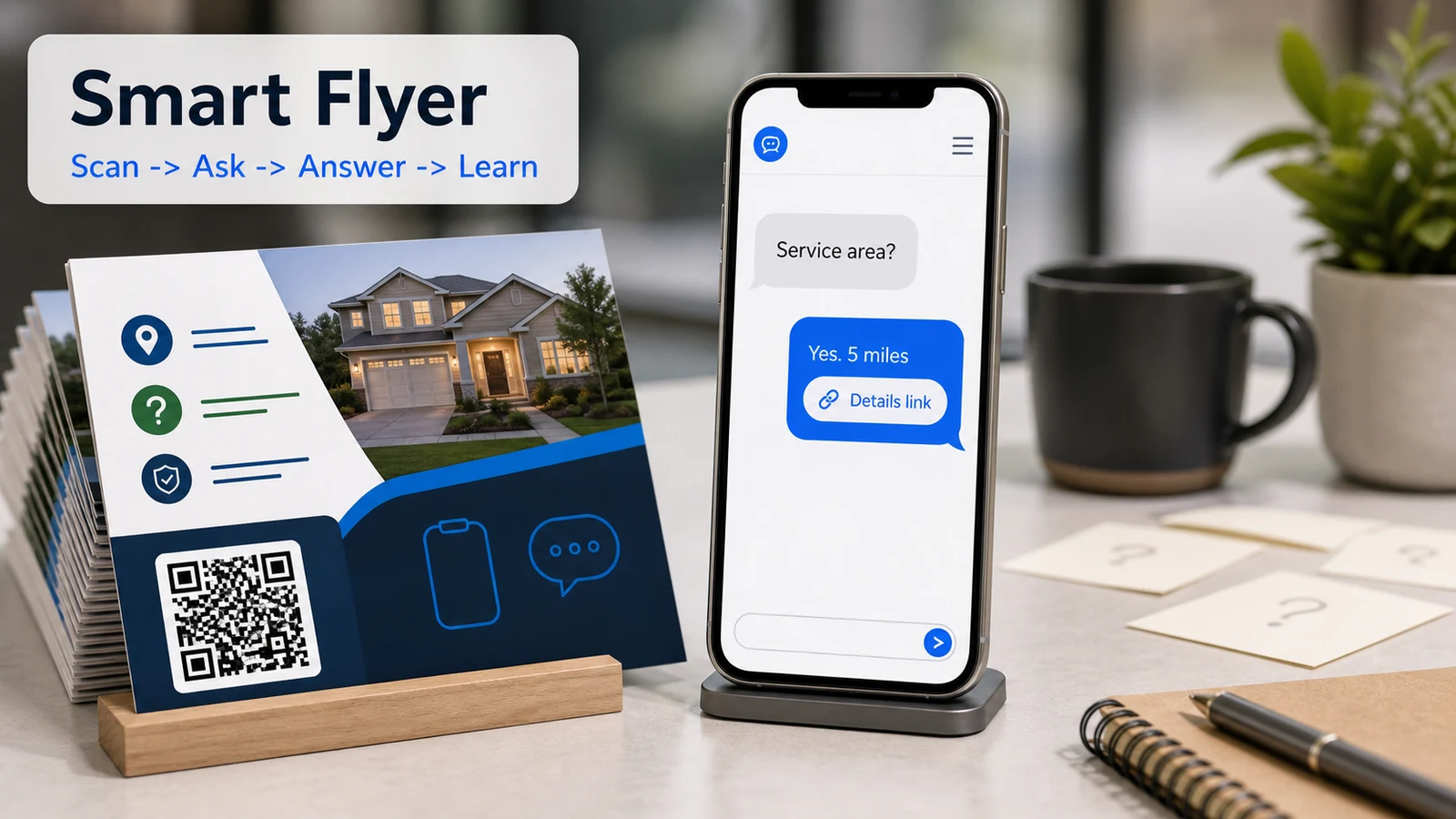
A smart flyer has three layers:
- A printed promise that gets attention.
- Trust signals that reduce the first doubts.
- A QR destination that answers the questions the paper cannot hold.
For many small businesses, RealLink AI can be that QR destination. Instead of sending every scan to a generic homepage, the flyer can open a public AI answer page trained on approved business information.
Customers can ask about services, pricing basics, hours, location, parking, menu items, service area, booking steps, policies, preparation, languages, offers, and next steps.
The important part is control. RealLink AI should answer routine, approved, repeatable questions and route sensitive or final-decision topics to a human. It should not pretend to check live inventory, live appointments, or final quote details unless the business has a supported integration for that.
The second benefit is question data.
When customers ask questions after scanning a flyer, those questions become marketing insight. If many people ask about price, your next flyer needs pricing clarity. If they ask about service area, your distribution or headline may be too broad. If they ask about parking, allergens, appointment length, return policy, or what to bring, that doubt belongs in the next print version.
Smart Flyer = Attention x Doubt Removal x Answered Questions
There is also a trust responsibility with QR codes. The FTC has warned consumers that QR codes can hide harmful links. For legitimate businesses, that means the flyer should make the QR path feel recognizable and safe: use a trustworthy domain, a clear scan promise, and a destination that matches what the flyer promised.
Stop Printing Paper. Start Printing Trust.
Before you print your next flyer, ask one question:
What would a skeptical but interested customer still need to believe before taking the next step?
That answer should shape the flyer more than the decoration.
If the customer needs proof, add proof. If the customer needs price clarity, add price clarity. If the customer needs to know what happens after the call, show the process. If the customer needs to ask a personal question before booking, give them a question path.
The strongest business flyers do not try to say everything. They say enough of the right things to make the next step feel obvious.
Attention gets the flyer noticed. Doubt removal gets the customer moving. A clear next step turns interest into action.
Turn your flyer into a question channel
Create a RealLink AI answer page for one flyer QR code. Let customers scan, ask routine questions, use embedded answer links or the hamburger menu when needed, and show you what doubts are stopping action.
Sources and Further Reading
- Google Search Central: Creating helpful, reliable, people-first content
- FTC: Advertising FAQs, A Guide for Small Business
- Stanford Web Credibility Project: Guidelines for Web Credibility
- BrightLocal: Local Consumer Review Survey 2026
- FTC Consumer Advice: Scammers hide harmful links in QR codes to steal your information
FAQ
Why do business flyers fail?
Business flyers usually fail when they create attention but do not remove enough doubt. A reader may notice the offer and still avoid action because the flyer does not explain price, proof, trust, next steps, service fit, or risk.
What should a flyer include to convert?
A converting flyer should include a clear offer, a specific audience or problem, one primary next step, trust signals, pricing or pricing-process clarity, truthful conditions, and a low-friction way to ask questions or take action.
How do you make a flyer more trustworthy?
Make a flyer more trustworthy by adding specific proof, clear contact details, real reviews or ratings when accurate, credentials where relevant, transparent offer terms, a recognizable website, and a simple explanation of what happens after the customer responds.
Should I put a QR code on a flyer?
Yes, if the QR code has a clear purpose. A flyer QR code should not just say "scan me." It should promise a useful next step, such as asking questions, checking service fit, viewing menu details, booking, reading reviews, seeing full event details, or requesting a quote.
How can RealLink AI help with flyers?
RealLink AI can turn a flyer QR code into a public AI answer page. Customers can scan the flyer, ask routine questions based on approved business information, use embedded answer links or hamburger-menu links when needed, and help the business see which doubts or questions appear most often.