
Texas | After-hours customer service
After-Hours Customer Service for Texas Small Businesses: Phone, Text, or Self-Service?
After-hours coverage is not one product decision. Separate urgent requests, routine questions, live commitments, and next-business-day work, then give each one the lightest channel that can handle it responsibly.
Summary
Choose after-hours customer service by customer task, not by vendor category. Review two to four weeks of calls, voicemails, texts, forms, and email, then classify each request as a stable public question, a live operational check, a judgement call, a complaint, or a genuinely urgent issue. Stable questions can often be answered immediately through a focused page, FAQ, recorded message, or QR destination. Live availability, final quotes, exceptions, complaints, safety matters, and contractual commitments need the current system or an authorised person. The goal is not to make every channel available all night; it is to tell customers what can happen now, what will happen later, and when.
Build the smallest dependable system first. Publish staffed hours and the time zone, record a concise voicemail, offer one useful non-phone path, carry context into the next-business-day handoff, and avoid collecting sensitive or unnecessary details. If the business sends automated texts, treat consent and opt-out handling as design requirements and check current federal and state rules. Run a 30-day pilot before committing to full live coverage. Measure useful first answers, correctly routed urgent requests, repeat contacts, handoff completion, abandoned enquiries, answer corrections, and staff time. Volume alone does not prove that the system helped.

Audit the after-hours demand you actually receive
Before buying an answering service or switching on automation, find out what customers ask outside staffed hours and what outcome each request really needs.
Texas has 3.5 million small businesses according to the U.S. Small Business Administration's 2025 state profile, but an equipment renter in Houston, a commercial maintenance firm in Dallas-Fort Worth, and a manufacturer in El Paso do not share one after-hours pattern. Pull a representative sample from the last two to four weeks. Include missed calls, voicemail, inbound texts, quote forms, email, website searches, social messages, QR-page questions, and notes from staff who answer personal phones. Remove personal details that are not needed for the review, but preserve the customer's wording, local time, channel, requested action, and eventual outcome.
Do not assume that every missed call was a lost sale. Some callers wanted hours, coverage, pickup instructions, document locations, or a way to prepare a quote request. Others needed a current inventory or scheduling check. Some were existing customers changing a job, reporting a problem, disputing a charge, or asking for an exception. A few may have required a prompt human response. The operating decision changes with the task, so count the reason and outcome rather than the ring.
Add the cost of the current failure. Record how often a customer contacts more than once, repeats information to a second person, abandons the enquiry, reaches the wrong employee, or waits for an answer that could have been public. Also record how often staff are interrupted after hours for something that could safely wait. This creates a baseline for a pilot and prevents an impressive call count from being mistaken for useful customer service.
- Sample every channel for at least two typical weeks and include weekends.
- Keep the customer task, local time, channel, answer source, handoff, and outcome.
- Separate new-business enquiries from existing-customer service matters.
- Count repeated contacts and information customers had to repeat.
- Measure the current failure before paying to move it to another channel.
Classify each request by the response it requires
The most useful dividing line is not phone versus digital; it is stable information versus a live commitment, human judgement, complaint, or urgent escalation.
Stable public information is the easiest place to improve. Examples include normal staffed hours, broad service area, standard preparation, accepted equipment types, public document locations, quote requirements, pickup procedures, and the correct contact route. These answers still need an approved source, owner, and review date, but they can often be delivered consistently by voicemail, a focused mobile page, a concise FAQ, or a public question page.
Current operational information requires the source of truth. A rental item may normally be available but already reserved. A field team may usually serve a county but have no capacity on the requested date. A part may be listed but not ready for pickup. Unless the after-hours channel is genuinely connected to the booking, inventory, dispatch, or order system, it should not say booked, confirmed, available, approved, or guaranteed. It can explain the process and gather the minimum information for a later check.
Human judgement covers final quotes, unusual site conditions, custom fit, exceptions, contract changes, complaints, refunds, disputed work, and safety-sensitive questions. A self-service route can identify the correct team and explain what information is useful, but it should not close the matter. Define a separate urgent route only for situations the business is actually equipped and staffed to handle. Never label a general inbox, chatbot, or voicemail as emergency coverage.
| Request class | Typical Texas small-business example | Best first handling |
|---|---|---|
| Stable public fact | Hours, broad coverage, preparation, document location | Recorded message, focused page, FAQ, or public answer page |
| Live operational check | Current stock, crew availability, pickup readiness, booking | Connected system or staff confirmation |
| Judgement or commitment | Final quote, unusual specification, exception, contract change | Authorised human review with context |
| Complaint or dispute | Refund, cancellation, disputed work, damaged item | Published complaint route and accountable person |
| Urgent or safety matter | Time-sensitive risk the business is trained to handle | Dedicated staffed escalation, or clear direction to the appropriate public service |

Compare phone, text, voicemail, and self-service by job
No single channel wins every after-hours situation, so compare them on immediacy, context, promise risk, staffing, accessibility, and data handling.
Live phone coverage is strongest when a caller is anxious, the issue is ambiguous, or a conversation can qualify the next step. It is expensive when most calls ask stable questions, and it creates risk if the person answering lacks authority or current operational data. A call centre or answering service needs a narrow script, escalation rules, business-hour definition, prohibited promises, secure message transfer, quality review, and a named owner. Test its answers against real calls rather than approving a generic script.
Text is convenient for short status updates and next-step links, but it is poor for complex explanations, sensitive details, or ambiguous commitments. Inbound text can preserve a written thread; outbound automated text introduces consent, identification, frequency, and opt-out obligations that need deliberate design. Email and forms suit less urgent work and structured quote preparation, but customers need a visible response target. Voicemail is still useful when it gives a direct message, hours, one alternative route, and a realistic callback window.
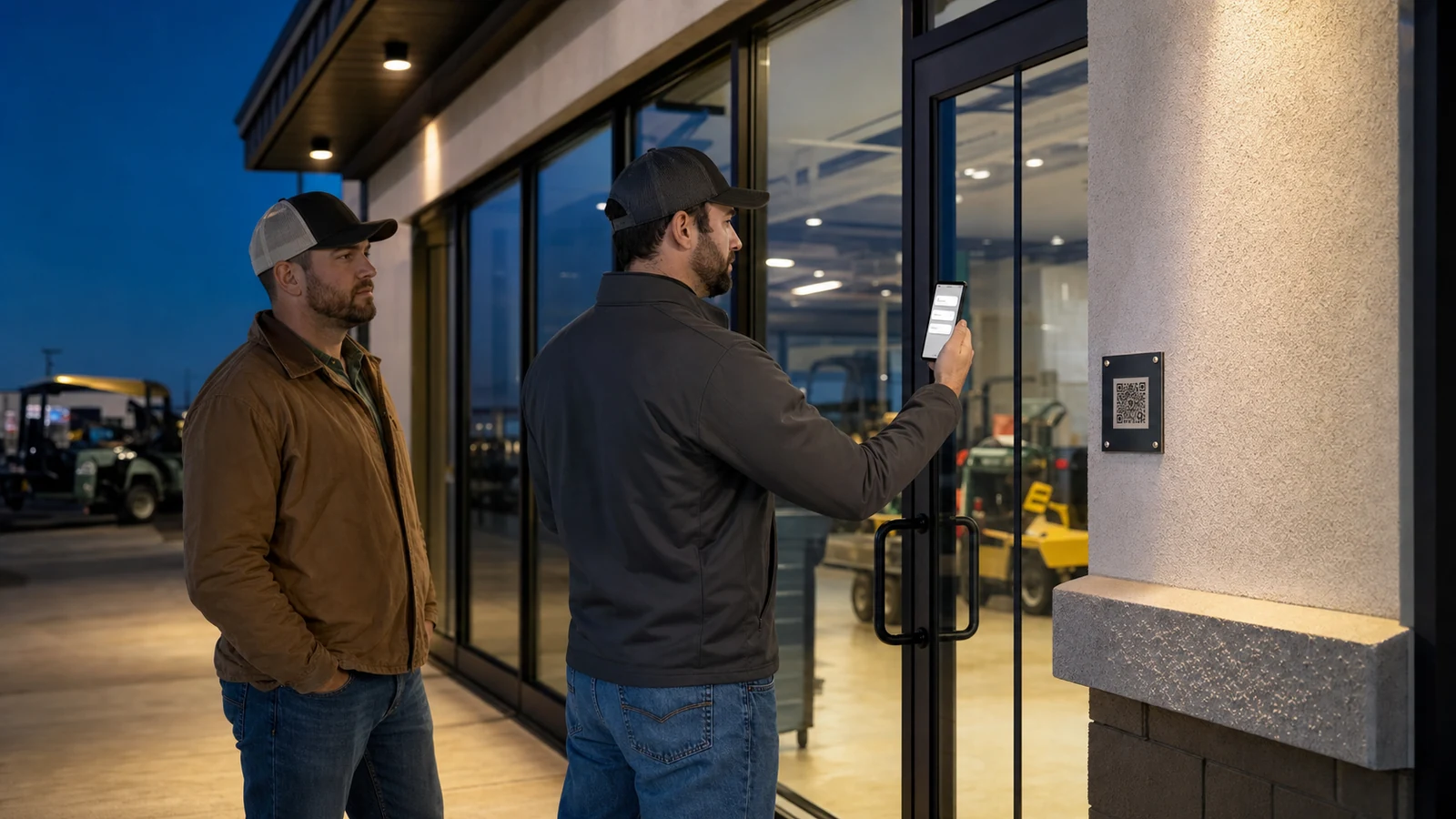
Self-service is strongest for stable public information that customers may ask in many ways. A focused page can work from a website link, QR sign, vehicle, business card, email signature, or voicemail message. It should make uncertainty visible and hand off unresolved questions with useful context. It does not replace live phone coverage when urgency, emotion, accessibility, identity verification, or authorised judgement makes a person necessary.
| Channel | Best for | Main weakness | Control to add |
|---|---|---|---|
| Live phone or answering service | Ambiguity, reassurance, qualification, staffed escalation | Cost and inconsistent promises | Approved script, authority limits, call review, secure handoff |
| Voicemail and callback | Low volume and next-business-day work | Unclear waits and missing context | Specific response window and alternative link |
| Two-way text | Short updates and simple next steps | Consent, opt-out, context, and sensitive-data risk | Clear identity, lawful consent, STOP handling, short retention |
| Form or email | Structured quote preparation and non-urgent detail | Slow feedback and duplicate questions | Confirmation, required-field discipline, response target |
| Focused self-service | Stable questions and preparation guidance | Cannot make live commitments by itself | Approved sources, review dates, visible human route |
Design phone coverage around authority and handoff
The person who answers needs to know what they may say, what they may collect, when they must stop, and exactly where the request goes next.
Write a one-page authority map before evaluating vendors. List the facts any responder may provide, the questions that require the current system, the commitments only named roles may make, and the conditions that trigger an escalation. Include what the responder must never request or record. A friendly conversation is not useful if it creates an unapproved price, booking, dispatch, refund, or safety promise.
Create short scripts from real customer language. Start with business identity and the fact that the line is being answered outside normal staffed hours. Ask only enough to identify the task and next step. Repeat the response window in absolute terms, such as by 10 a.m. Central Time on the next staffed business day, rather than saying soon. Give the caller a reference only when the actual case system creates one. Do not imply that a message has been reviewed by a technician, manager, or dispatcher when it has merely been recorded.
Test the handoff, not just the greeting. Send sample calls for a new quote, an existing order, a complaint, an uncertain product question, an accessibility need, and an urgent matter outside the service's scope. Confirm that each lands in the right queue with accurate context and no invented answer. Review recordings or transcripts only under a clear notice and retention policy, limit access, and remove old material when it no longer serves the stated purpose.
- Define approved facts, live-data checks, authorised promises, and prohibited topics.
- State that the interaction is after hours and identify the business clearly.
- Use an exact callback window with the business time zone.
- Test difficult handoffs before sending real customers through the workflow.
- Review vendor access, recording, transcript, retention, and deletion controls.
Use text for convenience without turning it into unwanted outreach
A text workflow should distinguish a customer-initiated conversation from automated promotional or reminder messages and make stopping future messages easy.
Begin with the narrow operational use case. A caller may choose to receive a link to public hours, quote preparation, or a secure contact form. An existing customer may ask for the correct support route. Keep the first message useful, identify the business, and avoid asking the customer to send passwords, payment card data, confidential documents, precise location, or sensitive personal information by ordinary text. Move protected matters to an appropriate channel.
Federal rules for robocalls and robotexts can depend on the technology, purpose, consent, and relationship. The Federal Communications Commission has confirmed that consumers can revoke consent through reasonable means and identifies common reply words such as STOP, QUIT, END, REVOKE, OPT OUT, CANCEL, or UNSUBSCRIBE for automated texts. Do not treat an existing phone number, prior purchase, or inbound call as blanket permission for every automated campaign. Build consent records, suppression, sender identification, and opt-out processing before scale, and obtain appropriate advice for the actual programme.
Separate service communication from marketing. A requested link or case update should not quietly enrol the person into recurring promotions. State expected frequency when messages will continue, keep the content tied to the disclosed purpose, and test whether opt-outs are honoured across every sending system and vendor. A human reply channel also needs coverage rules; two-way texting that no one monitors after hours merely creates a different kind of missed contact.
- Identify the business and the reason for the message.
- Keep service messages separate from marketing enrolment.
- Store the consent source and honour reasonable revocation requests.
- Do not collect sensitive or payment information through ordinary text.
- Publish when two-way replies are monitored and what happens after hours.
Build self-service for questions that do not need a live call
A useful after-hours page gives a direct answer from approved information, shows its limits, and offers the correct next step without pretending to be staffed.
Start with the ten to twenty stable questions that dominate the audit. Write each answer in three layers: the direct public fact, the conditions or boundary, and the next step. Put the most common tasks on the first screen. A customer outside a closed storefront may need staffed hours, coverage, pickup rules, preparation, accessibility information, and the correct next-business-day route. A B2B buyer holding a product sheet may need specifications, compatible uses, document links, and quote requirements.
Use the same approved source across the website, voicemail, QR page, email template, and answering-service script. Give every answer an owner and review date. If the source conflicts with another document, stop and resolve the conflict rather than letting automation choose. Say that staff confirmation is required whenever the answer depends on current inventory, scheduling, dispatch, weather, site conditions, or final price.
Make a person reachable. Offer a phone number during staffed hours, a concise form for non-urgent follow-up, and a clearly described escalation route where the business genuinely provides one. Carry the customer's question and chosen topic into the handoff so they do not begin again. If a public AI answer page is used, test paraphrases, misspellings, short questions, and unsupported requests. Review failed answers as source gaps rather than simply generating longer responses.
- Answer stable public questions first and show the source boundary.
- Place staffed hours and the next human response window near the top.
- Never claim live availability, dispatch, booking, or final pricing without verification.
- Carry the original question into the follow-up route when appropriate.
- Test unsupported questions and make uncertainty explicit.
Publish a response promise customers can interpret
Replace vague words such as soon and tomorrow with staffed hours, a named time zone, a channel-specific target, and an honest exception for holidays or unusual demand.
Texas businesses often serve customers across a large geography, and some also work with national suppliers or buyers. State the business time zone anywhere timing matters. List staffed days and hours, define what counts as a business day, and explain the public-holiday rule. Use an exact boundary such as messages received after 5 p.m. Central Time are reviewed from 8 a.m. on the next staffed business day. Adjust the wording to the real operation rather than borrowing a template.
Set different promises for different work. A stable question can be answered immediately. A simple callback may be targeted for the next staffed morning. A site-specific quote may need two business days after all required information arrives. A complaint may receive an acknowledgement first and a separate review update. If an answering service can only take a message, say that; do not let answered be confused with resolved.
Build a capacity trigger. When severe weather, seasonal demand, a holiday closure, or staff shortage changes the expected response, update the voicemail, public page, form confirmation, and text automation together. A stale promise creates extra follow-ups and erodes trust. Keep one owner responsible for the published status and one fallback message that can be activated quickly without making unsupported emergency claims.
| Element | Clear version | Avoid |
|---|---|---|
| Staffed window | Monday-Friday, 8 a.m.-5 p.m. Central Time | We are usually available |
| After-hours acknowledgement | Received now; reviewed from 8 a.m. next staffed day | Someone will get back to you soon |
| Live commitment | Availability requires confirmation in the booking system | This should be available |
| Holiday or surge | Current review target is two staffed business days | Normal response times apply |
| Urgent boundary | This channel is not monitored for emergencies | Contact us anytime |
Collect less customer data and keep control of the handoff
After-hours tools create records when supervision is thin, so minimise collection, restrict access, document vendors, and delete information that no longer serves the stated purpose.
Ask for the minimum needed to route the task. A public hours question needs no identity. A quote may need a business name, contact route, service location at an appropriate level, and project context, but it may not need a precise home address or photographs at the first step. Explain why each field is requested and keep optional fields optional. Do not place sensitive information in shared voicemail notifications, unprotected email forwards, team text threads, or public AI prompts.
The Texas Data Privacy and Security Act took effect July 1, 2024. The Texas Attorney General explains that many small businesses are generally exempt, while a small business that sells sensitive data must first obtain consumer consent. The Act also establishes broader duties for covered controllers, including purpose-related collection limits, privacy notices, security practices, processor contracts, and consumer rights. Applicability depends on the business and processing, so use the official guidance and qualified advice rather than assuming a small-business label settles every question.
Map every vendor in the after-hours path: phone carrier, answering service, recording or transcription provider, SMS platform, form, analytics system, AI provider, email, and CRM. Record what each receives, where it is processed, who can access it, how long it stays, how deletion works, and what happens at contract end. Use separate accounts, least-privilege access, multifactor authentication, and a tested offboarding process. A cheap service is costly if the business cannot retrieve or delete customer records.
- Collect no identity for public information that does not require it.
- Explain the purpose of each field and keep optional data optional.
- Map vendors, recordings, transcripts, storage, access, retention, and deletion.
- Protect administrative accounts with multifactor authentication.
- Check current Texas and federal requirements for the actual data flow.
Run a 30-day pilot before buying full coverage
Pilot one business line and one after-hours window long enough to observe real demand, then compare outcomes with the original baseline.
Choose a bounded pilot, such as weekday evenings for one service line or weekend enquiries for one location. Keep current phone access, add a concise voicemail and one self-service route, and use live coverage only for the request classes that truly need it. Train the receiving staff and prepare correction and escalation paths before launch. Do not redesign every customer channel at once; you need to know which change produced the result.
Review a small sample twice a week. Was the first answer useful? Did the system identify uncertainty? Did live-data questions wait for confirmation? Did complaints and urgent matters reach the right person? Did customers repeat their details? Were automated texts expected and stoppable? Did the source answer the question, or did staff privately invent another version? Correct the source and routing rules during the pilot rather than polishing superficial wording.
At day 30, compare outcomes and operating cost. A successful pilot may justify broader self-service, a better callback system, selective live phone coverage, or a combination. A failed pilot may reveal that the business has inconsistent information, unclear ownership, or an unreliable handoff rather than insufficient automation. Fix the underlying process before adding more channels.
| Measure | What it reveals | Misleading substitute |
|---|---|---|
| Useful first answer | Whether the customer could progress | Total conversations or page views |
| Correct urgent routing | Whether risk reached the staffed path | Calls answered |
| Repeat-contact rate | Whether expectations and answers were clear | Average message length |
| Handoff completion | Whether context reached the right owner | Form submissions alone |
| Correction and stale-source rate | Whether knowledge remains dependable | Number of FAQ entries |
| Staff time and coverage cost | Whether the operating model is sustainable | Vendor price without internal effort |
Use this implementation checklist
The plan is ready when customers can tell what is available now, staff know what happens next, and the business can audit every promise and data path.
Assign one operating owner, one content owner, and one privacy or security contact. The roles can belong to the same person in a very small company, but the responsibilities should be explicit. Publish staffed hours and time zone, approve the authority map, identify the source for each stable answer, write the voicemail, configure the alternative path, test accessibility, and document every vendor before the pilot begins.
Give staff a short launch brief. It should show request classes, response targets, prohibited promises, escalation contacts, where to record corrections, and how to respond when the customer shares information that should not be in the channel. Include an outage plan for the phone provider, QR destination, text platform, form, and CRM. Keep a typed web address beside any QR code so the information remains reachable when scanning fails.
Set a monthly review after the pilot. Retire obsolete answers, inspect public QR codes, test phone and text routes, review permissions, delete expired records, and examine newly repeated questions. Customer questions are evidence about what the business has not explained clearly. The strongest after-hours system improves daytime instructions, sales materials, product documentation, and handoffs instead of merely absorbing more contact.
- Audit real requests and establish the outcome baseline.
- Classify stable facts, live checks, judgement, complaints, and urgency.
- Publish staffed hours, time zone, response targets, and channel boundaries.
- Approve sources, scripts, authority limits, vendors, and data retention.
- Pilot a narrow workflow, review samples, and expand only after useful outcomes improve.
Sources and official guidance
- U.S. Small Business Administration Office of Advocacy: Texas 2025 Small Business Profile
- Federal Communications Commission: Rules for revoking robocall and robotext consent
- Texas Attorney General: Texas Data Privacy and Security Act
- Cybersecurity and Infrastructure Security Agency: Cyber guidance for small businesses
This article is operational guidance, not legal, privacy, safety, or compliance advice. Check current requirements and professional obligations for the business, location, and customer journey before implementation.
FAQ
Does every missed after-hours call require a live answering service?
No. First identify the task and outcome. Stable public questions may be handled by voicemail or self-service, while live operational checks, complaints, unusual requests, and urgent matters may need a connected system or authorised person. Buy live coverage for the request classes that benefit from conversation and prompt escalation.
What should a Texas small-business voicemail say after hours?
Identify the business, state the staffed days and hours with the time zone, explain when messages are reviewed, offer one useful alternative route, say what information to leave, and state clearly if the line is not monitored for emergencies. Keep the recording current during holidays or unusual demand.
Can self-service confirm a booking, dispatch, or current stock?
Only when it is genuinely connected to the current system and authorised to make that commitment. Otherwise it should explain the process, collect minimal preparation details, link to the official system, or state that staff confirmation is required.
Can a business automatically text everyone who calls after hours?
Do not assume an inbound call or known phone number creates permission for every automated text. The legal position depends on the technology, purpose, consent, and relationship. Identify the business, keep the message tied to the requested purpose, store consent where required, and honour reasonable opt-out requests.
Does the Texas Data Privacy and Security Act apply to every small business?
The Texas Attorney General says small businesses are generally exempt, except that a small business must obtain consent before selling a consumer's sensitive data. Other state or federal rules and contractual duties may still apply, and the business may not qualify as small for every purpose. Check the current official guidance for the actual data flow.
What should an after-hours pilot measure?
Measure useful first answers, correct urgent routing, repeat contacts, abandoned enquiries, handoff completion, customer repetition, source corrections, stale information, staff time, vendor cost, and whether response promises were kept. Call or conversation volume alone is not a customer outcome.
Last updated
Last updated: 2026-07-22. Country, privacy, platform, and pricing details should be rechecked before implementation.
Compare the broader after-hours service options
Use the general decision guide to compare live answering, AI phone tools, callbacks, and customer self-service before choosing a provider.