
Venue-based exhibitor question capture
Canton Fair Complex Exhibitor Guide: Capturing Export Buyer Questions Beyond Business Cards
A practical guide for exhibitors at Canton Fair Complex who need to turn export sourcing traffic, catalog scans, sample requests, MOQ conversations, OEM/ODM questions, and country-by-country buyer intent into follow-up data.
Summary
At Canton Fair Complex, the strongest lead signal is not the business card. It is the buyer question about MOQ, samples, OEM packaging, delivery, certificate proof, country shipping, distributor rights, or product comparison.
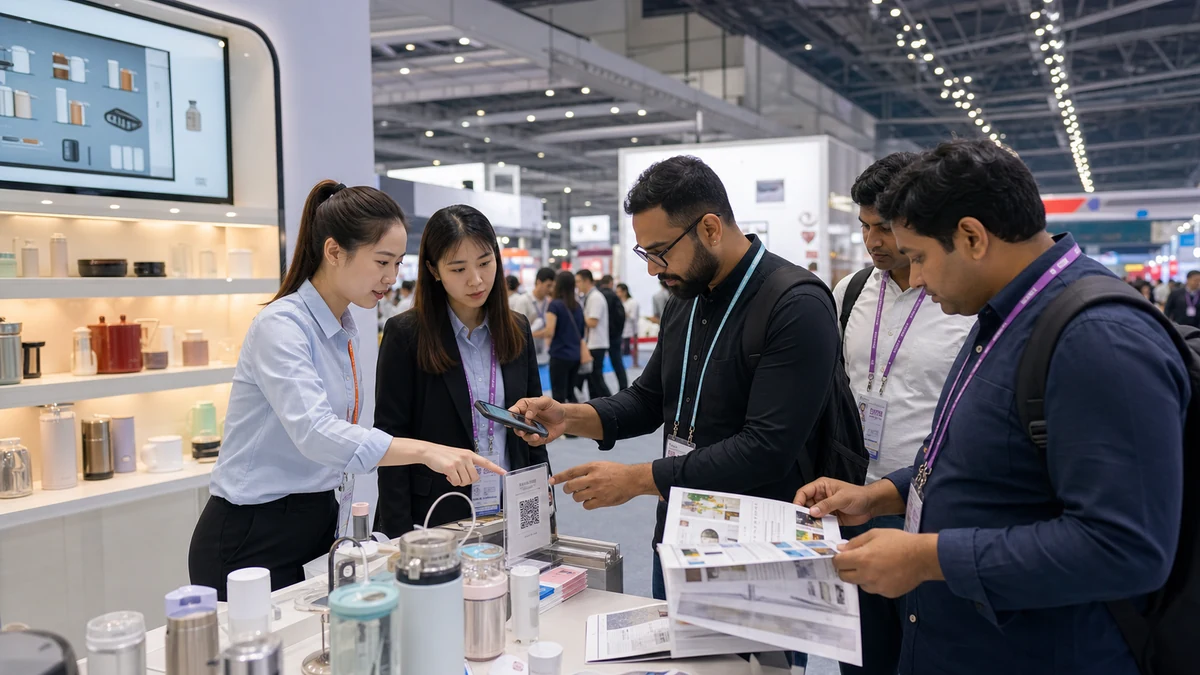
Why Canton Fair Complex exhibitors should think beyond business cards
The official Canton Fair introduction describes the China Import and Export Fair as a comprehensive international trade event with the longest history, largest scale, most complete product variety, broad buyer distribution, and the best transaction results in China. That reputation attracts buyers who are actively comparing suppliers, not only browsing a show floor.
For exhibitors, this creates a very specific problem. A badge scan or business card shows that a buyer passed the booth, but it does not show what the buyer was trying to decide. The valuable detail is hidden in questions such as 'What is the MOQ?', 'Can you do OEM packaging?', 'Can I get samples?', 'Do you ship to my country?', or 'Can you send the certificate after the fair?'
A strong Canton Fair plan captures those questions at the moment they appear, then uses them after the show to prioritize which buyers need samples, quotes, technical documents, packaging options, distributor discussion, or a second meeting.
Where buyer questions disappear at Canton Fair Complex
Questions disappear when booth conversations, catalog scans, sample requests, interpreter notes, country needs, and late-night supplier comparisons are not connected to one follow-up record.
Canton Fair buyers often move quickly. They compare many suppliers in the same category, collect catalogs, take photos, ask for sample rules, and review options later with a purchasing team. A sales team may remember the buyer's name, but forget whether the buyer cared about price tier, lead time, OEM color, carton size, certification, local distributor terms, or port of shipment.
The leak is bigger for multi-product exhibitors. If every product uses the same homepage QR, the team cannot tell which catalog page, sample, product line, or export question created the real interest. A buyer who scans from a sample label should not be treated the same as someone who scans a general brochure.
The fix is not more paper. It is a clearer question capture workflow: product-specific answer points, sample-specific follow-up, country notes, and a daily review of repeated questions.
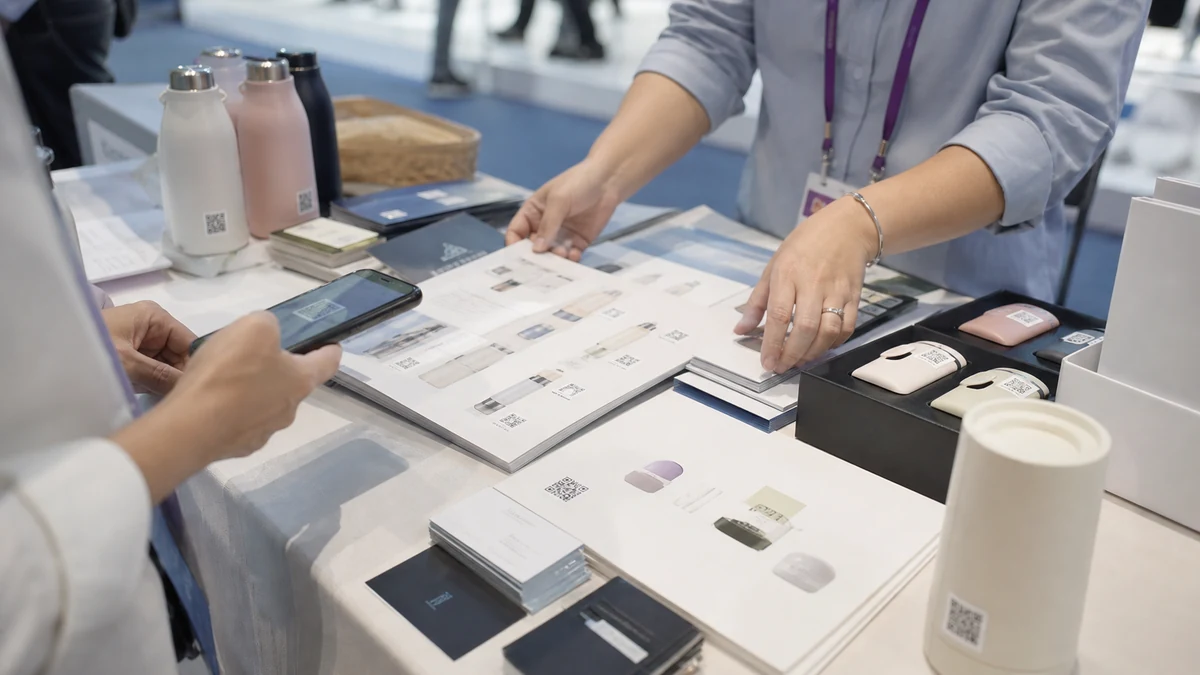
Best QR placements for Canton Fair Complex exhibitors
The best Canton Fair QR map separates booth entry, product category, catalog page, sample label, OEM/ODM sheet, certification proof, distributor packet, and post-show email.
A single QR code near the booth logo is too vague for a sourcing event. Buyers need fast answers at different decision moments. The booth-front QR can qualify category interest. Product tags can capture item-level demand. Catalog page QR codes can answer details after the buyer leaves the booth. Sample label QR codes can preserve which sample a buyer evaluated.
Add QR points to OEM/ODM packaging sheets, certification folders, price-range sheets, distributor materials, and post-show emails. Each destination should answer the immediate question and preserve context for the team: product, buyer country, requested proof, sample interest, quantity range, and next owner.
This is where RealLink AI fits naturally. Instead of sending every scan to a static homepage, exhibitors can make public AI answer pages for booth signs, product samples, catalog pages, and follow-up links so buyers can ask practical questions during and after the fair.
Buyer questions Canton Fair exhibitors should capture
The most useful Canton Fair lead signals involve MOQ, sample process, OEM/ODM support, private label packaging, certification, shipping country, payment terms, distributor rights, product comparison, and quote timing.
Before the fair opens, define your expected question categories. Consumer goods buyers may ask about packaging, color options, carton dimensions, shelf display, retail readiness, barcode support, and sample kits. Industrial buyers may ask about technical specifications, spare parts, warranty, installation, quality testing, and lead time.
Importers may ask for certificates, customs documents, HS code guidance, port options, shipping constraints, and payment terms. Distributors may ask about exclusivity, territory protection, margin, marketing support, minimum annual order, and whether the brand already has a partner in their market.
Treat serious questions as buying signals. A visitor asking for MOQ, sample shipping, country documents, or OEM terms is usually deeper in evaluation than a visitor who only takes a catalog.
| Question category | Example buyer question | What it reveals |
|---|---|---|
| MOQ and price | What is the MOQ for this model, and does the price change by quantity? | The buyer may be planning a first order or price comparison. |
| Samples | Can you send samples to my country, and how long does it take? | The buyer wants physical evaluation before commitment. |
| OEM/ODM | Can you change color, packaging, logo, material, or bundle configuration? | Customization or private label potential. |
| Certification | Do you have test reports, certificates, or export documents? | Trust, compliance, or procurement approval signal. |
| Distribution | Do you already have an exclusive distributor in our market? | Channel strategy and territory discussion. |
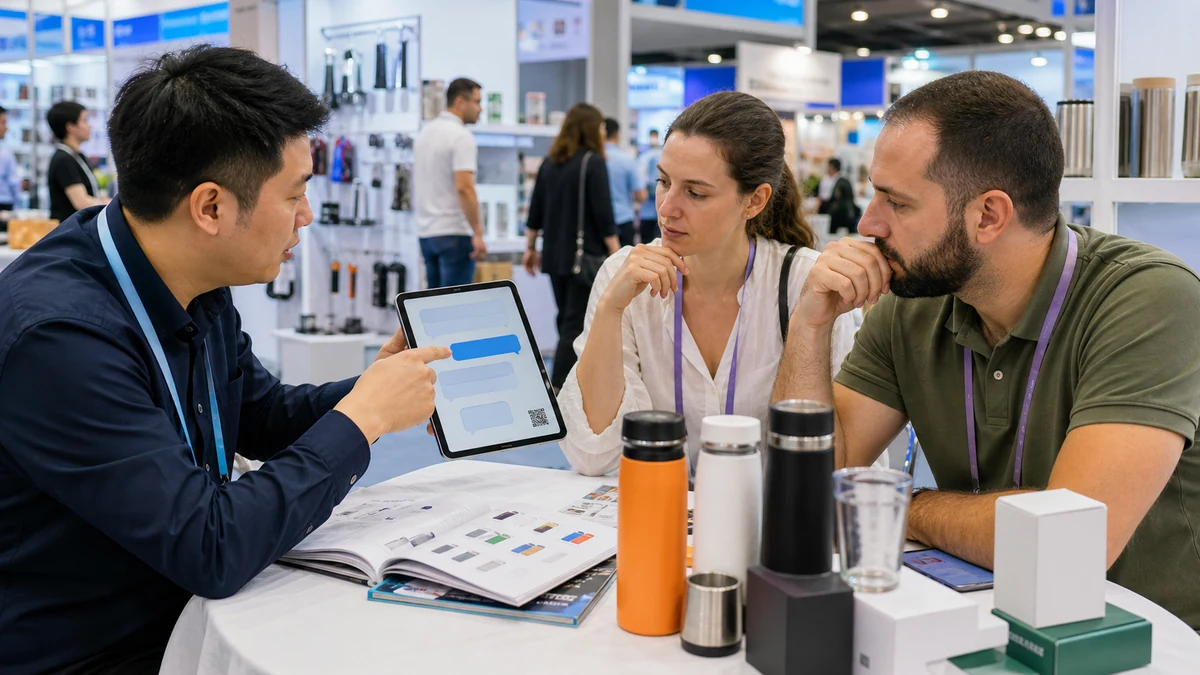
Question-matched proof checklist
A useful Canton Fair follow-up matches proof to the exact question: MOQ tables for quantity questions, samples for evaluation, certificates for trust, and OEM/ODM examples for customization.
Prepare proof before the booth opens. Your team should know where to find product specifications, MOQ ranges, sample policy, packaging options, color and material limits, certificate files, test reports, export case examples, shipping notes, warranty terms, and distributor criteria.
Separate public proof from controlled proof. Some materials can be shown to any buyer; others may require manager approval, legal review, NDA, compliance review, or technical owner confirmation. Booth staff should not promise documents they cannot send.
The strongest follow-up begins with the buyer's question: 'You asked about MOQ for the stainless model and OEM color packaging. Here are the MOQ range, sample process, and packaging options we discussed.'
- MOQ ranges, price-tier logic, lead-time ranges, quote workflow, and owner for commercial approval.
- Sample policy, sample cost rules, shipping constraints, packaging method, and sample tracking owner.
- OEM/ODM examples, private label options, color and material limits, packaging templates, and design approval steps.
- Certificates, test reports, product specifications, safety notes, customs or export document guidance, and quality owner.
- Distributor criteria, territory policy, exclusivity limits, marketing support, annual order expectations, and channel owner.
Post-show follow-up using buyer questions
After Canton Fair, follow-up should be prioritized by product category, buyer country, quantity range, sample request, OEM/ODM fit, proof request, distributor potential, and urgency.
A generic thank-you email is weak after a major sourcing fair. Buyers compare many suppliers, so the first follow-up should remind them of the exact question and next step. Mention the sample they handled, the catalog page they scanned, the quantity they discussed, the packaging option they requested, or the certificate they wanted.
Segment leads into practical lanes. Sample and MOQ questions go to sales operations. OEM packaging questions go to product or design owners. Certificate and compliance questions go to quality owners. Distributor territory questions go to channel owners. Technical questions go to specialists.
Late scans matter. A buyer may scan from a hotel, airport, office, or internal procurement meeting after the fair. Those scans reveal which products survived the comparison process and deserve fast follow-up.

How RealLink AI can help
RealLink AI turns Canton Fair booth, catalog, sample, OEM/ODM, certification, distributor, and post-show QR scans into multilingual buyer Q&A and product-level intent data.
A business card tells you who visited. A buyer question tells you what they are trying to buy, what blocks the order, and which proof they need. At Canton Fair, that question may reveal MOQ seriousness, country demand, sample readiness, OEM potential, technical risk, or distributor interest.
With RealLink AI, exhibitors can create public AI answer points for booth signs, product displays, catalog pages, sample labels, packaging sheets, proof folders, distributor packets, and post-show links. Visitors ask in their own language, receive answers based on approved company information, and the team can review question patterns after the fair.
RealLink AI does not replace pricing decisions, legal review, export compliance, customs advice, payment negotiation, or sales ownership. It keeps repeated answers available and prevents high-intent buyer questions from disappearing in the noise of a large sourcing event.
Sources and quality note
This guide uses official Canton Fair and Canton Fair Complex references, then turns those venue facts into practical exhibitor workflow guidance.
Always adapt this guidance to the official exhibitor manual, organizer rules, booth construction guidance, contractor deadlines, freight rules, customs constraints, safety requirements, privacy rules, and document approval workflow.
Canton Fair official introduction | Canton Fair official website | Canton Fair Complex venue operator | UFI Global Exhibition Industry Statistics
Related Canton Fair planning guides
Use these guides to connect venue preparation, buyer questions, and follow-up.
FAQ
Why should Canton Fair exhibitors capture buyer questions?
Because questions reveal buying intent: MOQ, samples, OEM/ODM needs, country demand, certificates, distributor interest, and follow-up priority.
Where should QR codes be placed?
Use booth entry, product tags, catalog pages, sample labels, OEM/ODM sheets, certification folders, distributor packets, and post-show emails.
What is the most important follow-up detail?
Reference the buyer's exact question and product context, not only the fact that you met at the fair.
Can RealLink AI answer in multiple languages?
RealLink AI can support multilingual buyer questions when configured with approved business information in the relevant languages.
Does RealLink AI replace export sales work?
No. It captures and organizes buyer questions. People still handle pricing, contracts, compliance, shipping, distributor negotiation, and account ownership.
Last updated
Last updated: 2026-06-18.
Turn Canton Fair scans into buyer-question data
Want booth, catalog, sample, or OEM/ODM QR scans to answer buyer questions during and after the fair? Create a RealLink AI answer point.