
QR Code Ideas for Real Estate Yard Signs
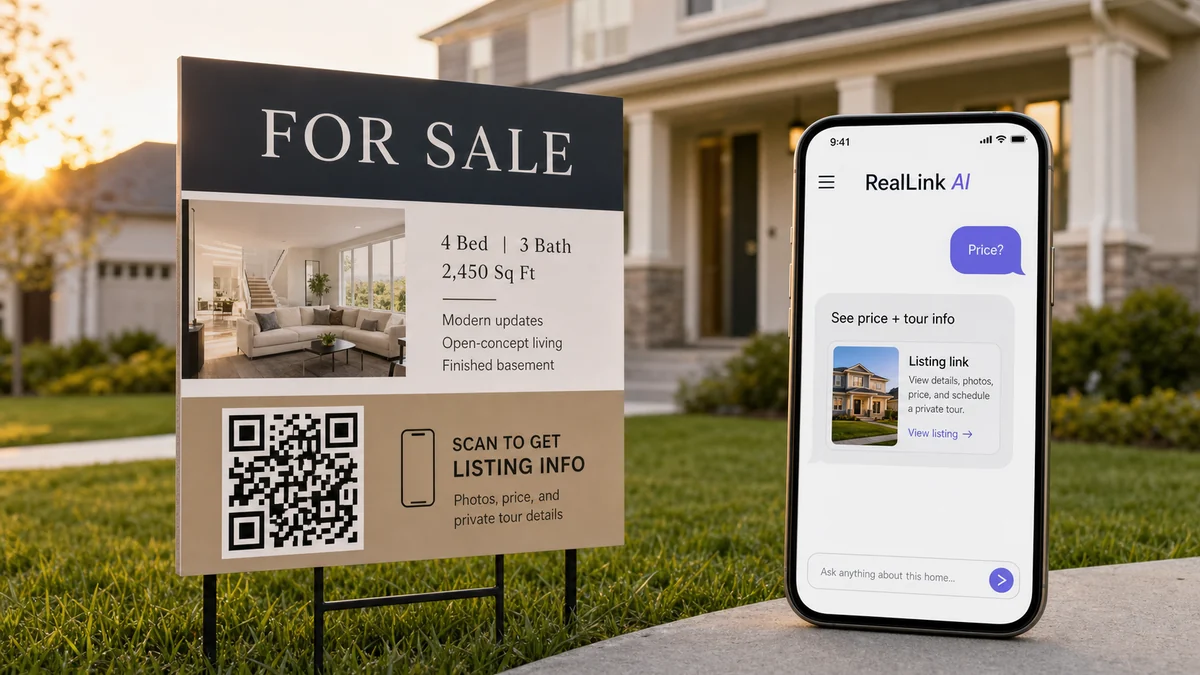
A QR code on a real estate yard sign should not just send people to a homepage. It should answer the question the buyer had when they stopped, scanned, or slowed down in front of the property.
TL;DR
A real estate yard sign QR code works best when it opens a mobile page built for the curbside moment. Buyers are usually asking: How much is it? Can I tour it? Is it still available? What does the inside look like? Who do I contact? A basic QR code can link to a listing page, virtual tour, or form. A stronger setup sends scanners to an AI answer page that answers property questions, shows links or video inside the answer, and keeps agent contact options in a simple menu. A QR code is not the strategy. The answer after the scan is.
What are the key takeaways?
| Takeaway | What it means for yard signs |
|---|---|
| The scan moment is high intent. | Someone near the property already has context and curiosity. |
| The QR destination matters more than the QR code. | A code that opens a weak page wastes attention. |
| Buyers want answers before forms. | Asking for contact info too early can create friction. |
| Mobile clarity wins. | The page after the scan must be fast, readable, and specific. |
| Compliance still matters. | Broker, MLS, local sign, and advertising rules should be reviewed. |
What should a QR code on a real estate yard sign do?
A real estate yard sign QR code should send buyers to the most useful next answer, not the most generic page. At minimum, it should help people see listing details, photos, tour options, open house timing, agent contact paths, and property-specific FAQs from a phone while standing near the home.
Good QR destinations include a mobile listing page, virtual tour, open house page, property FAQ, showing request page, or AI answer page trained on property details. The goal is not to make the sign look modern. The goal is to keep the buyer's curiosity alive.
Why do real estate yard sign QR codes often disappoint?
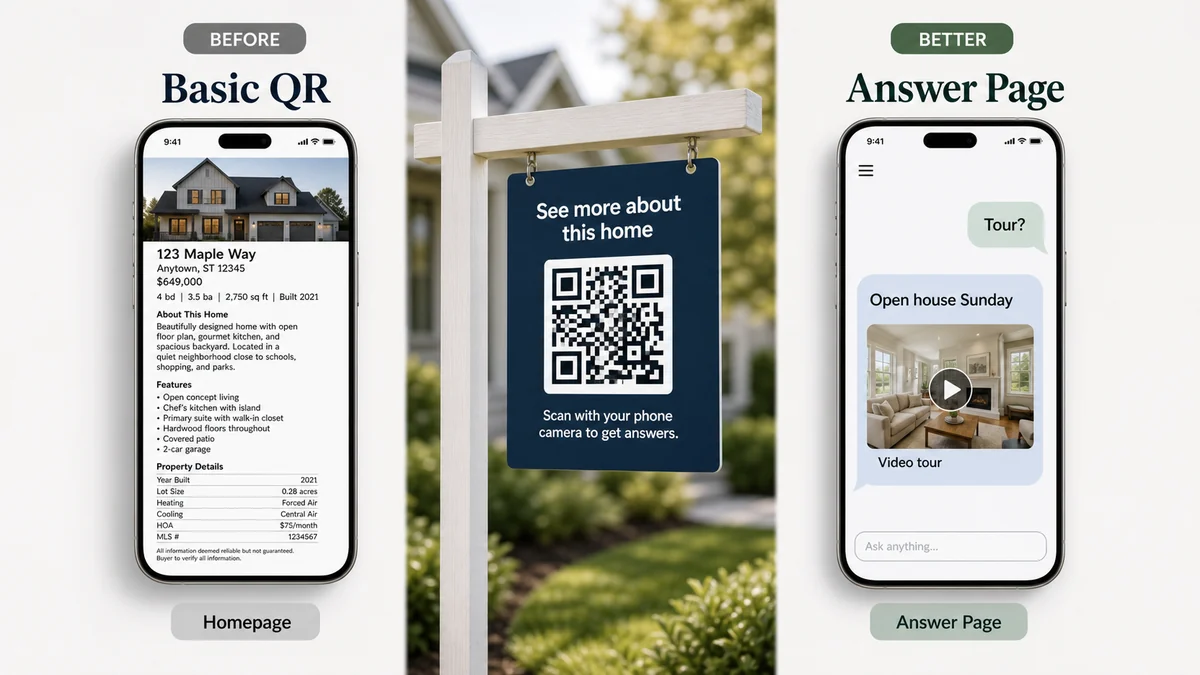
Most yard sign QR codes disappoint because they solve the printing problem, not the buyer problem. The sign gets a code, but the scan opens a homepage, PDF, slow listing page, or contact form that does not answer the specific question the person had at the curb.
A buyer does not scan because they want "more information" in general. They scan because they have a specific question right now: price, availability, inside photos, open house timing, private tour options, taxes, HOA details, or who to contact.
If the QR code sends them somewhere vague, the moment loses momentum.
What do most QR code guides miss?
Most QR code guides focus on placement, contrast, size, and tracking. Those details matter, but they miss the bigger strategy: the page after the scan must answer the buyer's question. A QR code is not the strategy. The answer after the scan is.
| QR code focus | What buyers actually need |
|---|---|
| Add a QR code. | Answer my question now. |
| Track scans. | Show what buyers were trying to learn. |
| Link to my website. | Send me to this property's details. |
| Collect a lead. | Give me enough confidence to ask for a tour. |
What questions do buyers actually ask from a yard sign?
Buyers scanning a real estate yard sign usually ask practical, immediate questions. They want to know whether the home fits their budget, schedule, family needs, commute, financing situation, and level of interest before they call, text, or submit a form.
- Is the property still available?
- What is the asking price?
- Can I see photos of the inside?
- Is there a video tour?
- When is the next open house?
- Can I schedule a private tour?
- How many bedrooms and bathrooms?
- What is the square footage?
- Are there HOA fees?
- What are the property taxes?
- What school district is listed publicly?
- What happens after I request a tour?
For regulated or sensitive topics, keep the answer careful. Real estate advertising rules, Fair Housing rules, MLS rules, brokerage requirements, and local sign ordinances can vary. The QR page should support compliant communication, not freestyle claims.
What is the bad solution vs better solution?
A bad QR setup sends people to a generic destination and hopes they figure it out. A better setup matches the QR scan to the buyer's immediate question, then gives a clear next step without forcing the person through unnecessary friction.
| Buyer moment | Bad solution | Better solution |
|---|---|---|
| Buyer sees the sign while driving. | Tiny QR code with no scan promise. | Large QR code with "Scan for price, photos, and tour info." |
| Buyer wants property details. | Link to brokerage homepage. | Link to property-specific page. |
| Buyer wants a tour. | Generic contact form. | Tour request page or answer page explaining tour options. |
| Buyer wants inside photos. | PDF flyer. | Mobile-first gallery or video tour. |
| Buyer asks a specific question. | Static page with buried details. | AI answer point with property FAQ answers. |
| Agent wants insight. | Scan count only. | Question patterns showing what buyers asked. |
Which QR code idea fits each real estate use case?
The best QR code idea depends on the property type, buyer intent, and operational reality. A luxury listing needs rich media. An open house sign needs schedule clarity. A rental sign needs availability and application steps. A land sign needs zoning, utilities, and location context.
| Use case | Best QR destination | What to include | Setup effort |
|---|---|---|---|
| Residential for-sale sign | Property answer page | Price, photos, tour options, FAQ, agent menu | Medium |
| Open house yard sign | Open house page | Date, time, parking, showing instructions, follow-up | Low |
| Luxury listing | Video-first page | Cinematic tour, private showing request, features | Medium |
| Rental sign | Rental FAQ page | Rent, availability, pet policy, application steps | Medium |
| Vacant land sign | Land details page | Lot size, zoning notes, utilities, map, agent contact | Medium |
| New construction sign | Community answer page | Models, incentives, build timeline, appointment link | High |
| Investor property sign | Data room request page | Rent roll summary, cap rate context, contact path | High |
How do you build a better QR yard sign?
To build a better QR yard sign, start with the buyer's question before choosing the QR tool. Decide what the scan should answer, create a mobile-first destination, add a clear scan promise, test the printed sign in real conditions, and review compliance before printing.
- Choose the scan promise.Example: "Scan for price, photos, and tour info."
- Match the destination to the property.Do not send all yard signs to the same homepage.
- Prepare the key answers.Include price, availability, photos, tour options, open house details, basic features, and contact path.
- Add useful media.Use interior photos, a short video tour, a floor plan, map, or approved listing link when relevant.
- Keep the page mobile-first.The buyer is likely scanning from a phone outside the property.
- Avoid premature lead gates.Give enough value before asking for name, email, or phone.
- Review compliance.Confirm brokerage, MLS, Fair Housing, advertising, and local sign requirements.
- Test the QR code physically.Print a sample, place it at realistic distance, scan in daylight and shade, and test with different phones.
- Track questions, not just scans.The most useful insight is what people wanted to know after scanning.
What are concrete QR code examples for real estate signs?
Strong QR code ideas connect the sign to the next useful answer. The best examples are not fancy. They are specific: scan for open house times, scan for the video tour, ask a question about this property, or scan for private showing options.
1. Standard for-sale sign
QR promise: Scan for price, photos, and tour info. Destination: Property-specific answer page. Best for: Residential listings where buyers want the basics fast.
2. Open house sign
QR promise: Scan for today's open house details. Destination: Open house page with time, parking notes, showing instructions, and follow-up options.
3. Luxury listing sign
QR promise: Scan for private video tour. Destination: Rich media page with video tour inside the answer experience and a private showing path.
4. Rental property sign
QR promise: Scan for rent, availability, and application steps. Destination: Rental FAQ page that reduces repetitive calls about pet policy, lease length, and move-in timing.
5. Vacant land sign
QR promise: Scan for lot details and property questions. Destination: Land-specific FAQ with zoning notes, utilities, map link, and agent contact menu.
6. New construction community sign
QR promise: Scan for models, pricing range, and appointment info. Destination: Community answer page for builders, developments, and model home traffic.
How can you do this without RealLink AI?
You can build a strong yard sign QR flow without RealLink AI by using a dynamic QR code, a mobile landing page, a property FAQ, a photo gallery, a video tour, and a contact form. The main tradeoff is that every update and question pattern must be handled manually.
A non-AI setup can work well. Create a dedicated page for each property, add the top buyer questions near the top, embed the video tour, add clear tour request instructions, put agent contact information in a compliant format, and use analytics to measure visits and form submissions.
This is often enough for simple listings. The weakness is that static pages cannot answer unexpected questions unless you already wrote the answer.
How does RealLink AI make it easier?
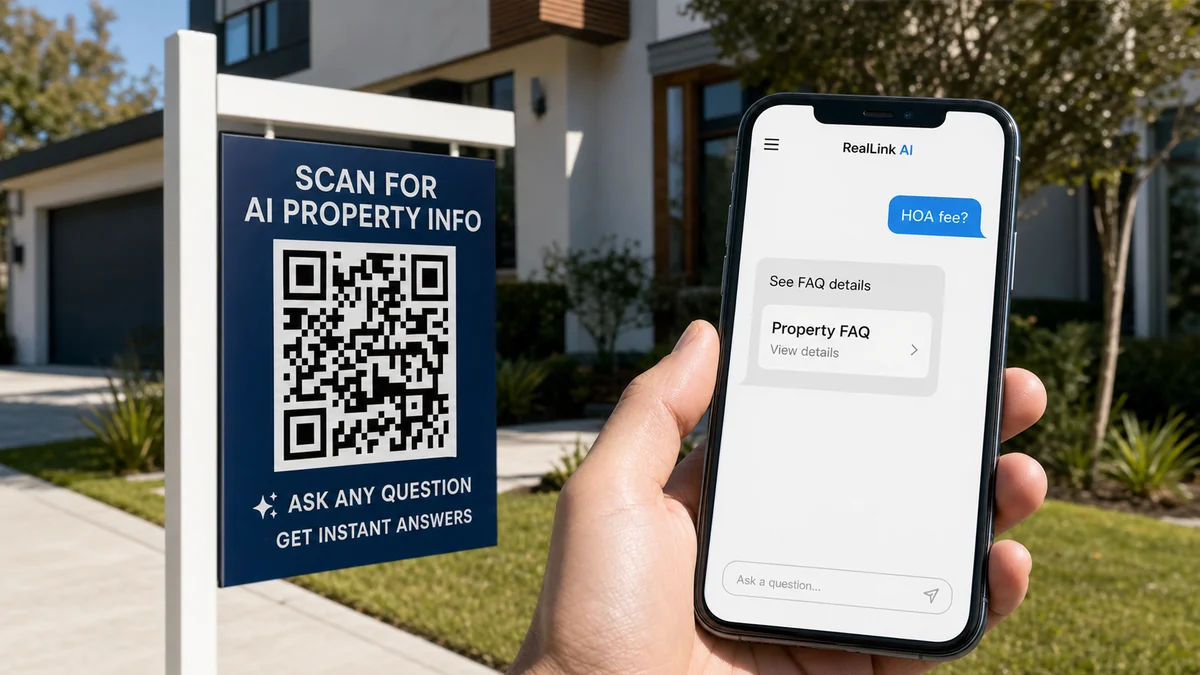
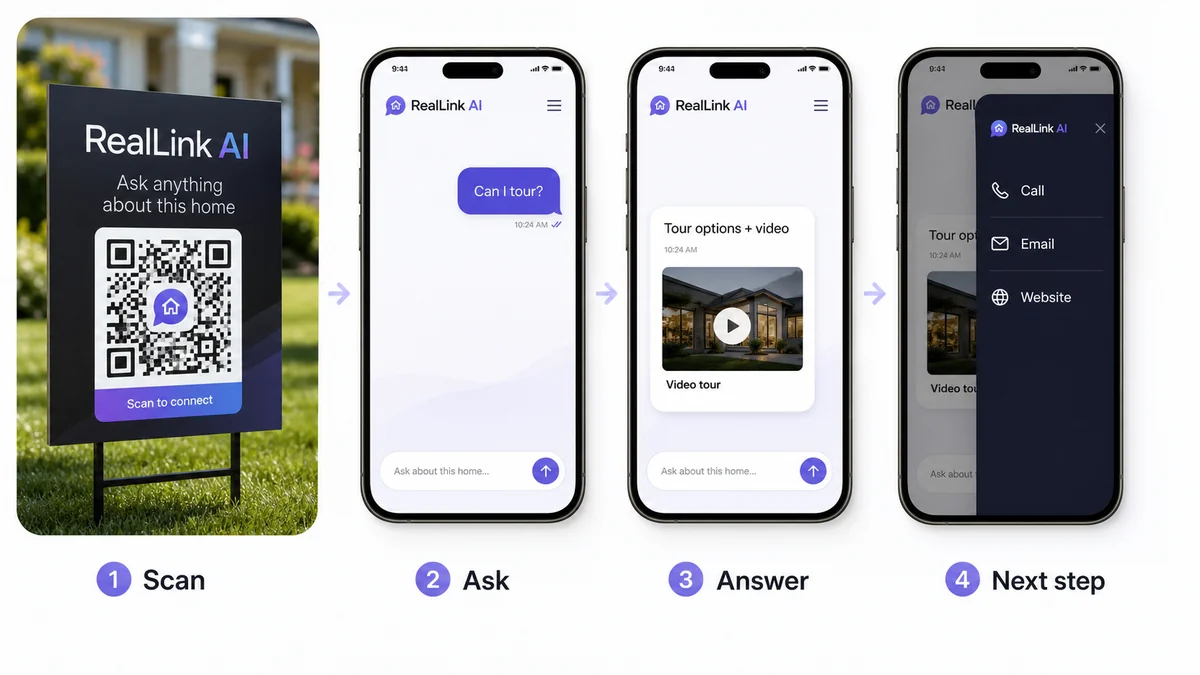
RealLink AI makes the QR code destination more useful by turning the scan into an AI answer page. Buyers can ask property questions in a speech-bubble interface, receive approved answers, open links or media inside the answer, and use the hamburger menu for agent contact paths.
RealLink AI is not just a QR code generator. It is the answer point after the scan. For real estate yard signs, that means the QR code opens a property-specific AI answer page, buyers ask questions like "Can I tour?" or "HOA fee?", and answers can include links, video embeds, images, or property cards inside the answer bubble.
Phone, email, website, and agent links stay in the hamburger menu. Sensitive or final questions can route buyers to the agent instead of making unsupported claims. Owners can also review question patterns to see what buyers keep asking.
FAQ
Should I put a QR code on a real estate yard sign?
Yes, if the QR code opens something useful. A yard sign QR code should help buyers see property details, photos, tour options, open house information, or answers to common questions. Do not add a QR code only because it looks modern.
What should a real estate yard sign QR code link to?
It should link to a property-specific mobile page, not a generic homepage. Good destinations include listing details, video tours, open house pages, showing request pages, property FAQs, or AI answer pages.
What is the best QR code idea for a real estate sign?
The strongest idea is usually a property question page: "Scan to ask about this home." It matches the buyer's real behavior because people at the sign often have specific questions before they contact an agent.
How big should the QR code be on a yard sign?
Make it large enough to scan from the actual viewing distance. For many yard signs, that means testing a large, high-contrast code from the sidewalk or curb before printing.
Should the QR code collect contact information immediately?
Usually not immediately. Buyers are more likely to continue when the page first answers useful questions. Ask for contact information when the buyer wants a tour, pricing confirmation, private details, or agent follow-up.
Can a QR code replace a listing page?
No. A QR code is only the doorway. The destination still needs accurate listing details, media, compliance review, and a next step.
Can RealLink AI answer every property question automatically?
No tool should make unsupported real estate claims. RealLink AI can answer based on trained property information and guide buyers to approved links, media, or agent contact paths. Sensitive, legal, financial, or final availability questions should be handled carefully.
What should agents avoid with QR codes on yard signs?
Avoid tiny QR codes, generic homepage links, slow pages, fake urgency, unsupported claims, fake testimonials, and lead forms that appear before the buyer gets any value. Also review brokerage, MLS, Fair Housing, and local sign rules.
Are QR codes useful for open houses?
Yes. Open house signs are one of the best use cases because the buyer needs immediate context: time, parking, entry instructions, property details, photos, and follow-up steps.
What is the difference between a QR code and an AI answer page?
A QR code only sends someone somewhere. An AI answer page gives the person a place to ask questions and receive useful answers after the scan. The QR code creates access; the answer page creates usefulness.
Ready to make the scan answer something?
A QR code should not just send people somewhere. It should answer the question they had when they scanned it. Create AI for your sign, flyer, menu, card, or packaging.
Last updated and author note
Last updated: 2026-06-03
Author/founder note: This guide was written from the RealLink AI point of view: offline marketing should not go silent after someone scans. For real estate signs, the real opportunity is not the QR code itself. It is the answer experience that helps a buyer move from curiosity to the next step.