
United States | Manufacturing and industrial sales
AI Customer Service for U.S. Manufacturers: A Practical Buyer-Question Workflow
Use approved product information to help buyers find specifications, prepare complete quote requests, and reach the right human without letting automation promise price, lead time, inventory, or engineering suitability.
Summary
AI customer service can be useful for a U.S. manufacturer when it answers stable, approved questions about product families, published specifications, document locations, sample-request steps, quote-request inputs, normal support routes, and the way a buyer reaches sales or engineering. It should not invent or confirm live inventory, production capacity, final price, delivery date, contract terms, regulatory suitability, or an engineering recommendation.
A sound rollout begins with the buyer questions already found in emails, calls, distributor notes, website forms, and trade-show follow-up. Give every answer an owner and an approved source, define the questions that must be handed to a person, protect drawings and customer data, and run one product-family pilot for 30 days. Measure whether buyers submit more complete RFQs and whether staff spend less time repeating stable information, not merely how many messages the system handles.

Decide whether the workflow fits the manufacturer
The best fit is a manufacturer with repeat pre-sale questions, stable public product information, and a clear sales or engineering owner for exceptions.
This guide is aimed at U.S. small and midsize manufacturers selling non-regulated industrial components, equipment, business supplies, fabricated products, or other goods that require explanation before a quote. The pattern is especially useful when several people answer the same questions across website forms, email, distributor channels, and events. It is less useful when every order is a unique engineering project and almost none of the information can be made public.
Write the first use case in one sentence before selecting a tool. A workable example is: a procurement manager considering Product Family A can find the published specification sheet, understand which details are needed for a quote, and reach the correct sales engineer when the application falls outside the standard range. That sentence identifies the buyer, product scope, safe information, next action, and human owner. It also prevents a pilot from turning into a vague promise to automate customer service.
Keep high-consequence sectors and decisions out of the initial scope. This workflow is not for medical, legal, financial, insurance, credit, gambling, minors, schools, or childcare services. Even in ordinary manufacturing, product safety, export controls, regulated compliance, custom engineering, warranty liability, and contract interpretation belong with qualified people. The customer-facing system should explain its limited role and provide a dependable route to a person when the question crosses that boundary.
- The same product or quote-preparation questions appear every week.
- Approved public documents already exist and have named owners.
- Sales and engineering agree on what automation may never promise.
- A buyer can reach a responsible person without starting over.
- The pilot can avoid confidential drawings and sensitive customer data.
Build the inventory from real buyer language
Collect ten business days of questions before writing answers, preserving the words buyers use and the point in the buying process where each question appears.
Pull a manageable sample from shared sales inboxes, call notes, contact forms, distributor messages, trade-show notes, and customer-service tickets. Remove names and confidential details, then keep the question in the buyer's own language. A buyer may ask, "Can this handle outdoor washdown?" while an internal document calls the topic environmental resistance. Keeping both phrases improves the answer, the page heading, and the terms that salespeople use in follow-up.
Tag each question by product family, buyer role, buying stage, frequency, source, information owner, change rate, confidentiality, and next action. Frequency alone is not enough. A rare question that blocks a large quote may deserve attention before a common but low-value request. At the same time, a frequently changing fact such as current inventory may be unsuitable for an automated answer unless the system is connected to a reliable, permissioned source.
Look for question chains rather than isolated sentences. A buyer who asks for price usually needs to clarify part number, quantity, material, finish, tolerances, destination, required date, and whether a drawing or sample exists. The useful response is not a speculative number. It is a concise explanation of the quote process and a checklist that helps the buyer send the information a salesperson needs. That reduces rework while preserving human control over the commercial decision.
| Buyer question group | Safe self-service content | Human or connected-system check |
|---|---|---|
| Published specifications | Approved dimensions, materials, document links, standard ranges | Application suitability, exceptions, safety, custom engineering |
| Quote preparation | Required quantity, drawing, finish, destination, target date, contact route | Final price, discounts, terms, quote validity |
| Samples and prototypes | Request steps and information needed for review | Availability, cost, export restrictions, expedited approval |
| Production and delivery | How capacity and lead time are confirmed | Current inventory, capacity, committed ship date |
| Support and warranty | Manuals, intake steps, published warranty process | Diagnosis, fault, liability, remedy, contract interpretation |

Design answers that make RFQs easier to evaluate
A manufacturing answer should help the buyer provide a complete request, not turn an unverified conversation into a quotation.
The U.S. Commercial Service notes that many export transactions begin with an inquiry followed by a request for quotation, and that overseas quotations usually need more product detail than domestic ones. The same operational lesson applies to many industrial buyers inside the United States: ambiguity early in the request creates email loops later. A useful answer page can show the information needed for review while leaving price, shipment, terms, and acceptance to the formal quote process.
For each product family, write a quote-readiness checklist in buyer order. Start with the part or capability being considered. Then ask for quantity, unit system, material, finish, tolerances that matter, destination, target date, end-use context, drawings or photos, and any required documentation. Explain which items are optional and why a missing item may delay review. Do not ask a buyer to paste confidential drawings, controlled technical information, or personal data into an unapproved public chat.
The closing action should fit the state of the request. A buyer gathering information may need a specification sheet or a distributor locator. A buyer with a defined requirement may need a secure RFQ form. A buyer with an unusual load, environment, or tolerance may need an engineering conversation. Give one primary next step and preserve the question summary so the next person can continue with context instead of asking the buyer to repeat everything.
- Explain what information makes a request reviewable.
- Separate guidance from a formal quotation or order acceptance.
- Route confidential files through an approved secure channel.
- Record units and product identifiers exactly as the buyer supplies them.
- End with one action appropriate to the buyer's stage.
Give every answer an owner, source, and review date
The quality of the customer experience depends less on fluent wording than on whether the underlying product information is approved, traceable, and current.
Create a source register rather than uploading every file the company has. For each answer, record the product family, approved fact, source document, revision, owner, public or restricted status, last review date, and trigger for rechecking. Engineering may own published dimensions, sales operations may own RFQ intake, logistics may own the process for requesting a delivery estimate, and customer support may own warranty intake. The customer should receive one coherent answer even when responsibility is distributed internally.
Product variants need explicit treatment. Similar model names, imperial and metric units, optional materials, regional certifications, and retired revisions can produce plausible but wrong answers. State the model or family in the response, preserve units, and link to the exact approved document. If the buyer has not identified the model, ask a narrowing question instead of blending specifications. If a document conflicts with the current source register, pause the answer and send the issue to the owner.
Write answers in a three-part pattern: the approved fact, the condition that may change it, and the next action. For example, explain where the standard material range is published, note that application suitability depends on operating conditions, and route the buyer to engineering with the relevant conditions. This pattern is more useful than a long marketing paragraph because it distinguishes information from judgment and tells the buyer exactly how to continue.
| Source field | What to record | Why it matters |
|---|---|---|
| Owner | Named role responsible for the fact | Someone can approve corrections and exceptions |
| Revision | Document number, version, or effective date | Old specifications do not silently remain active |
| Access class | Public, customer-only, partner-only, restricted | Sensitive material does not enter a public answer |
| Review trigger | Scheduled date or product-change event | Updates follow the manufacturing change process |
| Fallback | Person and route when the source is uncertain | The system can stop instead of guessing |
Write the automation boundary before launch
Stable approved information can be answered automatically; promises, live operational facts, safety judgments, exceptions, negotiations, and confidential matters need a person or a trusted system connection.
A practical allow list may include product-family orientation, published specifications, document locations, normal sample-request steps, RFQ input requirements, distributor contact routes, general order-process explanations, public manuals, and support intake instructions. Each answer should be narrow enough to verify. If an answer combines several documents or draws a conclusion that no owner has approved, it is no longer a simple retrieval task and should be reviewed as a new customer-facing statement.
The deny or handoff list should name specific question types: final price, discounts, payment terms, current inventory, available capacity, committed ship dates, expedited production, product substitutions, custom tolerances, engineering suitability, safety, compliance, export restrictions, contract terms, warranty fault, refunds, complaints, and confidential drawings. The system should not hide uncertainty behind confident language. It should say what it cannot confirm and identify what a person needs to evaluate the request.
Define operational failure behavior as carefully as the happy path. When the source is missing, two documents conflict, a part number is unclear, or the buyer asks for a restricted decision, the response should stop, capture only the minimum context, and offer a human route. Include expected response time only if the team can consistently meet it. A truthful "sales engineering will review this on the next business day" is better than an instant answer that creates an expensive expectation.
- Never imply that a conversation is a formal quote or order acceptance.
- Never confirm live data without a current authenticated connection.
- Never infer application safety or regulatory suitability.
- Never request restricted drawings through an unapproved channel.
- Always preserve a human route for ambiguity, exceptions, and complaints.
Place the answer workflow where buyer questions begin
Use the same governed answer source across the website, product literature, packaging, distributor materials, and trade-show follow-up, while tailoring the first prompt to each context.
On a website, the entry point can sit beside product-family pages, specification downloads, and quote-request guidance. Avoid a generic floating prompt that asks every visitor to "chat." A more useful invitation names the job: find the right product document, prepare an RFQ, understand sample steps, or route a technical question. The buyer knows what the interaction can do, and the manufacturer can measure which tasks genuinely reduce friction.
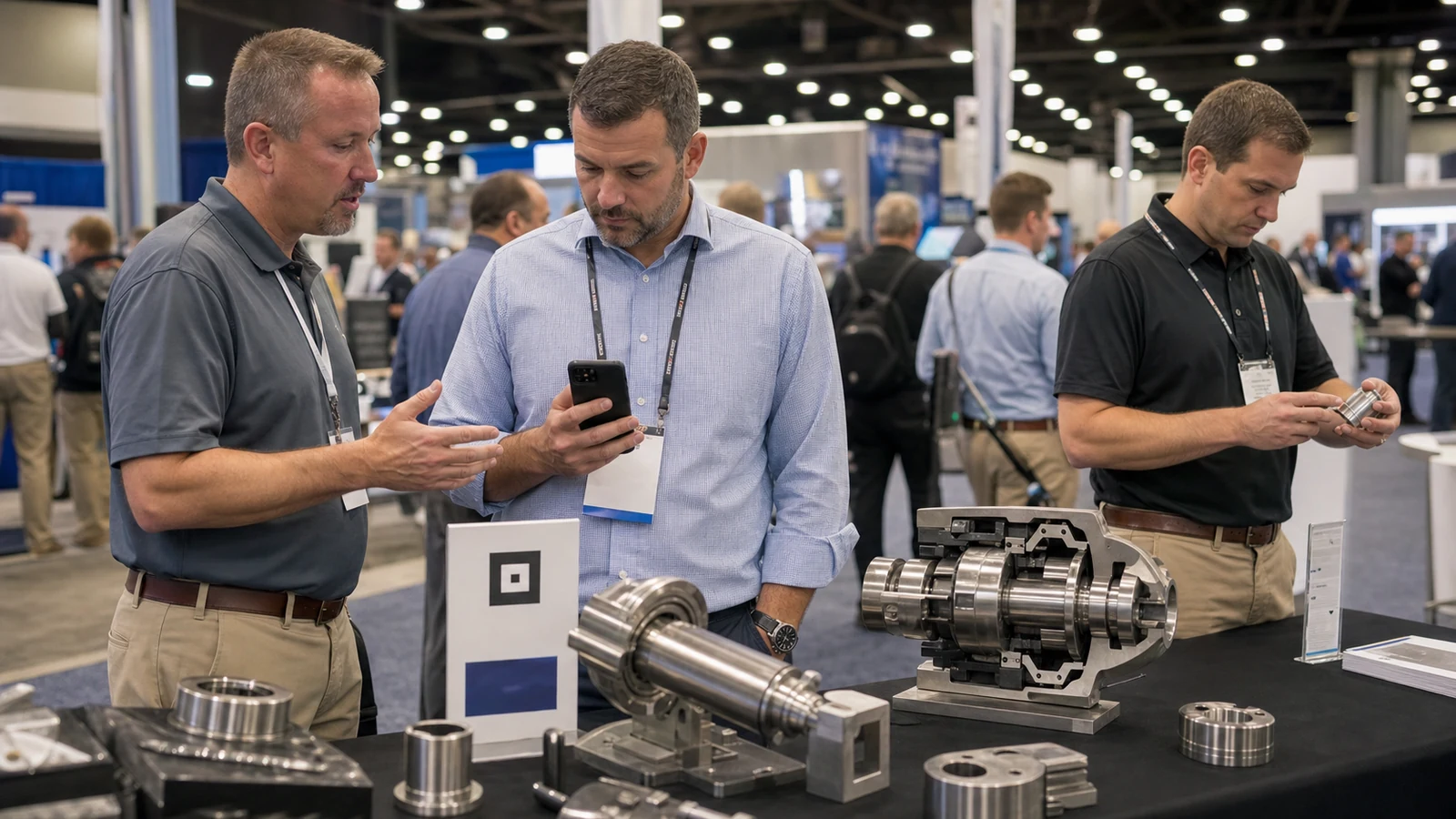
A QR code on a booth placard, line card, sample package, or printed catalog should open a mobile page tied to that source. The booth version might begin with product questions, document access, and a request to continue with a sales engineer. The packaging version might begin with setup documents, identification, and support intake. Do not send every scan to the home page, and do not ask for contact information before providing basic public help.
Preserve source context in the handoff. Sales should know that the buyer came from a particular product sheet, distributor card, or event display and should see the non-sensitive question summary. Source context helps staff prioritize and prepare, but it should not become hidden surveillance. Tell users what information is collected, collect the minimum needed, and avoid making sensitive inferences from a simple scan or question.
| Entry point | Good first task | Useful handoff context |
|---|---|---|
| Product page | Find approved specifications or compare public families | Page, family, question summary |
| Trade-show display | Continue a product conversation when staff are busy | Event, display, product interest, requested follow-up |
| Line card or catalog | Open the exact current document and RFQ checklist | Asset source and product family |
| Sample or package | Find identification, setup, and support intake | Model or batch only when safe and appropriate |
| Distributor material | Find the correct regional sales route | Distributor source and buyer location |
Protect drawings, buyer data, and internal knowledge
Treat a customer-facing AI workflow as another external information system with data classification, access control, retention rules, vendor review, and incident ownership.
Start with data minimization. Public answers should rely on public or explicitly approved material, not a shared drive full of drawings, customer names, quote history, supplier terms, or internal quality records. Keep restricted information in the systems designed to protect it. If the interaction needs a confidential drawing, direct the buyer to the manufacturer's approved secure upload or portal and explain what identifying information the sales team needs to match the file to the request.
Map the data flow from question entry through processing, logs, analytics, notifications, integrations, backups, and deletion. Identify which vendors or subprocessors can access the content, where data is stored or transferred, how long logs remain, and who can export them. Use role-based access, multifactor authentication, separate administrative accounts, and a documented offboarding process. Review the vendor's incident notification terms and decide who inside the manufacturer owns the response.
The NIST AI Risk Management Framework is voluntary, but its emphasis on governing, mapping, measuring, and managing risk is a useful structure for a small pilot. Record the intended use, affected users, known failure modes, evaluation examples, owners, and stop conditions. Test questions that should be refused or handed off, not only easy questions that make the demo look good. Revisit the risk record when products, documents, integrations, or customer groups change.
- Use approved public content for the first pilot.
- Document vendors, data locations, retention, deletion, and access roles.
- Keep confidential technical files in an approved secure channel.
- Test prompt injection, source conflicts, restricted requests, and bad part numbers.
- Name the person who can pause the system and coordinate incident response.
Test answers like customer-facing work instructions
Build a fixed evaluation set from real buyer questions and score accuracy, source support, boundary compliance, usefulness, and handoff quality before opening the workflow broadly.
Create a test set that includes the twenty most common questions, common paraphrases, incomplete part numbers, imperial and metric units, retired models, requests for current lead time, application-suitability questions, frustrated complaints, and attempts to obtain restricted information. Write the expected behavior for each item: answer from a named source, ask one clarifying question, refuse a restricted request, or hand off with specified context.
Have sales, engineering, quality, and customer support review the examples they own. A response can be factually accurate yet operationally poor if it points to the wrong document, buries the answer, omits the next action, or sounds like a guarantee. Record every correction as either a source issue, wording issue, routing issue, or scope issue. That classification tells the team whether to change content, rules, integration, or staffing.
Monitor after launch with sampled conversation review rather than relying on a satisfaction score alone. A buyer may rate a fast answer highly even if the answer was unsupported. Conversely, a safe handoff may look less convenient but protect the quote. Review unanswered questions, wrong-source incidents, repeat questions after an answer, handoff completion, and the time owners take to correct approved content. Pause the affected topic when the failure could create a commercial or safety commitment.
Run a 30-day pilot around one product family
Start small enough that owners can review every important answer and large enough to observe whether buyers submit better requests and staff repeat less information.
During the first week, choose one product family and one buyer journey. Build the question inventory, source register, allow list, handoff list, privacy notice, and evaluation set. In week two, draft concise answers and test them internally with sales and engineering. Connect only the entry points needed for the pilot. Do not begin by importing the whole catalog or exposing every channel.
In week three, release the workflow to a limited audience such as one product page, one distributor group, or one event follow-up cohort. Review the first conversations daily. Correct unsupported wording quickly, but do not broaden the scope simply because buyers ask adjacent questions. Adjacent questions are evidence for the next content decision, not automatic permission for the system to answer outside the approved range.
At day 30, compare the pilot with the previous period or a similar product family. Count complete RFQ submissions, clarification emails per request, time to the first useful human response, successful document finds, answered stable questions, handoff completion, unsupported-answer incidents, and content corrections. Expand only if buyers move forward with less friction and owners can maintain the information. A high message count without better requests is activity, not success.
| Measure | What it reveals | Warning sign |
|---|---|---|
| Complete RFQ rate | Whether buyers arrive with reviewable inputs | More submissions but the same missing details |
| Clarification loops | Whether repeat email work is declining | Questions simply move to a different channel |
| Handoff completion | Whether complex buyers reach the right owner | Captured questions wait without response |
| Supported-answer rate | Whether answers trace to approved sources | Fluent answers without an owner or revision |
| Correction time | Whether governance works after a problem | Known errors remain live across entry points |
Sources and official guidance
- NIST Manufacturing Extension Partnership: About NIST MEP
- NIST AI Risk Management Framework
- U.S. Commercial Service: Quotations and Pro Forma Invoices
- NIST Small Business Cybersecurity Corner
- FTC: Proposed policy statement addressing AI accuracy
This article is operational guidance, not legal, privacy, safety, or compliance advice. Check current requirements and professional obligations for the business, location, and customer journey before implementation.
FAQ
Can AI customer service produce a manufacturing quote?
It can explain what information is needed and route a complete request, but a formal quote should come from the manufacturer's approved pricing and order process. Final price, terms, validity, capacity, and delivery commitments require current company data and authorized review.
What manufacturing questions are safest to automate first?
Begin with approved public product orientation, document locations, standard specification ranges, sample-request steps, RFQ input requirements, distributor routes, public manuals, and normal support intake. Avoid live inventory, committed lead times, engineering suitability, safety, compliance, and contractual decisions.
Should buyers upload drawings into a chatbot?
Not into an unapproved public interaction. Direct confidential drawings, controlled technical data, and customer-sensitive files to the manufacturer's secure upload, portal, or other reviewed channel. Collect only the context required to match the secure submission to the request.
How should a manufacturer handle lead-time questions?
Explain the factors and the process used to confirm lead time, then route the request to an authorized person or a current connected system. Do not present historical, typical, or cached timing as a committed ship date.
Does a trade-show QR code need a separate answer experience?
It can use the same governed source, but the opening tasks should reflect the booth: identify the displayed product, find a specification, prepare follow-up, or reach a sales engineer. Preserve the event and product context in the handoff without collecting unnecessary personal data.
How long should the first manufacturing pilot run?
Thirty days is often enough for one product family and one buyer journey if owners review early conversations frequently. Expansion should depend on supported-answer quality, better RFQ completeness, fewer clarification loops, and reliable human handoff rather than message volume alone.
Last updated
Last updated: 2026-07-18. Country, privacy, platform, and pricing details should be rechecked before implementation.
Plan the trade-show handoff next
Manufacturers often discover the most valuable buyer questions at events. Use the trade-show lead capture guide to connect booth conversations, mobile follow-up, qualification, and the next human action.