
Trade show strategy case study
Trade Show Strategy Case Study Part 1: Build Around Buyer Questions
A practical trade show strategy case study showing how exhibitors can turn booth planning into buyer-question strategy, QR answer paths, staff roles, and follow-up.
TL;DR
This trade show strategy case study part 1 uses a realistic composite exhibitor, not a fabricated customer story. The lesson is simple: a booth plan becomes a trade show strategy only when it defines the buyer question, the answer path after the QR scan, the staff handoff, and the follow-up logic. A good strategy does not start with booth decoration. It starts with the question a serious visitor must resolve before they can move forward.
Case setup: a booth that looked prepared but had no strategy
In this trade show strategy case study, the exhibitor is a B2B company preparing for its first major industry show with a solid booth plan but a weak visitor strategy.
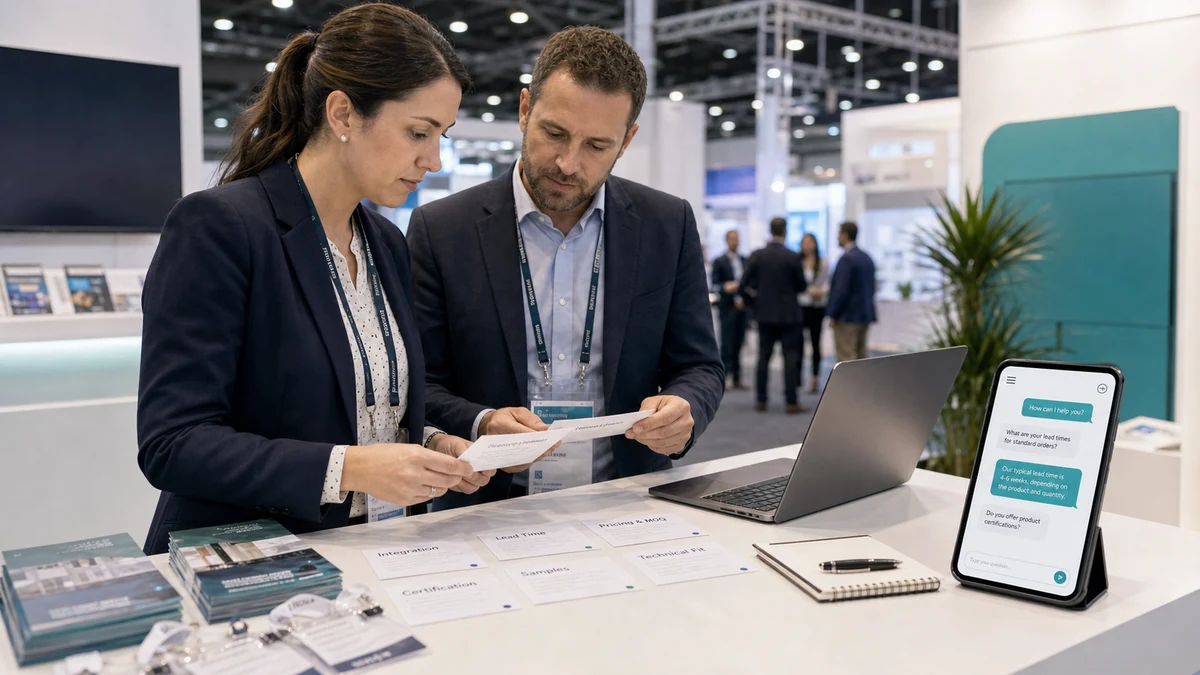
The company had the visible work under control: booth reservation, banners, printed brochures, sample display, staff schedule, travel, and a QR code. On paper, the preparation looked complete. The problem was that each item answered a logistics question, not a buyer question. The brochure explained the product. The banner used a broad promise. The QR code went to the homepage. The staff could demo the product, but they had no shared view of which visitor questions mattered most.
This is common. Exhibitors often confuse planning with strategy. Planning asks, "What do we need to bring?" Strategy asks, "What must a serious visitor understand, trust, and do next?" Planning fills the booth. Strategy moves the conversation beyond the booth.
The core mistake: measuring attention instead of question progress
The first strategic mistake was treating booth traffic as success before checking whether visitor questions were moving toward a next step.
During the show, the booth felt busy. People stopped, scanned, asked short questions, and took materials. But the team did not know whether the right questions were being answered. A procurement visitor asked about lead time. A technical evaluator asked about implementation. A distributor asked about region support. A founder asked for a simple comparison to alternatives. All of those questions require different follow-up, but the badge scans looked the same in the export.
The strategy fix was to stop asking, "How many visitors came?" and start asking, "Which buying questions appeared, and where did they go?" That change moved the team from booth activity to sales context.
The Messestrategie-style framework behind the case
A usable trade show strategy has four layers: target visitor, decisive question, answer path, and follow-up owner.
| Layer | Weak booth plan | Stronger strategy |
|---|---|---|
| Target visitor | "Anyone interested in the product" | Procurement, technical evaluator, distributor, partner, or founder with a defined next step. |
| Decisive question | "Learn more about us" | Lead time, proof, implementation, sample path, pricing context, territory, or risk. |
| Answer path | Homepage, brochure, or staff memory | Booth-specific QR answer page, prepared staff script, proof asset, and escalation owner. |
| Follow-up owner | Generic sales inbox | Question-specific owner: sales, technical, distributor manager, founder, or support. |
Execution plan used in the case
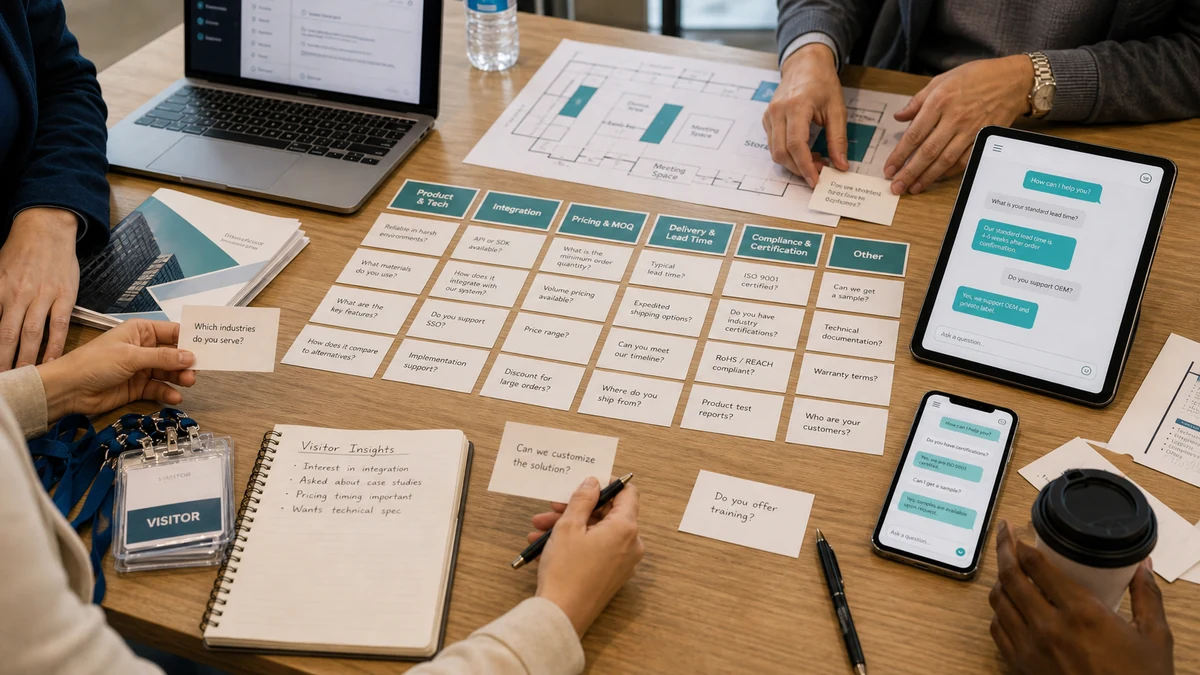
The team rebuilt the show around five buyer-question moves before changing any booth design.
- Define three visitor groups. Procurement wanted lead time and commercial terms. Technical evaluators wanted implementation and documentation. Distributors wanted territory, margin, and support model.
- Write the top 20 questions. The team listed questions that would block follow-up if they disappeared: sample timing, data handling, implementation effort, pricing context, region support, and proof.
- Map answers by channel. Simple repeated answers went to the QR answer page. Sensitive answers stayed with staff. Technical questions had an escalation owner.
- Train staff on handoff notes. Each serious conversation needed role, question, urgency, and next step.
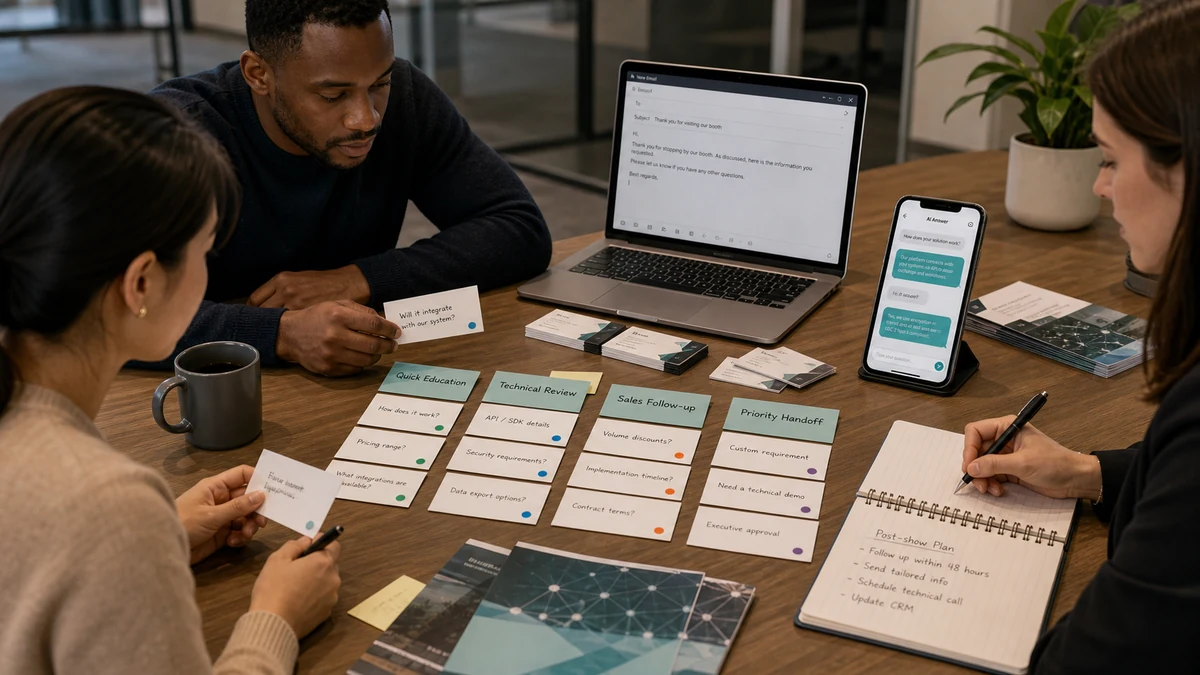
- Prepare follow-up by question theme. The first email was not generic. It continued the question: proof, sample, technical call, distributor discussion, or pricing context.
The QR answer path changed the booth behavior
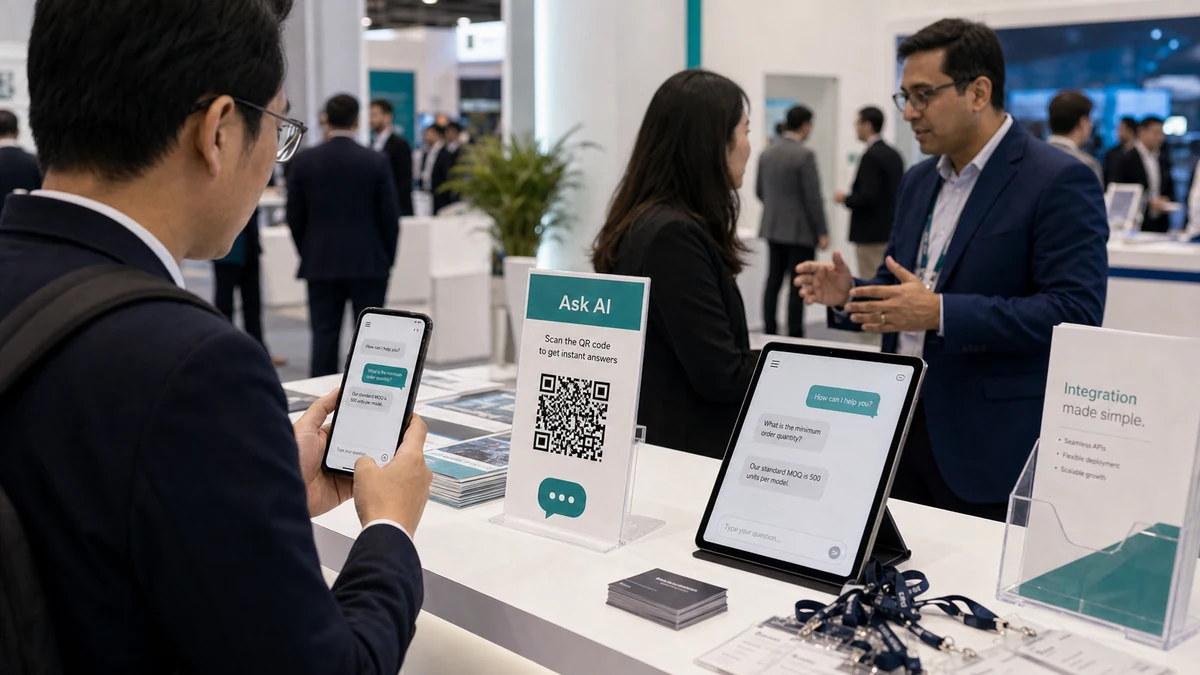
The QR code stopped being a passive link and became a self-service answer path for visitor questions.
The label changed from "Scan to learn more" to a question-based promise: "Ask sample, lead time, and technical questions." After scanning, visitors saw an answer page built for the show, not a generic website. It explained approved answers, linked documents, handled repeated questions, and routed final pricing or sensitive cases to a person.
This helped in two moments: when the team was busy and when visitors wanted to ask later. A visitor who did not want a long booth conversation could still explore. A visitor who scanned after leaving the hall could still ask. The QR path gave the strategy a second life beyond the aisle.
Follow-up logic after the show
The case did not rely on one mass email. Follow-up was grouped by question theme and next step.
Procurement leads received lead-time context, sample steps, and commercial next actions. Technical evaluators received documentation links and a technical call option. Distributor contacts received territory and partner-process information. Casual visitors received a lighter educational message. The team did not claim a guaranteed conversion lift. The practical improvement was operational: the first follow-up felt connected to what the visitor actually asked.
That is the point of a strategy case study. The win is not a dramatic story. It is the removal of avoidable friction between booth interest and post-show conversation.
Local strategy notes by market
Trade show strategy is not just translation. Each market has its own way of asking buying questions.
In Korea, export conversations, minimum order quantity, delivery timing, certificates, samples, and personal data notices often shape the first serious conversation. In Japan, internal approval documents, technical department review, delivery timing, and personal information handling often matter before a meeting can move forward. In Germany, a strong Messe strategy usually needs evidence, privacy compliance, technical proof, and careful post-show follow-up. In France, small and midsize companies often look for clear distributor fit, export documents, privacy notices, and a natural post-show follow-up path.
Case detail: what changed from day one to the week after
The practical value of the strategy appeared when the team reviewed the first day and adjusted while the show was still running.
At the end of day one, the team did not start with the lead count. They reviewed repeated questions. Procurement visitors kept asking for lead-time ranges. Technical visitors asked for implementation effort and documentation. Distributor visitors wanted territory and support model. Those patterns changed the booth on day two: the QR label became more specific, the demo script opened with the three visitor paths, and the staff note template moved from free-text notes to four fields.
The week after the show, the team could sort leads by question rather than by scan time. That created a cleaner internal handoff. Sales did not ask technical staff to remember every conversation. Technical staff received only the contacts that needed technical proof. Distributor contacts were not mixed with general prospects. The strategy did not make the booth louder. It made the next step less vague.
Where RealLink AI helps
RealLink AI supports this strategy by turning booth QR codes into public AI answer pages that preserve visitor questions and approved answer context.
It is not the strategy by itself. The strategy is deciding which questions matter and how they should move. RealLink AI helps execute the answer path: repeated answers, multilingual questions, document links, after-hours scans, and question patterns for follow-up. Staff still own trust, demos, negotiation, final quotes, and sensitive decisions.
Case-study and privacy note
This is a composite strategy case, not a claim about a named customer or guaranteed result. Keep case-study content truthful and avoid invented metrics. If contact details or visitor questions are collected, explain follow-up expectations and opt-out paths. U.S. teams can review FTC advertising guidance, the FTC CAN-SPAM guide, and Google's people-first content guidance. This article is not legal advice.
Related strategy guides
Continue with preparation, first-time exhibitor, and mistake-prevention guides.
FAQ
What is a trade show strategy case study?
It is a practical example showing how an exhibitor connects target visitors, buyer questions, QR answer paths, staff roles, and post-show follow-up.
Is this a real customer case study?
No. It is a realistic composite case built from repeated exhibitor patterns, not a named customer result.
What is the first step in trade show strategy?
Define the target visitor and the decisive question that must be answered before the visitor can move forward.
Where should the QR code lead?
It should lead to a booth-specific answer page or event landing page that continues the visitor question.
How does RealLink AI fit into trade show strategy?
It helps execute the answer path by giving visitors a place to ask approved questions and preserving question patterns for follow-up.
Last updated
Last updated: 2026-06-08.
Build the QR answer path for your trade show strategy
Use RealLink AI to preserve visitor questions and connect them to post-show follow-up.