
QR lead capture and AI sales reps
Trade Show Lead Capture with QR Codes: Turn Booth Questions Into Follow-Up Data
Learn how booth, catalog, product sample, and business card QR codes can become AI answer points that collect buyer questions and improve trade show follow-up.
Summary
A QR code does not capture a lead by itself. It only creates a moment of attention. The lead value appears when the page after the scan answers the visitor's question and preserves that question for follow-up.
RealLink AI can turn booth signs, catalogs, product samples, business cards, and post-show links into public AI answer pages. Visitors ask product, pricing-context, sample, distributor, technical, or multilingual questions, and those questions become follow-up context.
Why QR lead capture fails when the destination is weak
A scan is not a strategy. The page after the scan is the strategy.
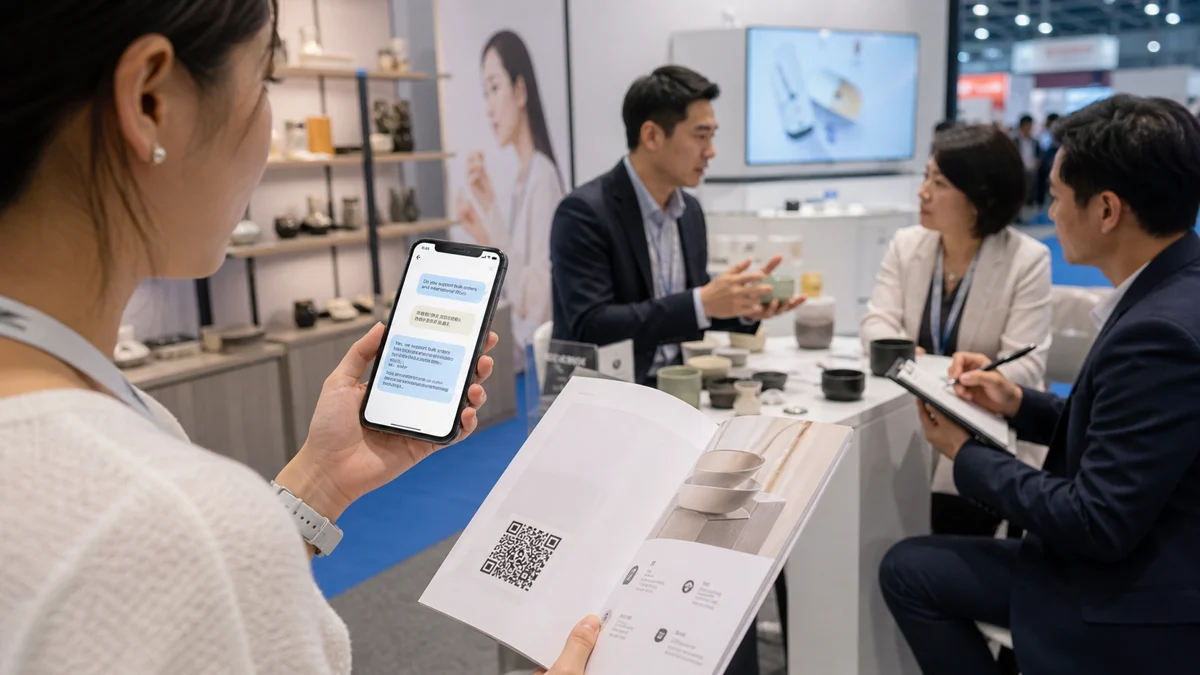
Many exhibitors print QR codes because they feel modern. Then the QR code opens a homepage, a long PDF, or a generic contact form. The visitor has to search for the answer while standing in a crowded hall. Most will not bother.
A better QR destination matches the moment: booth sign, catalog page, sample table, demo station, badge card, business card, or follow-up email. Each scan should have a promise: ask product questions, request samples, compare models, get pricing context, book a meeting, or continue in your language.
If the QR destination can answer the first question immediately, the scan becomes more than traffic. It becomes intent capture.
What does an AI sales rep mean at a trade show?
In this context, an AI sales rep is not a human replacement. It is a public answer page that keeps simple buyer questions moving.
Visitors often have small questions they do not want to ask a salesperson yet. They may wonder about price range, materials, country availability, sample policy, lead time, implementation, warranty, or whether the product fits their use case. Those questions can decide whether they return.
A public AI answer page gives the visitor a low-pressure way to ask. It can answer with approved information, plain URLs, or embedded videos when configured. It can also guide the visitor to the official contact, booking, or product link through the business's configured menu.
The human team still handles trust, demos, negotiation, sensitive requests, final pricing, and approvals. The AI sales rep handles repeated, explainable, approved questions at the moment the visitor is curious.
Best QR placements for trade show lead capture
Place QR codes where questions appear, not only where the graphic designer has space.
Use a booth-edge QR for fast aisle visitors. Use a product-display QR for specs, model comparisons, materials, and use cases. Use a sample-table QR for sample request, care, shipping, and quantity questions. Use a catalog QR to preserve context after the visitor leaves. Use a business-card QR for post-show questions and personal follow-up.
Do not make every QR code open the same generic page. If one QR sits beside a product sample, the first answer should know that product context. If another QR sits on a meeting card, the page should help with next steps, documents, calendar links, or questions from the buyer's internal team.
Label the QR with the promise. 'Ask product questions' is clearer than 'scan me.' 'Ask in your language' is better for international shows than 'more info.'
Turn booth questions into follow-up data
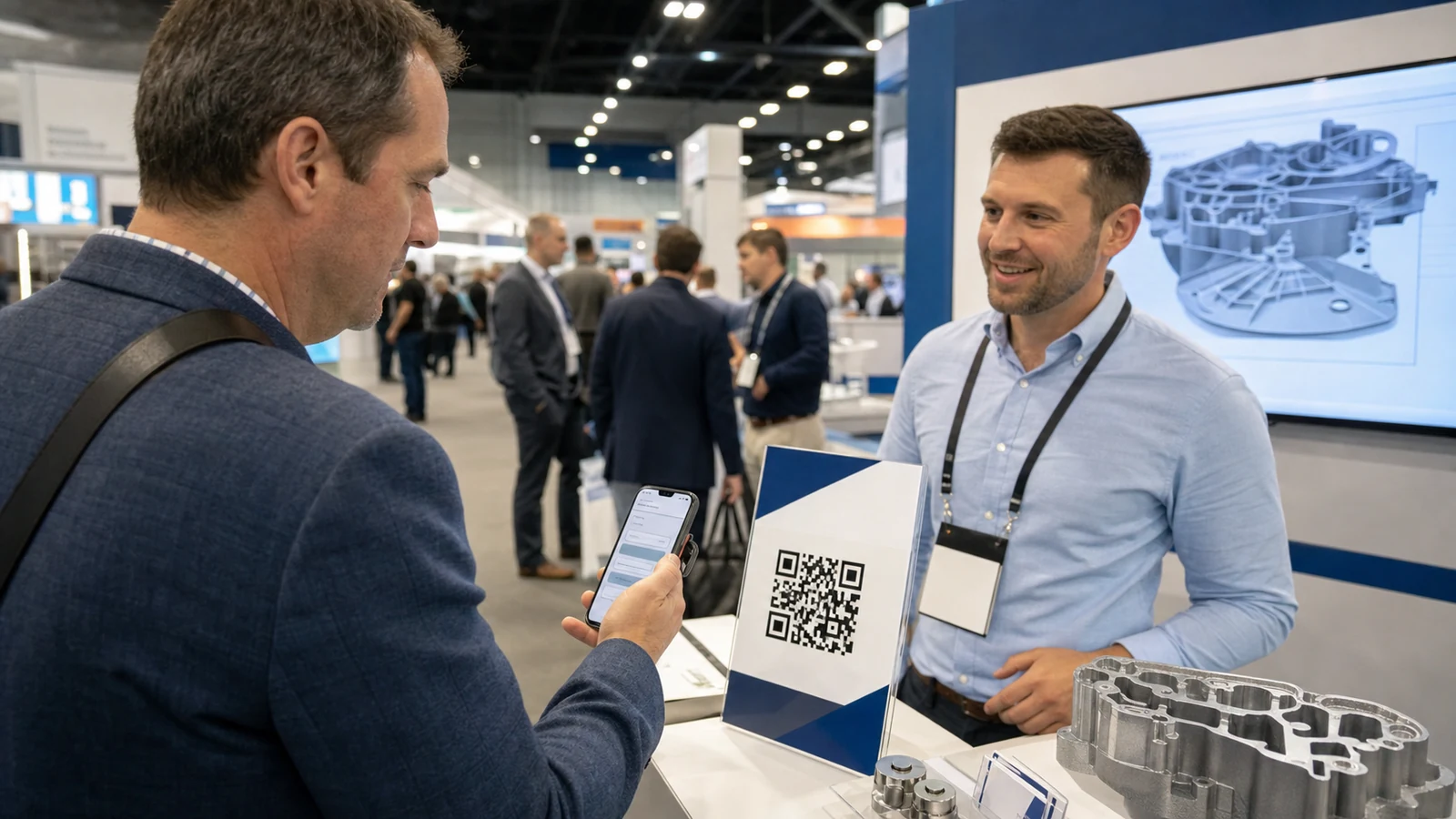
The most useful trade show data is often the question the visitor was too busy to finish at the booth.
When visitors ask through an answer page, the business can see patterns that a badge scanner alone cannot show. Which product got the most sample questions? Which language appeared? Which QR source produced distributor interest? Which proof was missing? Which question came right before a meeting request?
This is not exact accounting. Natural questions are flexible. But grouped question patterns can guide better follow-up, better signage, better catalog pages, better staff training, and better product messaging.
For example, if many visitors ask whether the product ships to their country, the next follow-up should address export readiness. If they ask about integration, sales should send technical proof. If they ask about samples, the team should prioritize sample-policy follow-up.
A simple setup plan before the booth opens
Build the answer path before printing the QR code.
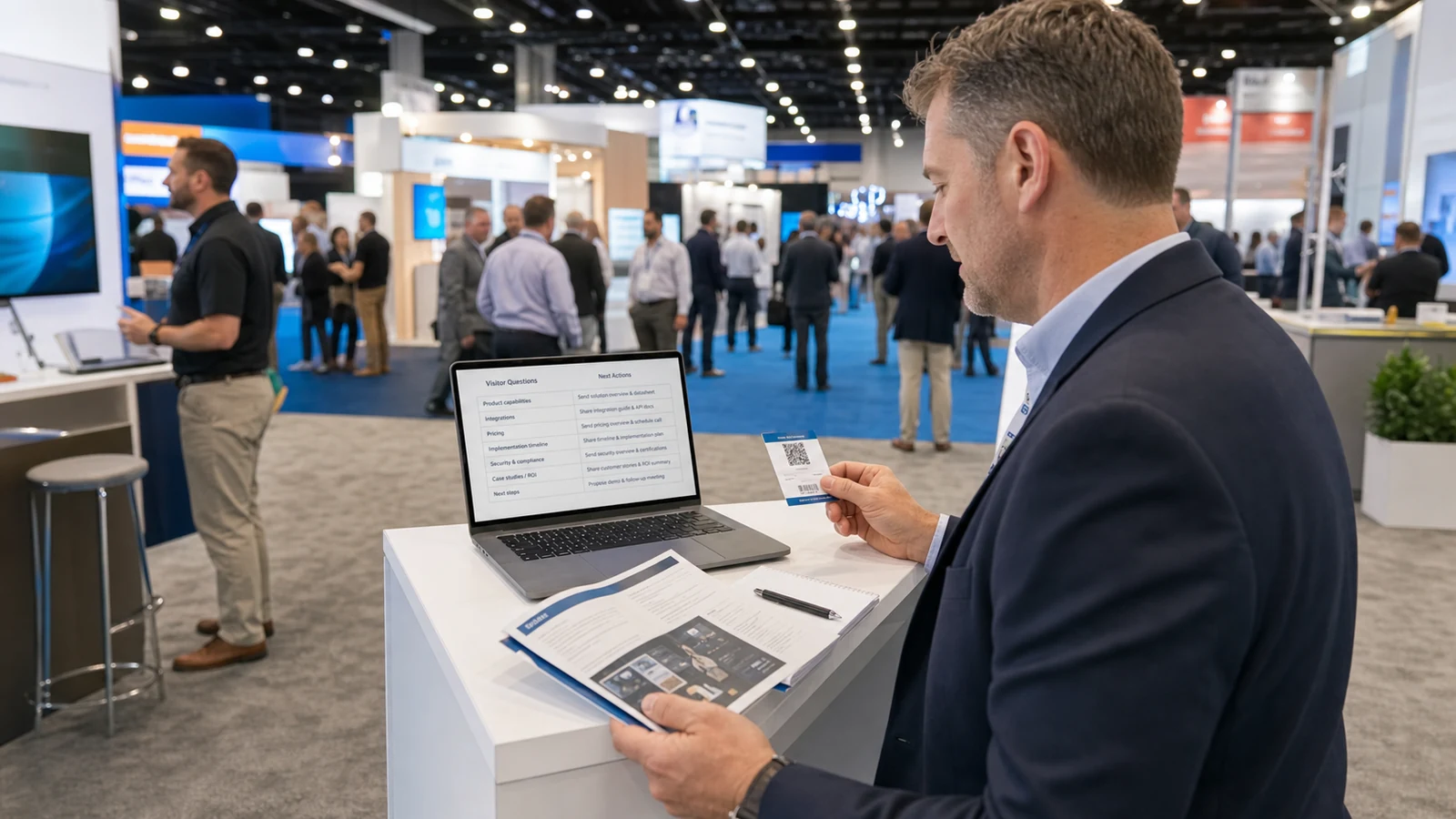
Start by listing the top 25 buyer questions. Group them by product, pricing context, proof, samples, technical fit, distributor path, language, and next step. Decide which answers can be public and which require a human.
Then create QR sources for the physical moments that matter. Keep the answer page trained on approved public information. Add plain links to catalogs, demo videos, sample request paths, official booking pages, or contact pages where appropriate.
Test the page on real phones. Ask the questions a skeptical buyer would ask. If the answer is vague, fix the training content before the show. If the answer should not be automated, route it to a human handoff instead.
How RealLink AI fits this workflow
RealLink AI helps exhibitors hire an AI Sales Rep for the booth without building a custom chatbot project.
With RealLink AI, each booth, catalog, sample, or card QR can open a public AI answer page. Visitors ask questions in a simple speech-bubble interface. The business trains the page with approved information and can review question patterns after the show.
This is different from sending visitors to a generic chatbot widget on a website. The page is made for the moment of the scan: physical booth material, one visitor question, a useful answer, and a clear next step.
From $5.60/month, RealLink AI includes 4,000 AI interactions, QR code use, public links, multilingual answers, and question insights. For a trade show, that is enough to test whether buyer questions can become better follow-up data.
QR code vs AI answer page
A QR code is the doorway. The answer page is what turns the scan into value.
A static QR code can send traffic. A form can collect contact details. An AI answer page can do both while preserving the question that created the lead. The best option depends on the booth goal and the visitor's patience.
| Option | What it captures | Best use |
|---|---|---|
| Static QR to homepage | Traffic source only | Broad brand awareness |
| QR to form | Contact fields | Meeting requests or sample forms |
| QR to PDF | Document access | Offline catalog replacement |
| QR to AI answer page | Visitor questions and intent context | Booth, catalog, sample, and multilingual follow-up |
Mistakes to avoid when using QR codes for lead capture
Do not make the visitor do all the work after the scan.
Avoid homepage QR codes for serious booth moments. Avoid long PDFs that are hard to read on a phone. Avoid forms that ask for too much before answering anything. Avoid unlabeled QR codes. Avoid promising live inventory, live booking, or final pricing unless your business has connected and approved that process.
Also avoid hiding the QR at the bottom of a catalog page with no explanation. Put it near the question moment and tell visitors what they can ask. The more specific the promise, the better the scan quality.
Finally, make sure the team reviews questions after the show. If the business never reads the questions, it loses half the value of QR lead capture.
FAQ
What should a trade show QR code link to?
It should link to a destination that matches the scan moment: product answers, sample request, meeting next step, pricing context, or multilingual Q&A.
Can QR codes capture leads?
Yes, if the destination collects useful context or lets visitors ask questions. A QR code alone only creates a scan.
What is an AI sales rep for a booth?
It is a public AI answer page that answers approved repeated questions and preserves question context for follow-up.
Does RealLink AI replace booth staff?
No. It supports repeated answers and question capture while people handle trust, demos, negotiation, approvals, and sensitive requests.
Last updated
Last updated: 2026-06-29.
Hire an AI Sales Rep for your next trade show
Your booth, catalog, and product samples can answer buyer questions in multiple languages and turn those questions into follow-up data.