
2026 Messe Frankfurt exhibitor operations
Messe Frankfurt Exhibitor Tips: A Practical 2026 Setup and Logistics Checklist
A venue-specific guide to stand approval, freight, move-in, hall routes, buyer meetings, staffing, proof documents, and the daily routines that keep a Frankfurt exhibition running.
What should a Messe Frankfurt exhibitor do first?
Start with the official event exhibitor manual, your hall and stand allocation, and Messe Frankfurt's current technical information. Build one deadline sheet that names the owner, supplier, order date, delivery date, and backup plan for every item affecting stand approval, freight, power, internet, badges, samples, meetings, and dismantling.
The venue's official services cover logistics and traffic management, stand construction, equipment, media, rooms, catering, and technical information. Treat those as connected operational workstreams. A booth design is not finished if freight cannot reach it, a demonstration lacks approved power, or the team cannot direct a buyer from another hall.
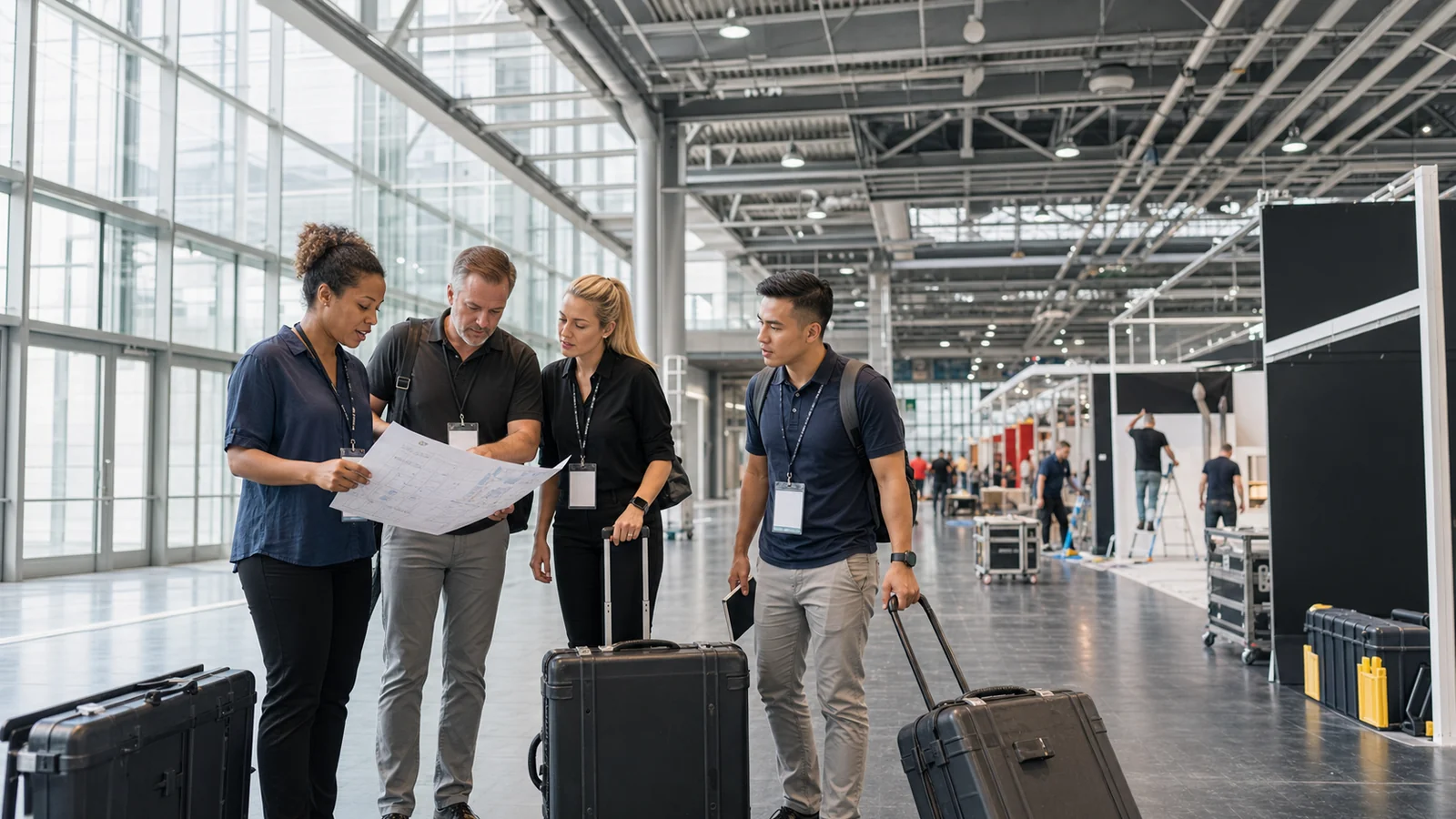
Before booking services, collect the event-specific rules
Messe Frankfurt operates the venue, but the organiser of your specific fair controls many deadlines, service packages, badges, and exhibitor procedures.
Create a source folder containing the official exhibitor manual, technical guidelines, stand construction requirements, logistics instructions, service-shop orders, badge rules, marketing deadlines, and dismantling schedule for your event. Label each file with the date downloaded. Rules can differ by fair, hall, stand type, construction height, and demonstration.
Do not plan from an old exhibitor's checklist alone. Use previous experience to generate questions, then confirm every deadline and technical requirement in the current official documents. When an organiser instruction and a general venue page appear different, ask the organiser or relevant Messe Frankfurt service contact which rule applies to your stand.
| Workstream | Primary evidence | Named owner | Decision to record |
|---|---|---|---|
| Stand construction | Current technical guidelines and organiser manual | Booth manager | Approval requirement, height, materials, submission date |
| Freight and traffic | Official logistics and traffic instructions | Logistics lead | Forwarder, delivery window, vehicle access, empty packaging |
| Utilities | Service-shop order and stand plan | Technical lead | Power load, internet, water, compressed air, shutdown needs |
| People | Badge and contractor access rules | Operations lead | Who enters during build-up, show days, and dismantling |
| Buyer programme | Floor plan and meeting calendar | Sales lead | Route, meeting buffer, host, backup contact |
A 12-week Messe Frankfurt preparation plan
Work backwards from the first build-up access time, not only from opening morning.
12 to 9 weeks before
- Confirm the legal exhibitor name, hall, stand number, stand type, organiser contacts, and contractor access.
- Download the current event manual and Messe Frankfurt technical information.
- Decide what will be demonstrated, powered, suspended, cooked, filled, driven, or otherwise needs technical review.
- Choose the stand builder and freight forwarder, then confirm who submits each approval.
- List the buyer groups the stand must serve: procurement, distributors, engineers, retailers, partners, or media.
8 to 5 weeks before
- Submit required stand documents and resolve open technical questions.
- Order utilities and venue services from the approved channels.
- Freeze freight dimensions, crate labels, customs documents, delivery contacts, and return-shipping plan.
- Prepare current datasheets, certificates, comparison sheets, sample rules, warranty notes, and approved claims.
- Invite priority buyers with the exact hall, stand, route note, meeting owner, and realistic walking buffer.
4 to 2 weeks before
- Run the demonstration with the exact hardware, adapters, video files, and backup mode travelling to Frankfurt.
- Assign greeter, qualifier, specialist, meeting owner, logistics contact, and daily note-review roles.
- Print only stable information. Put changeable details behind a maintained digital link.
- Prepare an incident sheet with organiser, venue service, stand builder, forwarder, hotel, and internal escalation contacts.
Final week
- Confirm freight status and on-site receiving instructions.
- Export the meeting calendar for offline access and check time zones.
- Pack a hand-carried recovery kit with adapters, cables, chargers, presentation files, basic tools allowed by the rules, and essential documents.
- Brief the team on what it may promise, what requires approval, and how every serious question becomes a named follow-up task.
Treat stand approval and utilities as operating requirements
A visual concept is only usable when it complies with the current construction, fire-safety, access, and technical requirements.
Messe Frankfurt's 2026 Technical Guidelines state that structures which have not been approved, do not comply with the guidelines, or are not otherwise legal may need to be altered or removed, potentially at the exhibitor's expense. Exhibitors are responsible for operational safety and compliance at their stands. Confirm whether your stand requires approval and which drawings, calculations, or material evidence must be submitted.
Make a utility schedule from the actual equipment list. Record voltage, load, plug, network, water, compressed-air, drainage, and overnight-power requirements where relevant. The technical guidelines say power is generally switched off one hour after the event closes on the final day, with exceptions needing prior notice. Equipment should be switched off at the end of each show day unless an approved operating need says otherwise.
Do not leave utility decisions to the installation crew on arrival. Mark outlets and connections on the stand plan, verify the order confirmation, and name the person authorised to approve on-site changes.
Plan move-in, freight, vehicle access, and empty packaging together
A crate is not delivered when it reaches Frankfurt; it is delivered when the correct team can receive, open, store, and later return it without blocking the hall.
Messe Frankfurt's official services page directs exhibitors to its Logistics Service and Traffic Management teams for delivery and traffic questions. The 2026 Technical Guidelines also set practical limits: vehicles on the exhibition grounds require permission, the maximum speed is 30 km/h and may be reduced to walking pace, and parking for exhibitor vehicles is limited.
The guidelines prohibit exhibitors and stand builders from using their own forklifts or crane trucks on the grounds. They also state that empty packaging may not be stored in the halls or aisles. Arrange lifting, internal transport, and empty-package handling through the authorised logistics route rather than assuming a contractor can improvise on site.
Freight handoff sheet
- Crate number, dimensions, weight, contents, customs status, and return destination.
- Forwarder contact, venue delivery point, permitted window, and person authorised to receive.
- Handling equipment needed and the authorised service order.
- Empty-package collection request and the identifier needed to retrieve it.
- End-of-show packing owner, collection window, labels, photographs, and damage record.
Keep one hand-carried copy of the freight list. Photograph every crate before dispatch and after opening. If a product or sample is essential to the stand, define a smaller backup that can travel separately within airline and customs rules.
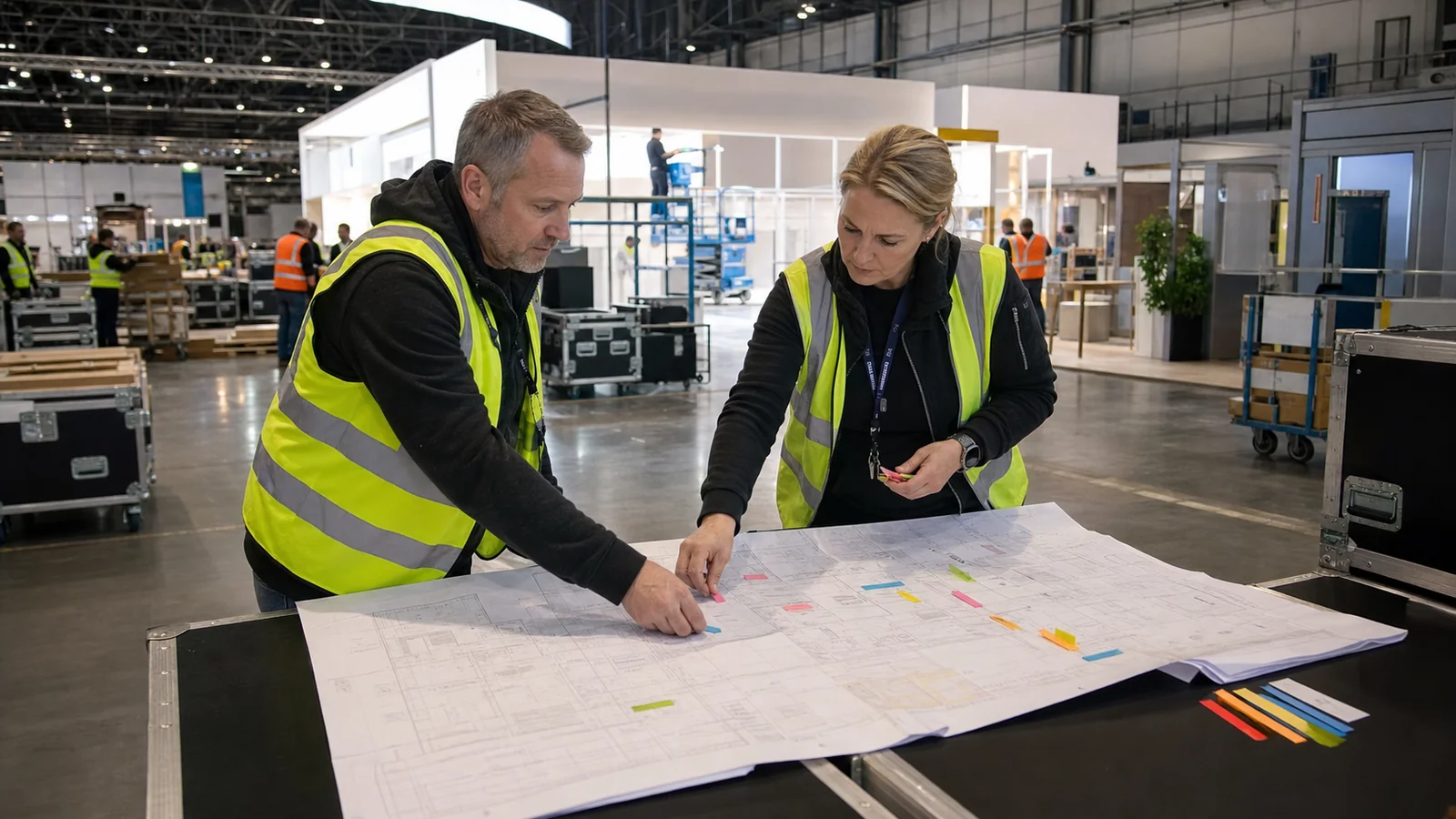
Write directions that work across halls
A booth number is an address, not a route.
Use the official floor plan and interactive tools for the specific event. Mark the nearest useful entrance, hall connection, fixed landmark, meeting room, partner stand, and exit. Then walk the route during setup. A direction that looks obvious on a PDF may be confusing from a different entrance or level.
Send every priority buyer a short route note: hall and stand number, nearest landmark, a map link, the host's mobile contact, and the time reserved. Add realistic buffers between meetings in different halls. If a buyer is late, the host should know whether to wait, move the meeting, or send a colleague to a landmark.
Messe Frankfurt's Media Package Manager supports exhibitor and product information across print, online search, the Navigator app, and the interactive map. Check the official listing early enough to correct category, product, contact, and stand information through the available event process.
Build a proof station for buyer comparison
Serious B2B visitors often need evidence they can take into an internal review, not another broad brochure.
Organise material by the decision it supports. A procurement buyer may need commercial scope and supply information. A technical evaluator may need dimensions, tolerances, materials, test reports, or compatibility. A distributor candidate may need territory assumptions, support boundaries, product training, and the next qualification step.
| Buyer question | Evidence to prepare | Human owner |
|---|---|---|
| Will this fit our requirement? | Current specification, limits, compatibility notes, test method | Technical specialist |
| Can we approve this supplier? | Company details, quality documents, relevant certificates, references allowed for release | Quality or compliance owner |
| What happens after purchase? | Installation, training, warranty, spares, service boundary, escalation path | Service owner |
| Can we distribute it? | Partner criteria, territory process, support model, non-confidential commercial next step | Channel manager |
| What should we do next? | Named follow-up, required input, responsible person, realistic date | Meeting owner |
Separate public material from documents that require an NDA or internal approval. Booth staff should know what can be shared, what can be shown but not sent, and what must be requested after the fair.
Assign roles by conversation stage
A large team without routing rules can make a booth slower than a small team with clear roles.
The greeter identifies why a visitor stopped and routes the conversation. The qualifier records role, country, product interest, timing, and the main question. A specialist handles technical or compliance depth. The meeting owner protects scheduled time and writes the agreed next step. An operations lead solves supplies, services, and logistics without pulling the whole team out of conversations.
Use a minimum lead record that staff can complete in under a minute after a conversation:
- Visitor and company, subject to the event's and your own data-handling rules.
- Product or application discussed.
- The buyer's exact question or decision barrier.
- Evidence requested.
- Next action, owner, and date.
- Language and preferred contact route.
A badge scan without the question is incomplete. A detailed note without an owner is also incomplete.
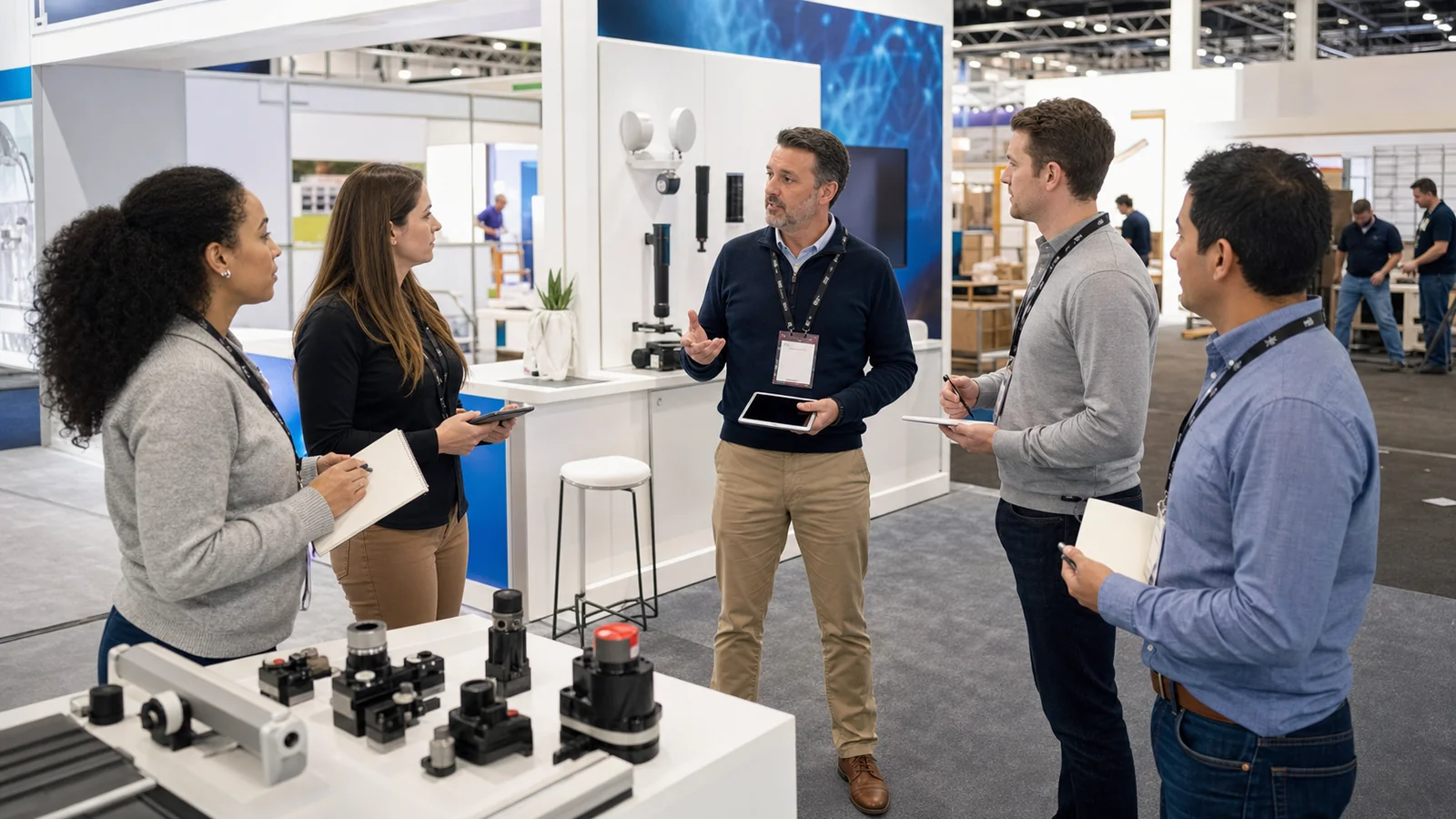
Use a three-part daily operating checklist
Before opening
- Test screens, demos, power, internet, links, and backup files.
- Check samples, documents, cleaning, storage, water, and staff badges.
- Review booked meetings, buyer routes, host names, language needs, and known questions.
- Confirm the operations contact and one risk that needs watching.
During the day
- Keep the aisle edge open and route long conversations away from the entrance.
- Record the buyer's question before starting the next conversation.
- Mark missing evidence immediately so the team does not promise it repeatedly.
- Rotate breaks before fatigue damages greetings and notes.
After closing
- Secure products and follow the required power shutdown process.
- Restock material and charge all devices.
- Assign every high-priority follow-up to a person and date.
- Group repeated questions and improve one sign, script, document, or demonstration for the next morning.
- Confirm the next day's deliveries, meetings, and staff arrival times.
Common Messe Frankfurt mistakes to avoid
Most failures are not dramatic. They are small unowned tasks that collide during build-up or a busy show day.
- Using last year's deadline sheet: verify the current event manual and service orders.
- Treating approval as the stand builder's private task: the exhibitor still needs visibility into submissions and open questions.
- Assuming any forklift can enter: use the authorised logistics arrangements stated in the current guidelines.
- Leaving empty crates behind the stand: arrange approved empty-package storage and retrieval.
- Scheduling meetings back to back across halls: add route and recovery time.
- Showing every visitor the same long demo: use a short orientation and a deeper specialist path.
- Collecting contacts without buyer questions: preserve the decision barrier and requested evidence.
- Waiting until the trip home to review leads: assign important actions each evening while the context is fresh.
Official sources and quality note
This guide was checked against Messe Frankfurt's current official service information and 2026 Technical Guidelines on August 7, 2026. The general guidance does not replace the exhibitor manual, approval, service orders, traffic notices, or organiser instructions for your specific event.
Related exhibitor guides
Buyer questions
Messe Frankfurt Exhibitor Guide
Turn certification, distributor, and product questions into useful follow-up context.
Planning
Trade Show Preparation Checklist
Coordinate objectives, people, material, demonstrations, and follow-up before travel.
Operations
Trade Show Exhibitor Mistakes
Find the planning gaps that weaken booth conversations and post-show action.
FAQ
Which Messe Frankfurt rules should I check first?
Check the current manual for your event, the venue's technical information, stand approval requirements, logistics and traffic instructions, service-shop orders, badge rules, and dismantling schedule.
Can an exhibitor bring its own forklift?
The Messe Frankfurt 2026 Technical Guidelines state that exhibitors and stand builders may not use their own forklifts or crane trucks on the grounds. Arrange the required handling through the authorised logistics route.
Can empty packaging stay behind the booth?
The 2026 Technical Guidelines state that empty packaging may not be stored in halls or aisles. Arrange approved removal, storage, and retrieval before move-in.
How much time should be left between buyer meetings?
There is no universal number. Walk the real routes during setup and add time for hall movement, wayfinding, overruns, and note-taking before setting the calendar.
Does this guide replace the official exhibitor manual?
No. Use the current organiser manual, technical requirements, approvals, and service instructions as the authority for your event and stand.