
Canada | After-hours answering options
After-Hours Answering Service for Canadian Small Businesses: Live, AI, or Self-Service?
Do not buy all-night coverage before you know what customers need. Separate stable questions, live operational checks, complaints, judgement calls, and urgent requests, then give each one the lightest dependable response path.
Summary
An after-hours answering service is useful only when it moves a customer towards the correct outcome. Audit two to four weeks of missed calls, voicemail, text, email, forms, and staff notes. Classify each request as a stable public question, a current operational check, an authorised judgement, a complaint, or an urgent matter. Stable questions can often be handled by a focused page, recorded message, or public question route. Current availability, final quotes, bookings, contract changes, complaints, safety matters, and exceptions require the current system or an accountable person. Do not pay a live service to repeat information that the business could publish clearly.
Compare live answering, AI phone tools, voicemail and callback, text, and self-service on authority, accuracy, accessibility, response time, privacy, and handoff quality. If commercial email or text is involved, check current CASL requirements for consent, sender identification, and unsubscribe handling. Apply the privacy law that fits the organisation, province, and cross-border activity; this initial guide is for English-speaking Canada outside Quebec. Publish staffed hours with a named time zone, run a 30-day pilot on one service line, and measure useful outcomes rather than calls answered.

Audit real after-hours demand before comparing providers
The first decision is not live versus AI; it is which customer tasks occur after hours and what authority, information, and response time each one requires.
Collect a representative sample from the last two to four weeks. Include missed calls, voicemail, inbound texts, quote forms, email, website searches, QR-page questions, social messages, and notes from staff who receive calls on personal devices. Remove names, phone numbers, addresses, order references, recordings, and other identifying details that are not needed for the review. Preserve the customer wording, local time, channel, requested action, existing answer source, handoff, and eventual outcome.
Do not count every missed call as a lost sale. A caller may want staffed hours, coverage, delivery information, pickup instructions, a document, product setup help, or the details needed for a quote. Another may need a current stock or schedule check. Existing customers may be changing an order, raising a complaint, or asking for an exception. Some issues can wait until the next staffed period; some need a prompt person. Count the task and outcome, not just the ring.
Record the cost of the current failure. How often does the customer call twice, repeat information to another employee, abandon the enquiry, reach the wrong team, or wait for an answer that could have been public? How often are owners interrupted for routine questions? This baseline makes a pilot measurable and exposes whether the underlying problem is missing information, weak routing, slow response, or genuine lack of coverage.
- Sample all customer channels across normal weekdays and weekends.
- Keep task, time zone, source, authority, handoff, and outcome.
- Separate new enquiries from existing-customer service and complaints.
- Count repeat contacts and information the customer had to repeat.
- Establish the current cost before transferring the workflow to a vendor.
Classify requests by answer risk and authority
Stable information, live facts, authorised decisions, complaints, and urgent issues should not share one script or one automation rule.
Stable public information is the strongest starting point. Examples include normal staffed hours, broad service area, public product specifications, standard preparation, document locations, general delivery process, and the correct contact route. These answers need an approved source, owner, and review date, but they can often be provided consistently by voicemail, a focused mobile page, FAQ, or public question page.
Current operational information must come from the source of truth. An item may normally be stocked but already allocated. A service team may usually cover a region but have no capacity on the requested date. Unless the channel is connected to the current inventory, booking, order, or dispatch system and is authorised to make the commitment, it should not say confirmed, available, booked, approved, or guaranteed. It can explain the process and gather minimal context for a later check.
Human judgement includes final quotes, unusual fit, site conditions, contract changes, complaints, refunds, disputes, accessibility accommodations, and safety-sensitive questions. A channel may explain the general process and route the matter, but it should not close it. Define an urgent route only for matters the business is actually trained and staffed to handle. A general voicemail, chatbot, or overnight vendor should never be presented as emergency coverage.
| Request class | Example | Recommended first response |
|---|---|---|
| Stable public information | Hours, broad coverage, preparation, document location | Recorded message, focused page, FAQ, or public answer page |
| Current operational fact | Stock, pickup readiness, crew capacity, booking | Connected current system or staff confirmation |
| Authorised judgement | Final quote, exception, unusual suitability, contract change | Accountable person with useful context |
| Complaint or dispute | Refund, cancellation, damaged item, disputed work | Published complaint route and human review |
| Urgent or safety matter | Time-sensitive issue within the business response scope | Dedicated staffed escalation or appropriate public service |
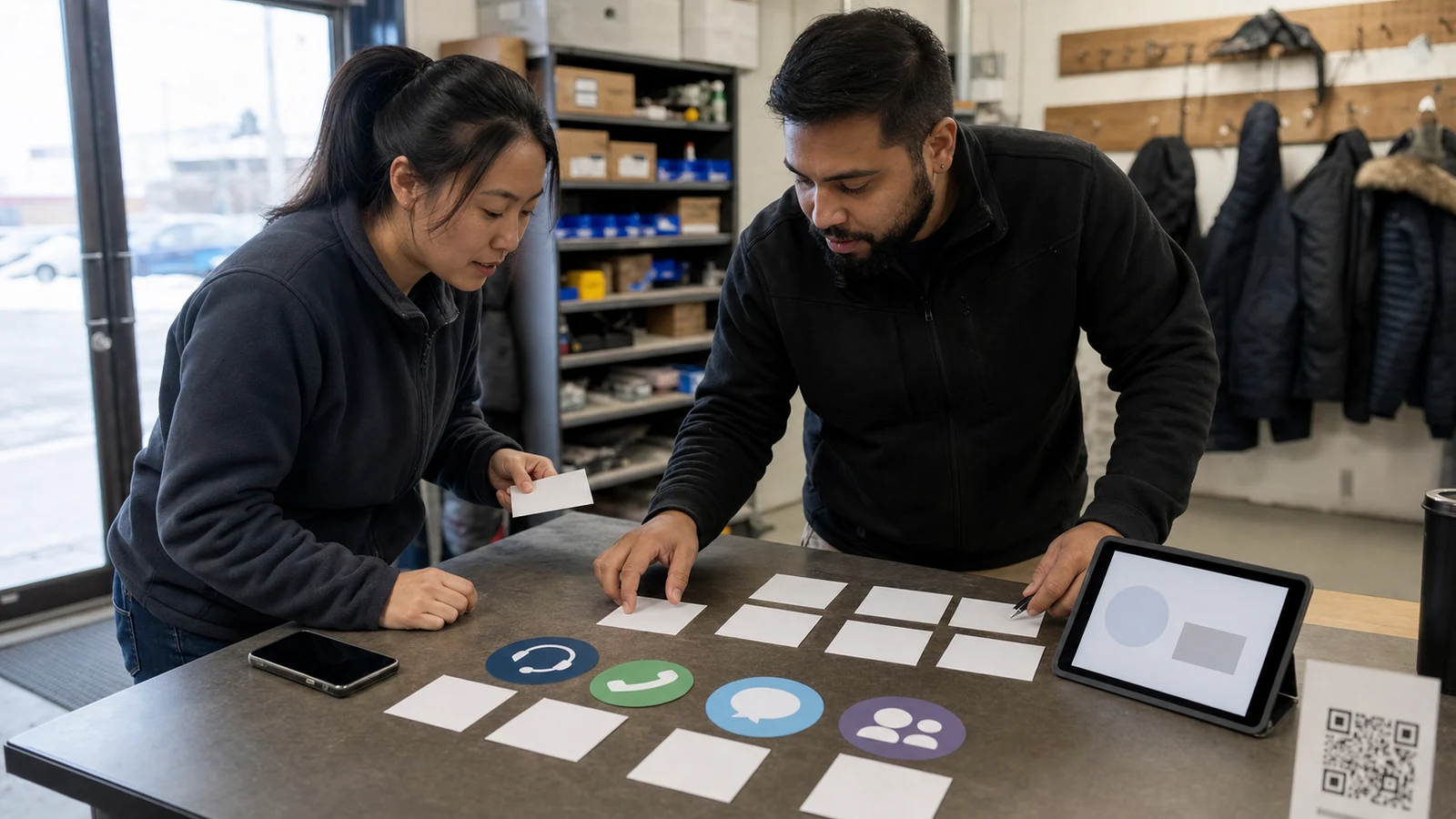
Compare live answering, AI phone, callback, text, and self-service
Choose by customer job, not by a provider label, because each option makes different trade-offs in immediacy, authority, consistency, accessibility, and cost.
Live answering works well when a caller needs reassurance, qualification, or rapid routing and the responder has an accurate script. It becomes expensive and risky when most calls ask stable questions or the agent lacks current systems and authority. An external service needs explicit opening language, approved facts, prohibited promises, escalation rules, secure message transfer, quality review, and an owner who corrects the source rather than coaching around contradictions.
AI phone tools can provide consistent greetings, collect simple routing context, and answer approved low-risk questions, but voice recognition, accents, background noise, ambiguity, and unsupported requests require testing. A confident synthetic answer is not evidence that the underlying information is current. The tool should disclose its automated role where appropriate, allow interruption and repetition, identify uncertainty, and offer a person or accessible alternative without trapping the caller in a loop.
Voicemail with a reliable callback is often enough for low volume. Text can deliver a requested link or short update, while email and forms suit detailed non-urgent work. Self-service gives stable information immediately from a website, QR sign, business card, product insert, or voicemail link. A strong system often combines these tools: public answers for routine questions, structured context for the callback, and selective live coverage for tasks that benefit from conversation.
| Option | Best for | Main limitation | Control to require |
|---|---|---|---|
| Live answering service | Conversation, reassurance, qualification, prompt routing | Cost and inconsistent authority | Approved script, limits, sample review, secure handoff |
| AI phone tool | Repeatable greeting and low-risk routing | Recognition errors and confident unsupported answers | Disclosure, uncertainty, human exit, real-call testing |
| Voicemail and callback | Low volume and next-staffed-period work | Unclear wait and missing context | Specific response window and useful alternative |
| Text, email, or form | Requested links, updates, and structured detail | Consent, privacy, delay, and channel fragmentation | Purpose, CASL review, confirmation, monitored ownership |
| Public self-service | Stable questions in varied wording | Cannot make live commitments by itself | Approved sources, review dates, visible handoff |
Evaluate a live answering service with real scenarios
A polished greeting is not enough; test whether the service respects authority, captures useful context, and completes the handoff under ordinary and difficult conditions.
Write a one-page authority map before requesting proposals. List facts any responder may provide, questions that require a current system, commitments only named roles may make, and conditions that end the script. Include information the responder must not request or place in a general message. Give vendors anonymised examples from the audit and ask them to demonstrate exactly how each would be handled.
Test six scenarios: a routine new enquiry, current availability, an unusual technical question, an existing order change, a complaint, and an urgent matter outside the service scope. Check the greeting, business identification, accuracy, escalation, response promise, message detail, destination queue, and whether the customer would need to repeat everything. Run the test during the actual overnight or weekend period, not only in a sales demonstration.
Review contracts for recordings, transcripts, data location, sub-processors, account access, retention, deletion, incident notification, service levels, training, and exit. Decide who can listen to recordings and why. A service should be able to delete or return records when the relationship ends. Price comparisons should include internal script maintenance, correction review, callback work, and vendor management, not only a per-minute or per-call fee.
- Give the responder an explicit authority and prohibited-promise map.
- Test real scenarios during the actual after-hours window.
- Inspect the complete handoff in the receiving system.
- Review recording, transcript, storage, access, retention, and deletion.
- Include internal maintenance and callback work in the total cost.
Make voicemail and callback a dependable service
Voicemail fails when it is vague, stale, or unowned; a concise recording and a disciplined callback queue can be a complete after-hours option for many small businesses.
Keep the recording short. Identify the business, state staffed days and hours with the time zone, give the expected review window, explain which details are useful, offer one non-phone route, and state clearly if the line is not monitored for emergencies. Do not ask callers to leave payment information, passwords, sensitive personal details, or long technical histories in a general mailbox.
Use a shared accountable queue rather than a personal phone. Capture caller preference, business or project context where needed, requested action, deadline, and the source they already consulted. Deduplicate repeat messages and assign an owner. A callback target should distinguish acknowledgement from resolution: returning a call does not mean stock, schedule, quote, complaint, or exception has been confirmed.
Close the loop. When staff respond, record the useful outcome and whether a source or routing rule was missing. Update the voicemail and alternative page together for holiday closures, seasonal changes, severe weather, or unusual volume. Test the phone number from outside the business, listen through the full recording, leave a sample message, and confirm that notification and ownership work.
- Name staffed hours, time zone, review target, and emergency boundary.
- Collect only context needed for the next action.
- Route messages to a shared queue with a visible owner.
- Distinguish acknowledgement, callback, and final resolution.
- Test the complete route after every material change.
Separate requested replies from commercial electronic messages
A customer asking for a link is not permission for unlimited promotion, so define the purpose of email and text messages and review CASL before automating them.
Use text or email for a narrow customer-requested task: send public hours, quote preparation, a secure form, a case acknowledgement, or the official booking route. Identify the business and keep the message tied to the request. Do not quietly enrol the recipient in recurring marketing or mix a service update with a promotional campaign. Protect the handoff when the message contains a link by showing a recognizable domain and avoiding unexplained shorteners.
The CRTC explains that commercial electronic messages, including commercial email and text, generally require consent, sender identification and a working unsubscribe mechanism, subject to the law's definitions and exceptions. Express and implied consent are not interchangeable, and implied consent can expire. The sender should be able to prove the consent it relies on. If a recipient withdraws consent, the process must carry that request across every sending platform and vendor.
Do not turn a nuanced compliance question into a script rule without review. A response to a customer enquiry, a requested quote, a service message, and a later promotional message may be treated differently. Map each message type, trigger, purpose, audience, consent basis, identity information, unsubscribe path, retention, and owner. Check current CRTC guidance and obtain appropriate advice for the actual programme before automated scale.
- Keep requested service replies separate from marketing enrolment.
- Identify the sender and show a trustworthy destination domain.
- Record the consent or exception relied on for each automated message type.
- Provide and test the required unsubscribe mechanism.
- Synchronise suppression across staff, platforms, and vendors.
Build self-service for questions that do not require a phone call
A public answer route should give the approved fact, its conditions, and the next step while making current-data and human-decision boundaries visible.
Start with the ten to twenty stable questions found in the audit. Put the most common tasks first: staffed hours, broad service area, preparation, document locations, product guidance, quote requirements, and the appropriate contact route. Write each answer in three layers: direct answer, important condition, and next action. Use customer language rather than internal department names.
Maintain one approved source across voicemail, website, QR pages, email templates, and vendor scripts. Assign an owner, approver, effective date, and review date. Stop an answer when sources conflict. State that staff confirmation is required when the outcome depends on current stock, schedule, location, weather, site conditions, final price, or an exception. A long FAQ is not a substitute for resolving inconsistent information.
Offer an accessible human route. Provide a phone number during staffed hours, a concise non-urgent follow-up form, and any genuine escalation path. Carry the original question and selected topic into the handoff when appropriate. Test short questions, paraphrases, spelling errors, French queries that may arrive even on an English-market page, and unsupported requests. This guide does not target Quebec, and a business serving Quebec should complete separate language, privacy, and legal review.
- Publish approved stable answers before asking for contact details.
- Show conditions and the next staffed response window.
- Do not confirm live stock, bookings, prices, or exceptions without the source of truth.
- Give customers a usable person-assisted alternative.
- Review failed and unsupported questions as information gaps.

Map privacy duties by organisation, province, and data flow
English-speaking Canada is not one uniform private-sector privacy regime, so identify the applicable law and protect the data even when a vendor presents one national workflow.
The Office of the Privacy Commissioner of Canada describes ten PIPEDA fair information principles: accountability, identifying purposes, consent, limiting collection, limiting use, disclosure and retention, accuracy, safeguards, openness, individual access, and challenging compliance. PIPEDA applies to covered commercial activities and to personal information crossing provincial or national borders in the circumstances described by the law. Federally regulated organisations are also subject to it.
Alberta and British Columbia have private-sector privacy statutes that may apply within those provinces, while PIPEDA can still matter for cross-border commercial information. Other provincial and sector rules can affect the analysis. Use the OPC's current guidance and jurisdiction tool, and obtain appropriate advice for the actual organisation and activity. This article intentionally excludes Quebec from its acquisition scope; do not treat that as a statement that Quebec customer data can simply be filtered out after collection.
Map the after-hours data path from phone carrier to answering service, recording or transcription provider, SMS platform, form, AI provider, email, CRM, analytics, backup, and support team. Record purpose, fields, storage and support locations, access, safeguards, retention, deletion, sub-processors, and contract exit. Collect no identity for public information that does not need it. Use multifactor authentication, least privilege, separate administrator accounts, and a tested deletion process.
| Privacy question | Evidence to maintain |
|---|---|
| Why is information collected? | Purpose statement and customer-facing explanation |
| Which law may apply? | Organisation, province, sector, and cross-border assessment |
| What is collected? | Field inventory and minimum-data rule by customer task |
| Who receives it? | Vendor, sub-processor, access, location, and contract map |
| How long is it kept? | Retention schedule and tested deletion process |
| How can a person ask questions? | Published privacy contact and request workflow |
Publish a response window that works across Canadian time zones
Customers need a staffed schedule, named time zone, channel-specific target, and clear holiday rule rather than vague promises such as soon or tomorrow.
Canada spans multiple time zones, and a business may serve buyers, distributors, or field locations far from its office. Put the business time zone beside staffed hours and every deadline. Use an absolute example such as messages received after 5 p.m. Pacific Time are reviewed from 8 a.m. on the next staffed business day. Define business days and public-holiday treatment. If the customer's location matters, ask only for the level of location needed for the task.
Set different targets for different work. A stable question can be answered immediately. A routine callback may be targeted for the next staffed morning. A technical quote may require two business days after complete information arrives. A complaint may have an acknowledgement target and a later review update. An automated acknowledgement should not imply that a technician, manager, or other person has reviewed the matter.
Use plain language and accessible alternatives. Customers may be outdoors, on a slow mobile connection, using assistive technology, speaking in a second language, or unable to use a QR code. Provide a typed URL, keyboard-usable page, readable contrast, descriptive headings, and a person-assisted route. Accessibility Standards Canada's plain-language standard offers a useful test: can the intended audience find, understand, and use the information?
| Element | Clear wording pattern | Avoid |
|---|---|---|
| Staffed hours | Monday-Friday, 8 a.m.-5 p.m. Pacific Time | We are normally open weekdays |
| Review target | Reviewed from 8 a.m. next staffed business day | We will reply soon |
| Live fact | Current availability requires staff confirmation | This should be available |
| Automated receipt | Your message was received; it has not yet been reviewed | Our team is handling it now |
| Urgent boundary | This channel is not monitored for emergencies | Contact us anytime |
Run a 30-day pilot and score useful outcomes
Pilot one service line and after-hours window, inspect real interactions weekly, and expand only when customer progress and handoff quality improve.
Choose a bounded pilot, such as weekday evenings for one B2B service or weekend product enquiries for one location. Keep the current number, add a concise recording and one useful alternative, then apply selective live or automated coverage only to the request classes that need it. Train the receiving staff, create correction and escalation routes, document vendors, and announce no capability that has not been tested.
Review a small sample twice a week. Was the first answer useful? Did the service identify uncertainty? Did live-data questions wait for confirmation? Did complaints and urgent matters reach the correct person? Did customers repeat information? Were electronic messages expected and stoppable? Correct the approved source and routing rules during the pilot instead of allowing staff and vendors to create private patches.
At day 30, compare the baseline with the pilot. A successful result may justify better self-service, a disciplined callback system, selective live answering, an AI phone workflow, or a combination. A poor result may reveal inconsistent source information, unclear ownership, or weak handoff rather than insufficient coverage. Fix the process before adding more channels.
| Measure | What it shows | Misleading substitute |
|---|---|---|
| Useful first answer | Whether the customer could progress | Calls answered |
| Correct routing | Whether the request reached the responsible owner | Messages taken |
| Repeat-contact rate | Whether answers and expectations were clear | Average call length |
| Handoff completion | Whether context survived the transition | Form submissions |
| Correction and stale-source rate | Whether the information remains dependable | Number of script entries |
| Total operating cost | Whether the model is sustainable | Vendor invoice alone |
Sources and official guidance
- CRTC: Frequently Asked Questions about Canada's Anti-Spam Legislation
- CRTC: Guidance on implied consent under CASL
- Office of the Privacy Commissioner of Canada: PIPEDA requirements in brief
- Office of the Privacy Commissioner of Canada: Privacy Guide for Businesses
- Accessibility Standards Canada: CAN-ASC-3.1:2025 Plain Language
This article is operational guidance, not legal, privacy, safety, or compliance advice. Check current requirements and professional obligations for the business, location, and customer journey before implementation.
FAQ
Does every missed call require a live answering service?
No. Audit the customer task first. Stable public questions may be handled by voicemail or self-service, while current operational checks, complaints, unusual requests, and urgent matters may require a connected system or authorised person. Use live coverage where conversation and prompt routing materially improve the outcome.
Can an AI receptionist confirm bookings or current stock?
Only when it is genuinely connected to the current system and authorised to make that commitment. Otherwise it should explain the process, gather minimal context, link to the official route, or state that staff confirmation is required.
Does CASL apply to after-hours text messages?
CASL applies to commercial electronic messages, including commercial text and email, when its legal elements are met. Consent, identification, and unsubscribe requirements and exceptions depend on the message and context. Separate requested service replies from later marketing and check current CRTC guidance for the actual workflow.
Which Canadian privacy law applies to an answering service?
It depends on the organisation, province, sector, commercial activity, and whether information crosses borders. PIPEDA may apply, while Alberta and British Columbia have private-sector laws that can apply within those provinces. This guide excludes Quebec acquisition and is not a jurisdiction determination.
What should an after-hours voicemail say?
Identify the business, state staffed days and hours with the time zone, explain when messages are reviewed, request only useful non-sensitive context, offer one accessible alternative, and state clearly if the channel is not monitored for emergencies.
What should a 30-day pilot measure?
Measure useful first answers, correct routing, repeat contacts, abandoned enquiries, handoff completion, customer repetition, source corrections, stale information, response-promise performance, staff time, and total cost. Calls answered is not enough.
Last updated
Last updated: 2026-07-23. Country, privacy, platform, and pricing details should be rechecked before implementation.
Compare the broader after-hours service models
Use the general decision guide to compare live answering, AI phone tools, callbacks, and customer self-service before choosing a provider.