
Australia | Customer enquiry operations
How Australian Small Businesses Can Reduce Repetitive Customer Enquiries
Repeated questions about service areas, preparation, documents, pickup, timing, and next steps usually signal an information gap. Build a reliable answer system before adding more channels or automating replies.
Summary
Begin with a two-to-four-week enquiry log across email, phone notes, web forms, counter conversations, social messages, and after-hours requests. Remove unnecessary personal details but preserve the customer's wording, channel, time zone, task, answer source, and outcome. Group questions by customer job rather than by internal department. Then separate stable public facts from current operational information and matters that require judgement. Automate or publish only the first category confidently; connect the second to a current system or staff check; and route complaints, exceptions, disputes, safety concerns, individualized quotes, and promises to a responsible person.
The durable fix is not a longer FAQ. It is a maintained answer system: one approved source, clear owner and review date, channel rules, visible response-time expectations, minimal personal-information collection, secure AI and vendor controls, and a handoff that carries useful context. Australia spans several time zones and daylight-saving patterns, so publish response windows with a location or time-zone reference rather than saying tomorrow or soon. Pilot one service line for 30 days and measure useful answers, successful handoffs, repeated information gaps, corrections, complaint separation, and staff rewriting time.

Build an enquiry log from real customer wording
You cannot reduce repetitive enquiries reliably until you can see what customers ask, when they ask it, and what happened after the answer.
Collect a representative sample from the last two to four weeks. Include email subjects, contact forms, phone and voicemail notes, counter questions, service vehicle conversations, social messages, website searches, and after-hours requests. Remove names, phone numbers, addresses, account details, photos, and other identifiers that are not needed for the review. Keep the customer's original phrasing because internal labels often hide the real uncertainty. A team may call an issue mobilisation requirements while customers ask what needs to be ready before the technician arrives.
For each enquiry, record the customer task, channel, local time, service or product, existing answer source, staff member who responded, time to a useful answer, whether the question was resolved, and the next action. Add whether the answer depended on current capacity, location, weather, inventory, booking, a site assessment, or individual judgement. Those conditions determine whether the information can be published, must be connected to a current system, or should remain with a person.
Group questions by what the customer is trying to accomplish: determine fit, prepare for service, compare public options, understand a process, locate a document, check a service area, request a quote, change an existing job, raise a complaint, or obtain support after purchase. Do not count only exact repeated sentences. Customers express the same uncertainty in different words, and a useful cluster reflects meaning. Question grouping is decision support, not an exact accounting record, so review samples rather than trusting labels blindly.
- Keep original customer wording after removing unnecessary identifiers.
- Record the task, channel, time, source, owner, response, and outcome.
- Mark questions that depend on current operations or individual judgement.
- Group by customer job rather than internal department.
- Review examples inside each cluster before changing the answer system.
Sort enquiries by the promise risk of the answer
The safest automation boundary is based on what the answer commits the business to, not simply how often the question appears.
Stable public information is the best starting point. Examples include standard service scope, typical preparation steps, public operating hours, document locations, product care, broad coverage areas, accepted enquiry channels, and the process for requesting a quote. Even stable information needs a source and review date, but it can often be answered consistently through a webpage, FAQ, email template, printed guide, or public question page.
Current operational information needs verification. A hire item may usually be available but not on the requested date. A field team may usually cover a suburb but not at a promised time. A business may publish typical lead times but still need to check workload, parts, weather, travel, or site conditions. Do not turn a historical pattern into a live promise. Connect the answer to the relevant booking, inventory, job, or scheduling system, or state clearly that staff confirmation is required.
Judgement and rights-sensitive matters belong with a person. These include final prices, unusual specifications, complaints, refunds, cancellations, consumer-guarantee questions, contract changes, disputed work, safety concerns, accessibility accommodations, and requests involving sensitive information. A self-service channel can explain the general process and gather minimal routing context, but it should not close the issue or make a commitment that an authorised staff member has not reviewed.
| Answer class | Examples | Recommended handling |
|---|---|---|
| Stable public fact | Service scope, preparation, document location, general process | Publish from an approved source with an owner and review date |
| Current operational fact | Stock, crew capacity, pickup readiness, booking, live lead time | Use the current system or require staff confirmation |
| Individual judgement | Final quote, exception, custom suitability, unusual site condition | Route to the responsible person with useful context |
| Complaint or rights issue | Refund, cancellation, disputed work, consumer guarantee | Use the complaint process and preserve human review |
| Sensitive or urgent matter | Personal, safety, security, or confidential business information | Stop public automation and direct to an appropriate protected channel |

Create one approved answer source with owners and review dates
Repetition falls only when email templates, staff explanations, web pages, printed materials, and automated answers draw from the same maintained facts.
Choose the authoritative source for each question cluster. It may be a controlled knowledge document, service manual, approved product sheet, operations policy, current booking system, or named team. Record the exact fact, conditions, source location, owner, approver, effective date, and next review date. When two sources conflict, pause the reusable answer until the owner resolves the discrepancy. Faster distribution of inconsistent information makes the customer experience worse, not better.
Write answers in layers. Begin with a direct sentence that resolves the common question. Follow with conditions and boundaries, then the next step. For example: list the normal service area, explain that travel or scheduling outside that area requires confirmation, identify the details needed for a check, and state the response window. Avoid words such as guaranteed, available, approved, or booked unless the responsible system or person has actually made that determination.
Set review frequency according to change risk. Public hours and contact routes may need immediate review after any operational change. Seasonal service areas, pricing methods, lead-time ranges, and product versions may need scheduled checks. Durable setup instructions may change less often but can carry greater consequences if wrong. Give staff a simple correction route so a repeated customer question or field observation can trigger source review rather than being patched privately in one inbox.
- Link each answer to one approved source rather than copying text between channels.
- Name the content owner, approver, effective date, and next review date.
- Write the direct answer, conditions, and next step in that order.
- Avoid live promises unless a current system or authorised person confirms them.
- Give frontline staff a fast route to flag wrong or missing information.
Choose the lightest channel that can responsibly complete the task
A FAQ, public question page, form, booking system, phone route, and human inbox solve different kinds of enquiries and should not be treated as interchangeable.
Use a concise webpage or FAQ when the question is predictable and the customer benefits from scanning the answer. Use website search or a structured help centre when there are many documents or product versions. Use a public question page when customers express the same public questions in varied language and would benefit from a conversational route to approved information. Use a form when the business genuinely needs structured details for a quote or case, not as a gate before public information.
Use the official booking, ordering, inventory, or job-management system when the customer needs a current commitment. A general chatbot or answer page should not claim to confirm a slot, table, pickup, item, or crew unless it is connected to the source of truth. Use phone or live messaging for urgency and ambiguity when staff are actually available, and publish the staffed hours. Outside those hours, explain what can be answered now, what will wait, and when the customer can expect a person.
Connect the channels instead of duplicating them. A vehicle QR code can open service coverage and quote-preparation guidance, then link to the official enquiry form. A package insert can open model-specific support and then route an unresolved issue to the correct team. An automatic email response can answer the top preparation questions and state the response target. The customer should not have to repeat the same details at every transition.
| Customer task | Good first channel | Handoff condition |
|---|---|---|
| Find a stable public fact | Focused webpage, FAQ, or public answer page | Source is missing, conflicting, or outdated |
| Prepare a useful quote request | Checklist followed by a short structured form | Scope is unusual or needs a site assessment |
| Confirm current availability | Official live system or staff check | System cannot confirm the requested condition |
| Resolve a product-support question | Model-specific guide or searchable help | Troubleshooting fails, safety is involved, or the model is unclear |
| Raise a complaint or dispute | Published complaint route | Always preserve review by an authorised person |
Publish a response promise that works across Australian time zones
Clear expectations reduce follow-up enquiries, but vague words such as soon or tomorrow can create confusion across locations, weekends, and daylight-saving periods.
Business.gov.au recommends publishing expected turnaround times when email responses take longer. Make the promise specific enough to be understood and modest enough to be kept. State the staffed days and hours, the business time zone, what counts as a business day, and whether public holidays affect the target. A national or interstate business should avoid a single unlabeled clock because Australia has several time zones and not every state follows daylight saving.
Use different response targets for different work. A routine product question may be reviewed within one business day. A site-specific quote may need two or three business days after all required information arrives. A complaint may have an acknowledgement target and a separate investigation update. An urgent safety or security issue needs its own clearly marked route if the business is equipped to handle it; do not imply emergency coverage where none exists.
Automated acknowledgements should repeat what was received, what will happen next, and the expected time frame without claiming that a person has reviewed the matter. Include a reference only when it is generated by the actual case system. If volume changes and the published target cannot be met, update the public message before more customers rely on it. Consistent expectations often remove where is my reply follow-ups without any new AI.
- Name the business time zone and staffed hours.
- Define business days and public-holiday treatment.
- Use different targets for routine enquiries, quotes, and complaints.
- Do not imply that an automated acknowledgement is human review.
- Update the promise when operations can no longer meet it.
Keep complaints, consumer rights, and exceptions out of the FAQ queue
A complaint may begin with familiar wording, but it requires a traceable process and human judgement rather than a reusable closing answer.
Create an explicit complaint category in the enquiry log. Signals include dissatisfaction with work, a request for repair, replacement, refund, cancellation, or compensation, a disputed charge, a claim that information was misleading, or a request to escalate. Do not classify these as another delivery, warranty, or price FAQ simply because the same nouns appear. Give customers a visible route, acknowledge receipt, preserve the original message, and identify who is authorised to review and decide.
Business.gov.au states that businesses selling goods and services in Australia must comply with Australian Consumer Law and provide truthful information. Reusable content can explain the business's complaint process, documents that may help, expected acknowledgement, and contact route. It should not tell a person that they have no remedy, that a store policy overrides consumer guarantees, or that an outcome is certain without review. Avoid using AI to make a final decision about a customer's rights or a disputed set of facts.
Exceptions also need human ownership even when they are not complaints. Unusual site access, custom specifications, weather disruption, remote travel, accessibility needs, damaged products, missed appointments, and conflicting records may change the responsible answer. The self-service system should recognize uncertainty, stop making promises, summarize the known context, and hand the customer to the correct team. A successful handoff is part of customer service, not evidence that automation failed.
- Tag complaint and rights-related language separately from routine questions.
- Publish the process and response expectations, not a predetermined outcome.
- Preserve the customer's original account and relevant records.
- Give decision authority to an identified person or role.
- Treat a clear, context-rich handoff as a successful result.
Minimise customer data and secure any AI-assisted workflow
Reducing repetitive enquiries does not require copying full customer conversations or sensitive records into a public AI tool.
Start with public business facts and anonymised question themes. Remove names, phone numbers, email addresses, street addresses, account details, job photos, payment information, staff records, and confidential commercial details unless a protected downstream process genuinely needs them. Keep the public answer experience separate from quote, complaint, or account workflows. Explain what information is collected, why it is needed, which provider receives it, how long it is kept, and how a person can contact the business about privacy.
Do not assume that every Australian small business is outside the Privacy Act. The OAIC notes that many businesses with annual turnover of $3 million or less are not covered, but important exceptions apply. A business should check its own activities and current law. Business.gov.au recommends protecting customer information even when the Privacy Act does not apply and notes that personal information may include names, contact details, photos, IP addresses, and opinions that identify a person.
Australian government cyber guidance published in January 2026 identifies data leaks, unreliable or manipulated outputs, and supply-chain vulnerabilities as key risks when small businesses adopt cloud AI. Review vendor settings, data use, storage, access, training practices, breach notification, and service dependencies. Define what staff must never enter, anonymise where practical, verify outputs against the approved source, restrict administrator access, and keep a human involved when a response could create a significant commitment or harm.
- Use public facts and anonymised themes for the reusable answer layer.
- Separate public questions from protected quote, complaint, and account workflows.
- Check whether the Privacy Act and Australian Privacy Principles cover the business.
- Review vendor data handling, training use, access, storage, and incident terms.
- Verify AI outputs and keep people responsible for consequential decisions.
Design after-hours self-service around a truthful handoff
After-hours help should resolve stable questions immediately and set an honest expectation for matters that require staff, without pretending that the business is continuously staffed.
List the questions that arrive outside staffed hours and divide them by what can be answered safely. Public hours, service scope, preparation, document links, product care, and quote requirements may be available immediately. Current availability, appointment changes, crew arrival, final pricing, urgent site conditions, and complaints may require the current system or next staffed period. Make that boundary visible before the customer enters a long conversation or form.
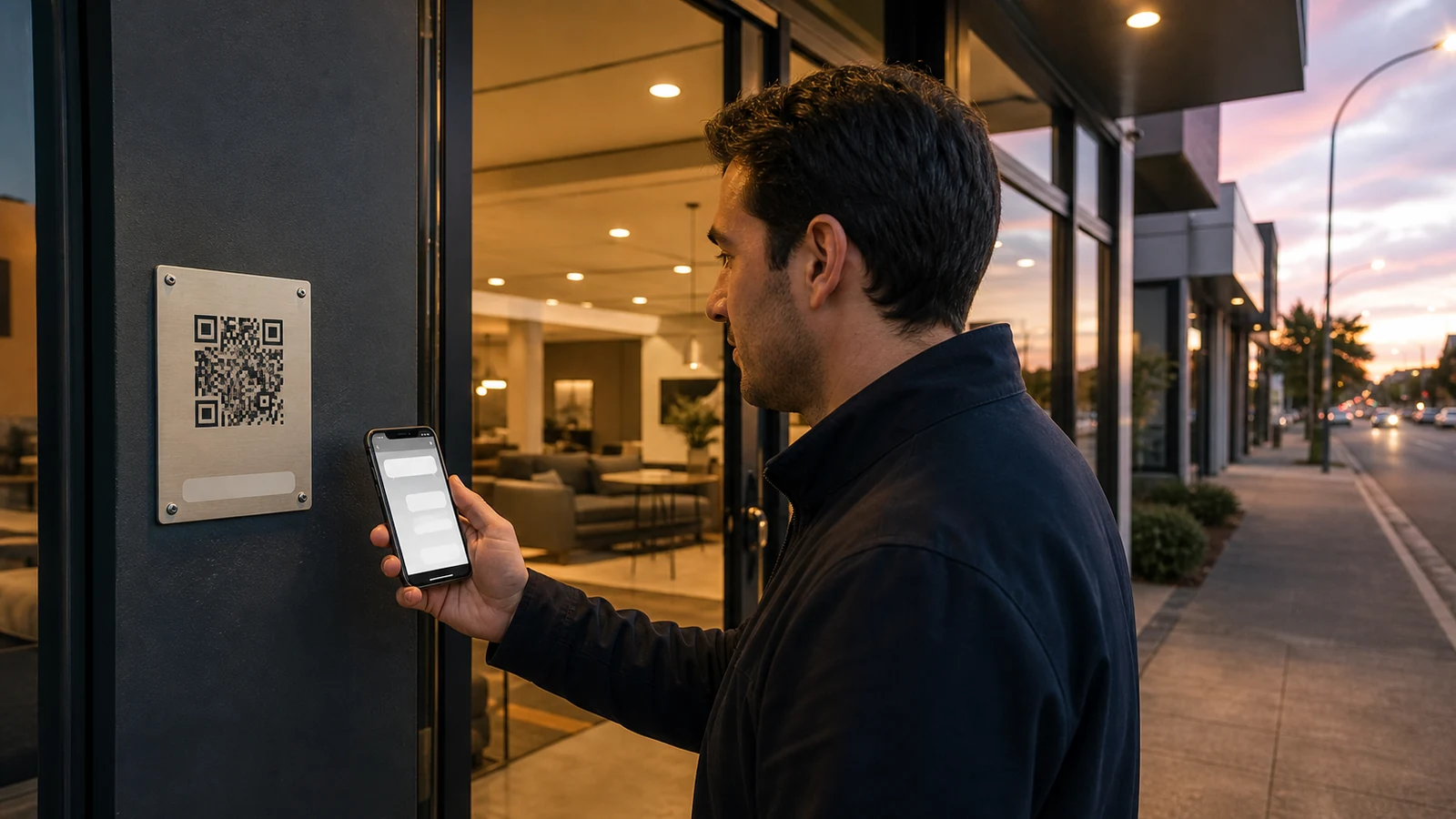
Place the entry point where the question begins: the storefront, service vehicle, product insert, invoice, email signature, voicemail message, or website contact page. A QR code or short link can open the same maintained source, but the message beside it should state the benefit. For example, offer after-hours service information and question help rather than promising 24/7 support. Include the business time zone and the next response window for unresolved matters.
When handing off, carry the minimum useful context: the question summary, service or product, location at a broad level, urgency stated by the customer, information already shown, and the customer's chosen contact method. Ask for more detail only when it is required. Do not send the customer back to the beginning or make staff search through an unstructured transcript. The best after-hours system saves effort on both sides while keeping the final commitment with the right person.
| After-hours enquiry | Immediate help | Human follow-up |
|---|---|---|
| Service coverage and preparation | Show approved area and preparation guidance | Confirm unusual location or site condition |
| Current booking or pickup status | Link to the official status or booking system | Review when the system cannot confirm |
| Product setup | Show model-specific instructions and checks | Escalate unresolved or safety-related issues |
| Quote request | Explain required details and response target | Price and approve after review |
| Complaint or cancellation | Acknowledge the route and expected review | Authorised person assesses the facts and response |
Use repeated questions to fix the source of confusion
The best reduction often comes from changing a sign, product sheet, service rule, or handoff rather than adding another answer channel.
Review the top clusters each week and ask where the customer first should have received the answer. If callers repeatedly ask whether a suburb is covered, the service-area explanation may be too vague. If customers ask what to prepare before pickup, the confirmation message or counter material may be incomplete. If installers and office staff give different answers, the approved source or training is inconsistent. Fix that earlier point, then update the reusable answer.
Look for questions that reveal a purchasing barrier rather than a support burden. Customers may be testing fit, comparing a process, checking proof, estimating effort, or trying to avoid an unexpected condition. A clear answer can improve the quality of a later enquiry, but do not treat every question as a sales lead. Anonymous learning still has value when it improves product information, quote forms, field instructions, packaging, and staff scripts.
Close the loop with frontline staff. Show them which answers changed and why, invite examples where the standard response failed, and record exceptions without turning every exception into a public rule. Retire obsolete templates and remove outdated printed material. The system becomes reliable when corrections flow back to the source and then out to every channel, not when each employee maintains a private collection of better wording.
- Ask where the answer should have appeared before the enquiry began.
- Fix signage, confirmations, product sheets, and forms as well as FAQs.
- Treat questions as signals of uncertainty, not automatically as leads.
- Share approved changes with frontline and field staff.
- Retire obsolete templates and printed materials when the source changes.
Test one service line for 30 days before expanding
A narrow pilot makes it possible to verify answer quality, handoff, privacy, and operational ownership before the workflow spreads across the business.
Choose one service line with a visible volume of routine enquiries and no high-risk subject matter. This guide is intended for permitted examples such as equipment hire, commercial maintenance, wholesale, specialty retail, manufacturing, and general business services. It does not target healthcare, legal, financial, insurance, credit, gambling, emergency, or minor-directed services. Select the top 15 to 25 question themes, approve the sources, define the automation boundary, and brief every staff member who may receive a handoff.
Measure useful first answers, time to a useful answer, successful handoffs, repeated information gaps, corrections, stale-source incidents, complaint separation, customer repetition after handoff, and staff time spent rewriting known information. Sample actual interactions daily at first. Stop an answer immediately if the source is wrong or the workflow makes an unsupported promise. Record why a handoff occurred so the team can distinguish a healthy boundary from a missing public answer.
At day 30, decide whether to expand, revise, or stop. Expand only if the approved sources are maintained, staff trust the handoff, customers can reach a person when needed, personal information is proportionate, and the system reduces confusion without hiding operational problems. Document the owners, review cycle, vendor settings, access list, retention plan, incident route, and outage fallback. Natural conversations vary, so use grouped questions and time estimates as operational signals rather than exact accounting.
- Start with one allowed service line and 15 to 25 question themes.
- Review answer samples daily during the first stage.
- Track useful answers, handoffs, corrections, repetition, and staff rewriting time.
- Stop unsupported promises and repair the source before resuming.
- Expand only when ownership, privacy, security, and human access are working.
Sources and official guidance
- business.gov.au: Communicate with customers
- business.gov.au: Protect your customers' information
- OAIC: Privacy guidance for small business
- Australian Cyber Security Centre: Artificial intelligence for small business
- business.gov.au: Australian Consumer Law and your business
This article is operational guidance, not legal, privacy, safety, or compliance advice. Check current requirements and professional obligations for the business, location, and customer journey before implementation.
FAQ
What repetitive customer enquiries should an Australian small business handle first?
Start with stable public questions that have approved, low-change answers: service scope, preparation, document locations, standard process, product care, contact routes, and quote requirements. Keep live availability, final prices, exceptions, complaints, safety, and individualized decisions with the current system or responsible person.
Is a longer FAQ enough to reduce repetitive enquiries?
Not by itself. A useful system also needs one approved source, owners, review dates, channel rules, response-time expectations, correction flow, privacy controls, and a handoff that carries useful context. Fix signs, forms, confirmations, and product information when they are the original cause.
Can an AI chatbot confirm appointments or stock?
Only when it is genuinely connected to the current booking, inventory, or job system and the integration is designed to make that commitment. Otherwise it should explain the process, link to the official system, or state that staff confirmation is required.
How should an Australian business state after-hours response times?
Name the staffed days and hours, the business time zone, what counts as a business day, and public-holiday treatment. Avoid soon or tomorrow for interstate customers. Use different targets for routine questions, quotes, complaints, and urgent routes.
Does the Privacy Act apply to every Australian small business?
Not every small business is covered, but important exceptions apply and the position depends on the business's activities and current law. Check the OAIC guidance and seek appropriate advice. Protecting customer information and collecting only what is needed remain sound practices even where the Act does not apply.
What should a 30-day pilot measure?
Measure useful first answers, time to a useful answer, successful handoffs, repeated information gaps, corrections, stale-source incidents, complaint separation, customer repetition after handoff, and staff rewriting time. Do not treat conversation or scan volume alone as success.
Last updated
Last updated: 2026-07-21. Country, privacy, platform, and pricing details should be rechecked before implementation.
Compare self-service with phone coverage options
Review the Australian comparison of live reception, AI phone tools, missed-call workflows, and customer self-service before choosing another channel.